Outrage can only go so far. These days it seems that everybody is outraged over something. The result is a kind of a moral numbness. A weariness that makes it hard to look at the dark side of humanity that seems so much in evidence today. People are especially unwilling to confront issues concerning war. Something about war arouses primitive instincts that call us to lay aside normal standards of decent and moral behavior as we rally to the defense of our group. The military harnesses these feelings to turn ordinary decent men and women into killers. That is what war is all about. The question is where to draw the line.
International law now attempts to distinguish behaviors that are acceptable and unacceptable in warfare. This is not an easy task because war in any form is opposed to peacetime morality. At best, warfare involves the deliberate murder of opposing soldiers. There is a recognition that civilians will inevitably be victims as they are caught in the crossfire, driven from their homes, witness traumatic events and be unable to live normal lives. However, we now condemn deliberate targeting of civilians. The principle is that hostilities should be confined to armies fighting each other.
In World War II the Nazis clearly overstepped these bounds in a number of ways. The genocide against Jews, Gypsies and others was the worst abuse. The death camps could only exist by denying the humanity of these people. We respond by saying “Never Again shall we allow this to happen to anybody.”
The Nazis were also condemned for their brutal occupation of the countries they conquered. They held the entire community responsible for any attack on their troops. They would respond by holding government officials and other prominent people hostage. Sometimes they would be executed in response to attacks by the resistance. In other cases, the whole community would be punished by withholding necessities of life.
After the war, the Nuremberg trials and the Geneva Conventions outlawed these practices as war crimes. They declared that deliberate targeting of civilians would not be tolerated and that reprisals should be proportionate to the “offense” and should be confined to the guilty parties and not innocent people.
Last week’s attacks in Gaza and indeed Israel’s treatment of Palestinians in general appears to violate these principles. At the same time it can be said that Palestinian terrorists violate these principles when they bomb Israeli civilians. It would be a mistake, however, to equally condemn both sides. The degree of violence and power is clearly unequal. Israel has occupied the West Bank and Gaza since 1967. The establishment of settlements there violate the principle that military occupation should be temporary and that civilians should not be displaced. It is the settlements that make a political solution impossible. In order to maintain the settlements, Palestinian territory has to be fractured into a myriad of little enclaves that have no economic or political cohesion.
In response to the kidnapping of one soldier, Cpl. Gilad Shalit, Israel launched an attack on Gaza that clearly holds not only the Hamas led government but the entire population responsible. They bombed the power plant that provides power to most of Gaza, leaving people without electricity and water, which depends on pumps. They have also prevented food and other supplies from getting into Gaza, bombed government offices and taken much of the Palestinian Cabinet prisoner. Israel says that all this is to exert “pressure” on those holding Cpl. Shalit to release him.
It is hard to see this attack as anything other than collective punishment on the entire civilian population and the holding of government officials as hostages, which are exactly the type of war crimes that the Nuremberg Trials and the Geneva Conventions condemned when they were practiced by the Nazis. Of course, Shalit was kidnapped in response to Israeli attacks which were responses to attacks by Palestinian groups.... It seems ironic that the Israeli government seems to be more outraged by the one action that had a military, rather than a civilian target and thus did not violate the “rules of war”.
The current crisis represents an escalation in their tactics but is not essentially different than the policy they have been pursuing in the Palestinian territories in general. Free travel between different parts of the West Bank is not allowed. Periodic blockades and numerous check points give the military complete control over whether people can go to work or school. and whether food an other necessities of life are available. People’s homes are demolished if the military thinks that somebody there, or a relative of somebody there is a “terrorist”. There is no way to challenge such a decision.
The US is quick to condemn Hamas for their refusal to recognize Israel but slow to condemn Israel, who we support with $3 billion in aid a year, for their part in perpetuating the violence and preventing a solution. It will do no good for Hamas to change their stance if the reality of life for Palestinians does not improve. What does the Israeli government think is going to happen if they continue to pursue this course? Palestinians who see no prospect of a settlement they can live with turned to Hamas in the last election. Desperation leads to desperate measures. I can only see a continuation of the cycle of violence in which the unequal power will lead to unequal suffering but suffering nonetheless on both sides. It will be impossible to prevent terrorists from attacking and Israel will never be able to live in peace. Likewise anti-American feeling will continue to increase because of our support for these brutal Israeli policies, with tragic consequences.
The only solution is for Israel to adhere to the Geneva Conventions and move towards an end to the occupation. Palestinians will have no reason to seek peace unless they see a prospect for a return to normal life and self determination. Israel must commit to a policy of peace, justice and self-determination and the US must adopt a policy of “tough love” to get them on track and keep them on track.
July 02, 2006


June 18, 2006
Close Guantanamo?
When three prisoners at Guantanamo Bay committed suicide last week it focused attention once again on this top secret prison. The US military has identified the three men as Ali Abdullah Ahmed of Yemen, and Saudis Mani Shaman Turki al-Habardi al-Utaybi and Yassar Talal al-Zahrani. Since 2002 the United States has used Guantanamo to hold prisoners in the “war on terror” because it exists in a kind of a legal limbo that, according to the Administration, puts it outside of any legal oversight.
The US established the Guantanamo Bay base during the Spanish American war over 100 years ago. That war “liberated” Cuba from Spanish colonial rule, while firmly establishing an American presence, including extended periods of American military occupation and the establishment of a dictatorship friendly to American business interests. The original lease for the Guantanamo base was signed in 1903 under terms established by the Platt Amendment, which set the terms for ending the US military occupation. In 1934, the lease was rewritten with the provision that it could not be changed or canceled without the agreement of both the US and Cuban governments, or until the US abandoned the base. In other words, the US can maintain a base in Cuba, even against the wishes of the Cuban government and since the revolution in 1959, this has been the situation. Cuba contests the legality of the lease, refuses to cash the checks the US dutifully sends it, and demands that the US leave but recognizes that they don’t have the ability to force the question.
The Bush Administration finds this situation very convenient. They claim that because Guantanamo is outside the US, that US laws and the Constitution do not apply there and since Cuba does not recognize the American presence, they have no oversight either. This is quite different than US military bases elsewhere in the world, which are subject to agreements with the host countries that have to be periodically renewed. This gives them some leverage. Furthermore, the Administration claims that the Geneva Conventions and the international laws of war do not apply because the prisoners aren’t technically soldiers in an established army. Rather they are relegated to the status of “enemy combatants” who have neither the rights accorded to Prisoners of War, or to civilians. Logically this position doesn’t make much sense. Either we are fighting a war, or we aren’t. If we are fighting a war, then our enemies must be recognized as fighting a war as well, and should be treated as enemy soldiers under international and military law, and as POWs when they are captured. If we aren’t, then prisoners should be brought to trial under the criminal justice system.
The “Enemy Combatant” label is a convenient fiction that is maintained to allow the government carte blanche in their treatment of these prisoners. They want to be able to hold people indefinitely with no standards of treatment and no accountability to anybody. Guantanamo is actually the most public of these prisons. Others exist in Afghanistan and Iraq, including Bagram Airbase and Abu Graihb. Add to those the CIA prisons reported to have been established in secret locations around the world. Apparently the Eastern European locations were closed after their cover was blown. And in a process known as rendition, prisoners are secretly transported to other countries, apparently so they can be tortured without any restrictions that might appl under American custody.
Although they don’t like the word, torture is central to what goes on in all of these secret prisons. Interrogation techniques employ a sophisticated combination of physical and psychological techniques to break them down. The military claims that it is necessary to obtain information. The classic argument is that torture would be justified in order to prevent an imminent terrorist attack. I assume that if that ever happened it would have been trumpeted as a major victory. In fact, studies have shown that torture is remarkably ineffective. Prisoners will either resist despite extreme pain or break down and say anything they think the torturer wants to hear, neither of which is useful. Psychological methods, such as isolation, sensory deprivation and humiliation aimed at breaking down personal identity and resistance have been developed by the CIA and are being put to widespread use now.
The continuing resistance of prisoners at Guantanamo calls these techniques into question, even on the grounds of effectiveness, to say nothing of morality or the effects on world opinion of America or the treatment of Americans who are held as prisoners or hostages.
The suicides are a matter of great concern to the military, not out of concern for the prisoners, but because of the effect on public opinion. Amazingly the military considers itself the victim here. This is made clear by the statement of Navy Rear Adm. Harry B. Harris, commander of Joint Task Force Guantanamo, who said, "I believe this was not an act of desperation, but an act of asymmetric warfare aimed at us here at Guantanamo, We have men here who are committed jihadists. They are dangerous men and they will do anything they can to advance their cause." (From the Department of Defense defenselink website story Three Guantanamo Bay Detainees Die of Apparent Suicide.)
There is plenty in the conditions of their confinement that could lead to suicide as the only way out. They are at the complete mercy of their captors with no prospect of ever being released, looking forward to the rest of their lives spent under conditions of physical and psychological abuse. Their only avenue of protest has been hunger strikes, which have been combatted by tying the prisoners down and forcing feeding tubes down their throat. It may also be true that the suicides are a last ditch attempt to sacrifice a hopeless existence on the chance that it will attract enough attention to improve conditions for their fellow prisoners.
The new film, “The Road to Guantanamo” documents these conditions, while telling the story of three British Muslims captured in Afghanistan and held for two years at Guantanamo before being released with no formal accusations or charges ever being leveled.
Clearly the veil of secrecy is ever so slowly being pulled aside, leading to pressure to close the prison. At the same time, the publicity and court decisions giving a little bit of access to lawyers and requiring some legal process for prisoners are a hindrance to the policy of total isolation that the Administration thinks is necessary both for successful interrogations and to minimize political criticism. It might actually serve their purposes better to close Guantanamo and use other secret prisons, even more removed from public view instead.
The US established the Guantanamo Bay base during the Spanish American war over 100 years ago. That war “liberated” Cuba from Spanish colonial rule, while firmly establishing an American presence, including extended periods of American military occupation and the establishment of a dictatorship friendly to American business interests. The original lease for the Guantanamo base was signed in 1903 under terms established by the Platt Amendment, which set the terms for ending the US military occupation. In 1934, the lease was rewritten with the provision that it could not be changed or canceled without the agreement of both the US and Cuban governments, or until the US abandoned the base. In other words, the US can maintain a base in Cuba, even against the wishes of the Cuban government and since the revolution in 1959, this has been the situation. Cuba contests the legality of the lease, refuses to cash the checks the US dutifully sends it, and demands that the US leave but recognizes that they don’t have the ability to force the question.
The Bush Administration finds this situation very convenient. They claim that because Guantanamo is outside the US, that US laws and the Constitution do not apply there and since Cuba does not recognize the American presence, they have no oversight either. This is quite different than US military bases elsewhere in the world, which are subject to agreements with the host countries that have to be periodically renewed. This gives them some leverage. Furthermore, the Administration claims that the Geneva Conventions and the international laws of war do not apply because the prisoners aren’t technically soldiers in an established army. Rather they are relegated to the status of “enemy combatants” who have neither the rights accorded to Prisoners of War, or to civilians. Logically this position doesn’t make much sense. Either we are fighting a war, or we aren’t. If we are fighting a war, then our enemies must be recognized as fighting a war as well, and should be treated as enemy soldiers under international and military law, and as POWs when they are captured. If we aren’t, then prisoners should be brought to trial under the criminal justice system.
The “Enemy Combatant” label is a convenient fiction that is maintained to allow the government carte blanche in their treatment of these prisoners. They want to be able to hold people indefinitely with no standards of treatment and no accountability to anybody. Guantanamo is actually the most public of these prisons. Others exist in Afghanistan and Iraq, including Bagram Airbase and Abu Graihb. Add to those the CIA prisons reported to have been established in secret locations around the world. Apparently the Eastern European locations were closed after their cover was blown. And in a process known as rendition, prisoners are secretly transported to other countries, apparently so they can be tortured without any restrictions that might appl under American custody.
Although they don’t like the word, torture is central to what goes on in all of these secret prisons. Interrogation techniques employ a sophisticated combination of physical and psychological techniques to break them down. The military claims that it is necessary to obtain information. The classic argument is that torture would be justified in order to prevent an imminent terrorist attack. I assume that if that ever happened it would have been trumpeted as a major victory. In fact, studies have shown that torture is remarkably ineffective. Prisoners will either resist despite extreme pain or break down and say anything they think the torturer wants to hear, neither of which is useful. Psychological methods, such as isolation, sensory deprivation and humiliation aimed at breaking down personal identity and resistance have been developed by the CIA and are being put to widespread use now.
The continuing resistance of prisoners at Guantanamo calls these techniques into question, even on the grounds of effectiveness, to say nothing of morality or the effects on world opinion of America or the treatment of Americans who are held as prisoners or hostages.
The suicides are a matter of great concern to the military, not out of concern for the prisoners, but because of the effect on public opinion. Amazingly the military considers itself the victim here. This is made clear by the statement of Navy Rear Adm. Harry B. Harris, commander of Joint Task Force Guantanamo, who said, "I believe this was not an act of desperation, but an act of asymmetric warfare aimed at us here at Guantanamo, We have men here who are committed jihadists. They are dangerous men and they will do anything they can to advance their cause." (From the Department of Defense defenselink website story Three Guantanamo Bay Detainees Die of Apparent Suicide.)
There is plenty in the conditions of their confinement that could lead to suicide as the only way out. They are at the complete mercy of their captors with no prospect of ever being released, looking forward to the rest of their lives spent under conditions of physical and psychological abuse. Their only avenue of protest has been hunger strikes, which have been combatted by tying the prisoners down and forcing feeding tubes down their throat. It may also be true that the suicides are a last ditch attempt to sacrifice a hopeless existence on the chance that it will attract enough attention to improve conditions for their fellow prisoners.
The new film, “The Road to Guantanamo” documents these conditions, while telling the story of three British Muslims captured in Afghanistan and held for two years at Guantanamo before being released with no formal accusations or charges ever being leveled.
Clearly the veil of secrecy is ever so slowly being pulled aside, leading to pressure to close the prison. At the same time, the publicity and court decisions giving a little bit of access to lawyers and requiring some legal process for prisoners are a hindrance to the policy of total isolation that the Administration thinks is necessary both for successful interrogations and to minimize political criticism. It might actually serve their purposes better to close Guantanamo and use other secret prisons, even more removed from public view instead.
June 11, 2006
Haditha, War Crimes and an Act of Conscience
Lets start with First Lt Ehren Watada, who this week announced that he will refuse deployment to Iraq. He feels impelled to take this action, which puts him on the line for court martial and a substantial prison term, because he believes that “the war in Iraq is not only morally wrong but a horrible breach of American law.” Lt. Watada joins a number of other soldiers, sailors and marines who cannot in good conscience participate in the war.
Each individual who has taken this position has acted for their own unique reasons. Lt. Watada is notable because he is the first commissioned officer to refuse deployment. He hasn’t claimed Conscientious Objector (CO) status because he does believe that some wars are justified. In fact, he joined the Army in 2003, when the war was already under way.
However, he has come to realize that the reality of this war is very different from the story that he believed when he signed up. The government told him that the war was about weapons of mass destruction and fighting terrorism. It turns out that the weapons were imaginary and that Iraq posed no threat to the United States. Furthermore is is clear that the Bush Administration knew this very well and deliberately lied to the American people and to the world. They sent our troops into harms way on false pretenses in furtherance of a secret agenda.
The war at its inception was a violation of international law, the UN Charter, and US law because it was not sanctioned by the UN and was not undertaken in self defense.
The war in its conduct is a violation of all of the above as well as the Army’s Law of Land Warfare because of the indiscriminate killing of civilians, collective punishment in Fallujah and elsewhere and torture and mistreatment of prisoners.
Given this new understanding of the war, Lt. Watada could not in good conscience participate. In his words, “My oath of office is to protect and defend America’s laws and its people. By refusing unlawful orders for an illegal war, I fulfill that oath.” He informed his superiors and asked to be assigned to duties not directly connected to the war, or to resign from the Army. The Army has refused these requests and intends to prosecute him if he refuses deployment to Iraq.
The Haditha “massacre” offers some insight into why people have been talking more and more about war crimes. This was just one incident during three years of war but it is hardly unique. Haditha is a city in Al Anbar province about 150 miles northwest of Baghdad. It is the site of the largest hydroelectric dam in the country, which gives it strategic importance. It has been the site of several attacks against Iraqi officials and police and American troops.
Initial reports from the Marines stated that a roadside bomb killed one American and 15 civilians in November 2005. In February 2006, a video of the bodies of the civilians showed that they had been shot in their homes. Eyewitnesses reported that after the American was killed, Marines stormed nearby houses and killed men, women and children indiscriminately. The story only made it to the mainstream press in the US a few weeks ago, leading to investigations and possible prosecution of the troops involved. The thing that was most shocking to Americans was the possibility that our troops had deliberately murdered civilians. Congressman John Murtha, a former Marine said that the episode might prove to be America’s darkest hour in Iraq. “This is the kind of war you have to win the hearts and minds of the people. And we’re set back every time something like this happens.”
Today’s Washington Post offers an account of the events that day by one of the Marines involved. Staff Sgt. Frank Wuterich told his story through his attorney in an attempt to show that his actions were consistent with military rules of engagement in Iraq and to defend himself against possible criminal charges.
He says that they did not set out to kill civilians. However, they shot first and asked questions later. “Marines noticed a white, unmarked car full of ‘military aged men’ lingering near the bomb scene. When Marines ordered the men to stop, they ran; ...it was standard operating procedure at the time for the Marines to shoot suspicious people fleeing a bombing, and the Marines opened fire. ... Iraqis .. said the vehicle was a taxi carrying a group of students to their homes and that the driver tried to back away from the site, fleeing in fear. ... AK-47 shots rang out from homes on the south side of the road. ... A corporal with the unit leaned over to Wuterich and said he saw the shots coming from a specific house ... A four-man team of Marines, including Wuterich, kicked in the door and found a series of empty rooms, noticing quickly that there was one room with a closed door and people rustling behind it ... They kicked in that door, tossed a fragmentation grenade into the room, and one Marine fired a series of "clearing rounds" through the dust and smoke, killing several people ...The Marine who fired the rounds ... had experience clearing numerous houses on a deployment in Fallujah, where Marines had aggressive rules of engagement.” Noting that there were only civilians in the room, they figured that the insurgents had slipped out the back door, so they charged into another house with the same tactics and the same results. Altogether, 15 - 24 civilians were killed, including children as young as 2 years old. It does not appear that any actual insurgents were killed.
There are a number of aspects of this report that are deeply disturbing. The Geneva Conventions require troops to minimize civilian casualties. This conduct displays a reckless disregard for civilian life. Troops assume that anybody they encounter is likely to be an enemy and act accordingly. This is especially true of men of “military age”. During the siege of Fallujah, women and children were allowed to leave the city as American troops prepared to attack but men were not. The assumption was that all men were suspected insurgents. There have been numerous reports from American troops that they respond to any attack with indiscriminate fire in that direction, regardless of who might be caught in the crossfire. Air attacks cause the most civilian casualties. The very first “official” bombing of the war, attempting to kill Saddam Hussein, instead killed a small child. Thousands of civilians have been killed and wounded by American troops who cannot or will not tell the difference between fighters and bystanders. Dahr Jamail, an independent journalist covering Iraq, documents many other similar events in his article, Countless My Lai Massacres in Iraq.
Other violations of international law, constituting war crimes, include the use of white phosphorus bombs in Fallujah, attacks on ambulances, preventing people from receiving medical care, and the widespread torture of prisoners. There are also indications that the American supported Iraqi police or militias are involved in rounding up, torturing and killing people. This may be related to the Salvador Option, as outline in this January 2005 Newsweek article.
Lt. Watada is responding to this systematic violation of international law by taking a principled and courageous stand. It is the highest form of patriotism to defend the Constitution, the rule of law and morality when the government seems to have abandoned it.
Each individual who has taken this position has acted for their own unique reasons. Lt. Watada is notable because he is the first commissioned officer to refuse deployment. He hasn’t claimed Conscientious Objector (CO) status because he does believe that some wars are justified. In fact, he joined the Army in 2003, when the war was already under way.
However, he has come to realize that the reality of this war is very different from the story that he believed when he signed up. The government told him that the war was about weapons of mass destruction and fighting terrorism. It turns out that the weapons were imaginary and that Iraq posed no threat to the United States. Furthermore is is clear that the Bush Administration knew this very well and deliberately lied to the American people and to the world. They sent our troops into harms way on false pretenses in furtherance of a secret agenda.
The war at its inception was a violation of international law, the UN Charter, and US law because it was not sanctioned by the UN and was not undertaken in self defense.
The war in its conduct is a violation of all of the above as well as the Army’s Law of Land Warfare because of the indiscriminate killing of civilians, collective punishment in Fallujah and elsewhere and torture and mistreatment of prisoners.
Given this new understanding of the war, Lt. Watada could not in good conscience participate. In his words, “My oath of office is to protect and defend America’s laws and its people. By refusing unlawful orders for an illegal war, I fulfill that oath.” He informed his superiors and asked to be assigned to duties not directly connected to the war, or to resign from the Army. The Army has refused these requests and intends to prosecute him if he refuses deployment to Iraq.
The Haditha “massacre” offers some insight into why people have been talking more and more about war crimes. This was just one incident during three years of war but it is hardly unique. Haditha is a city in Al Anbar province about 150 miles northwest of Baghdad. It is the site of the largest hydroelectric dam in the country, which gives it strategic importance. It has been the site of several attacks against Iraqi officials and police and American troops.
Initial reports from the Marines stated that a roadside bomb killed one American and 15 civilians in November 2005. In February 2006, a video of the bodies of the civilians showed that they had been shot in their homes. Eyewitnesses reported that after the American was killed, Marines stormed nearby houses and killed men, women and children indiscriminately. The story only made it to the mainstream press in the US a few weeks ago, leading to investigations and possible prosecution of the troops involved. The thing that was most shocking to Americans was the possibility that our troops had deliberately murdered civilians. Congressman John Murtha, a former Marine said that the episode might prove to be America’s darkest hour in Iraq. “This is the kind of war you have to win the hearts and minds of the people. And we’re set back every time something like this happens.”
Today’s Washington Post offers an account of the events that day by one of the Marines involved. Staff Sgt. Frank Wuterich told his story through his attorney in an attempt to show that his actions were consistent with military rules of engagement in Iraq and to defend himself against possible criminal charges.
He says that they did not set out to kill civilians. However, they shot first and asked questions later. “Marines noticed a white, unmarked car full of ‘military aged men’ lingering near the bomb scene. When Marines ordered the men to stop, they ran; ...it was standard operating procedure at the time for the Marines to shoot suspicious people fleeing a bombing, and the Marines opened fire. ... Iraqis .. said the vehicle was a taxi carrying a group of students to their homes and that the driver tried to back away from the site, fleeing in fear. ... AK-47 shots rang out from homes on the south side of the road. ... A corporal with the unit leaned over to Wuterich and said he saw the shots coming from a specific house ... A four-man team of Marines, including Wuterich, kicked in the door and found a series of empty rooms, noticing quickly that there was one room with a closed door and people rustling behind it ... They kicked in that door, tossed a fragmentation grenade into the room, and one Marine fired a series of "clearing rounds" through the dust and smoke, killing several people ...The Marine who fired the rounds ... had experience clearing numerous houses on a deployment in Fallujah, where Marines had aggressive rules of engagement.” Noting that there were only civilians in the room, they figured that the insurgents had slipped out the back door, so they charged into another house with the same tactics and the same results. Altogether, 15 - 24 civilians were killed, including children as young as 2 years old. It does not appear that any actual insurgents were killed.
There are a number of aspects of this report that are deeply disturbing. The Geneva Conventions require troops to minimize civilian casualties. This conduct displays a reckless disregard for civilian life. Troops assume that anybody they encounter is likely to be an enemy and act accordingly. This is especially true of men of “military age”. During the siege of Fallujah, women and children were allowed to leave the city as American troops prepared to attack but men were not. The assumption was that all men were suspected insurgents. There have been numerous reports from American troops that they respond to any attack with indiscriminate fire in that direction, regardless of who might be caught in the crossfire. Air attacks cause the most civilian casualties. The very first “official” bombing of the war, attempting to kill Saddam Hussein, instead killed a small child. Thousands of civilians have been killed and wounded by American troops who cannot or will not tell the difference between fighters and bystanders. Dahr Jamail, an independent journalist covering Iraq, documents many other similar events in his article, Countless My Lai Massacres in Iraq.
Other violations of international law, constituting war crimes, include the use of white phosphorus bombs in Fallujah, attacks on ambulances, preventing people from receiving medical care, and the widespread torture of prisoners. There are also indications that the American supported Iraqi police or militias are involved in rounding up, torturing and killing people. This may be related to the Salvador Option, as outline in this January 2005 Newsweek article.
Lt. Watada is responding to this systematic violation of international law by taking a principled and courageous stand. It is the highest form of patriotism to defend the Constitution, the rule of law and morality when the government seems to have abandoned it.
June 04, 2006
Controlling the Net
Check out last week’s discussion of Net Neutrality

When the internet burst on the scene in the 90s it was a classic demonstration of free market economics as companies big and small, new and well established, competed like crazy for their share of cyberspace. It was the most competition the American economy has seen in years.
The same thing happened in the political sphere. And the combination of e-mail and websites made the net a great organizing tool. Advocacy groups get people signed up for e-mail lists that deliver action plans direct to your desktop. Websites give more information and people are urged to pass along these messages to their friends and get them involved too. Bloggers and alternative media sites can deliver a very focused message. Grassroots democracy got a real shot in the arm. These tools are being used by all political viewpoints. It has fostered a competitive marketplace of ideas that is available for anybody to search out.
I didn’t even mention the purely social aspects of the net, which are huge and all sorts of information (true and not so true) that people share over the net in a way that we couldn’t even imagine a decade or two ago. Plenty of people are finding ways to make money facilitating that as well. Plenty of others are just using it for all that it is worth.
Now that we have it, there is a feeling that this is the only way that things could have turned out. The internet as a force of nature. Actually, it was designed to be a structure that is free and open...the information superhighway that would allow anybody to go anywhere they want to go. The idea was to facilitate precisely the kind of competition and innovation we have seen. It succeeded beyond anybody's wildest dreams precisely because of that openness and lack of centralized control.
The internet could have been set up differently, as a more centralized way for companies to deliver content to consumers. Then it might have ended up more like cable TV for instance. Now, cable as a model isn’t terrible. It just doesn’t offer the innovation and flexibility and democracy that we get from an open internet.
China presents an interesting example of more centralized control over the net. They are trying to use their government control over internet portals to limit political opposition. In this case they try to filter out politically objectionable sites, much as filters here try to block spam or porn. Their idea of objectionable isn’t written down anywhere but encompasses discussions of Tibetan independence, Falun Gong, the Tiananmen Square protests in 1989, and the BBC.
Western companies have come under criticism for helping China control the net in this way. They argue that the tools they provide are basically the same as firewalls and filters that any large network needs. They aren’t responsible for what the Chinese government does with these tools. In any case they figure it is the price they pay for doing business in China. The Chinese market is growing rapidly as they move rapidly into the digital age. China has more people online than any other country except the United States.
In addition to sophisticated filtering, China has established a principle that any website or access provider is responsible for monitoring the content they make available. A crackdown a few years ago closed a number of internet cafes and installed sophisticated filters in others that block 500,000 sites and report people to the police who attempt to access them. This is much more effective than having government officials try to monitor everything. Providers will tend to err on the side of caution to avoid being shut down or even prosecuted. It is difficult to maintain this level of control and some people just put up sites that they know will be shut down in the hope that they will attract an audience in the interim. Still, Amnesty International has documented 33 people who have been imprisoned for using the internet to circulate or download information. Amnesty also reports that China “aims to use advanced information and communication technology to strengthen police control in China and a massive surveillance database system will reportedly provide access to records of every citizen.”
Similar efforts in the US haven’t gotten very far, yet. Schools and libraries routinely restrict access to sites they think are objectionable. Pornography is the usual target but I have heard rumors that schools are restricting access to blogs in general as well. Apparently they think it is a waste of time for students who are supposed to be studying. There have also been attempts, unsuccessful so far, to hold providers here responsible for objectionable content on their servers, which sparked accusations of suppression of free speech. And of course the NSA has been analyzing internet activity as part of their “war against terrorism”. The FBI asked Service Providers to maintain records of everybody’s activity on the net for two years so they can track every site you visited and the searches you made and who you email.
Here corporate telecommunications companies control the portals and without net neutrality there is nothing to stop them from exercising the same kinds of control as the Chinese. The difference would be in the types of sites they don’t like. Right now they are asserting the right to restrict high speed access to companies that pay for the privilege. They could decide to block anti-corporate sites or sites they think are unpatriotic. It’s downright un-American.
Here is a petition to help persuade Congress to preserve Net Neutrality.
When the internet burst on the scene in the 90s it was a classic demonstration of free market economics as companies big and small, new and well established, competed like crazy for their share of cyberspace. It was the most competition the American economy has seen in years.
The same thing happened in the political sphere. And the combination of e-mail and websites made the net a great organizing tool. Advocacy groups get people signed up for e-mail lists that deliver action plans direct to your desktop. Websites give more information and people are urged to pass along these messages to their friends and get them involved too. Bloggers and alternative media sites can deliver a very focused message. Grassroots democracy got a real shot in the arm. These tools are being used by all political viewpoints. It has fostered a competitive marketplace of ideas that is available for anybody to search out.
I didn’t even mention the purely social aspects of the net, which are huge and all sorts of information (true and not so true) that people share over the net in a way that we couldn’t even imagine a decade or two ago. Plenty of people are finding ways to make money facilitating that as well. Plenty of others are just using it for all that it is worth.
Now that we have it, there is a feeling that this is the only way that things could have turned out. The internet as a force of nature. Actually, it was designed to be a structure that is free and open...the information superhighway that would allow anybody to go anywhere they want to go. The idea was to facilitate precisely the kind of competition and innovation we have seen. It succeeded beyond anybody's wildest dreams precisely because of that openness and lack of centralized control.
The internet could have been set up differently, as a more centralized way for companies to deliver content to consumers. Then it might have ended up more like cable TV for instance. Now, cable as a model isn’t terrible. It just doesn’t offer the innovation and flexibility and democracy that we get from an open internet.
China presents an interesting example of more centralized control over the net. They are trying to use their government control over internet portals to limit political opposition. In this case they try to filter out politically objectionable sites, much as filters here try to block spam or porn. Their idea of objectionable isn’t written down anywhere but encompasses discussions of Tibetan independence, Falun Gong, the Tiananmen Square protests in 1989, and the BBC.
Western companies have come under criticism for helping China control the net in this way. They argue that the tools they provide are basically the same as firewalls and filters that any large network needs. They aren’t responsible for what the Chinese government does with these tools. In any case they figure it is the price they pay for doing business in China. The Chinese market is growing rapidly as they move rapidly into the digital age. China has more people online than any other country except the United States.
In addition to sophisticated filtering, China has established a principle that any website or access provider is responsible for monitoring the content they make available. A crackdown a few years ago closed a number of internet cafes and installed sophisticated filters in others that block 500,000 sites and report people to the police who attempt to access them. This is much more effective than having government officials try to monitor everything. Providers will tend to err on the side of caution to avoid being shut down or even prosecuted. It is difficult to maintain this level of control and some people just put up sites that they know will be shut down in the hope that they will attract an audience in the interim. Still, Amnesty International has documented 33 people who have been imprisoned for using the internet to circulate or download information. Amnesty also reports that China “aims to use advanced information and communication technology to strengthen police control in China and a massive surveillance database system will reportedly provide access to records of every citizen.”
Similar efforts in the US haven’t gotten very far, yet. Schools and libraries routinely restrict access to sites they think are objectionable. Pornography is the usual target but I have heard rumors that schools are restricting access to blogs in general as well. Apparently they think it is a waste of time for students who are supposed to be studying. There have also been attempts, unsuccessful so far, to hold providers here responsible for objectionable content on their servers, which sparked accusations of suppression of free speech. And of course the NSA has been analyzing internet activity as part of their “war against terrorism”. The FBI asked Service Providers to maintain records of everybody’s activity on the net for two years so they can track every site you visited and the searches you made and who you email.
Here corporate telecommunications companies control the portals and without net neutrality there is nothing to stop them from exercising the same kinds of control as the Chinese. The difference would be in the types of sites they don’t like. Right now they are asserting the right to restrict high speed access to companies that pay for the privilege. They could decide to block anti-corporate sites or sites they think are unpatriotic. It’s downright un-American.
Here is a petition to help persuade Congress to preserve Net Neutrality.
May 28, 2006
Hand Over Control of the Internet to Who??
The great thing about the Internet is that it makes it really easy for everybody to freak out about the same thing at the same time...and
feel like they are thinking for themselves rather than just being told the official story. The thing about the internet is that everybody tells you what to think. There are a million contradictory versions of the story out there all at once. At the same time it is really easy to get tuned into a particular point of view to get your own personal party line. So if you want somebody to tell you what to think, you can find somebody that you learn to trust because they usually tell you exactly what you want to hear. Then when they come up with a new issue, you can just follow blindly along. Isn’t it great?
Actually, I do think it is great. The free and open nature of the net allows you to find other people who share your views, whether you want to persuade others, be persuaded yourself or just hang out. It doesn’t matter whether you have a political cause or a commercial cause. Both have flourished in recent years. Lots of companies are making money online, either through selling stuff to people or by selling advertising on popular sites. Lots of people are enjoying the diversity of products available, time and gas saved and good prices by buying online.
The thing everybody is freaking out about right now...One of the things everybody is freaking out about right now is Net Neutrality. The big telecom companies that control the backbone of the net want to give preferential treatment to sites that pay extra for the privilege. They think that since they own the wires everybody has to use, they should have the right to decide who gets to use them and on what terms. This runs contrary to a general principle that a common carrier should allow everybody to use their network on a equal basis. They get paid for providing this service but they can’t favor one content provider over another. If they were to be allowed to do so, it would be easy for them to use what amounts to monopoly power to promote their own sites or other big business sites that can pay extra at the expense of the rest of us.
Congress is working on a major revision of the Telecommunications Act of 1996. As part of this revision some Senators and Representatives have written legislation to preserve Net Neutrality. A Coalition of big telecom companies are lobbying hard against it. They have even confused the issue by claiming that Net Neutrality would impose government control over the net and change its essential character. You can check out their website, which includes a cute little cartoon, if you want to see what they are saying. It is worth noting that among their major sponsors are AT&T and BellSouth, who didn’t seem to care so much about the abuses of big government when they ignored privacy laws and released customer call records to the NSA. This is not about the government controlling the internet, it is about whether we want to give that power to a handful of monopolistic telecoms.
Thirty years ago, AT&T was broken up into smaller companies because it exercised monopolistic control over the telephone system. Under the competition that resulted the industry has prospered as never before and the telephone system has developed into what is now the telecom industry, encompassing not only local and long distance phone service but cell phones, the internet and cable as well. Curiously, despite the obvious benefits they have derived from this competition the industry is undergoing a wave of mergers that seems intent on recreating monopoly control by just a few huge telecoms. For most Americans access to phone service, cable TV and the net is controlled by just one or two big telecoms.
In this atmosphere, the threat is not government enforcing neutrality but monopolists enforcing control based on dollars and/or political opinions. Already AOL has blocked e-mail that refers to a site critical of their plan to charge e-mailers for preferential treatment. This plan would bypass spam filters to deliver e-mail from companies that pay a fee direct to members’ inboxes. Those who don’t pay would risk having their mail labeled as spam or relegated to a 2nd tier system. The Save the Internet Coalition has documented a number of similar instances of corporate control. Plus they have their own collection of cute videos.
This is a really interesting coalition that brings together a range of consumer organizations, civic action groups and internet businesses to lobby for Internet Neutrality. Although the telecoms try to make it sound like it is just big companies like Microsoft and Google looking for a free ride, the coalition includes groups from all sides of the political spectrum from the Christian Coalition to Move-On Civic Action, Gun Owners of America, Craig Newmark (of Craig’s List) and Consumer’s Union. Some of these groups never thought they would agree on anything, but the internet is such a powerful communications tool for all of them that they have joined together to preserve their ability to use it. Companies that benefit from the innovation and opportunity of an open net and would rather not pay telecoms extra fees are also on board. The real economic beneficiaries of net neutrality are the small undercapitalized startups who have a great idea. If the telecoms have their way they could be priced out of the marketplace before they even start, which would be fine with the monopolists but not so good for the rest of us.
Here is a petition to help persuade Congress to preserve Net Neutrality.
Tune in next week for more on controlling the net
feel like they are thinking for themselves rather than just being told the official story. The thing about the internet is that everybody tells you what to think. There are a million contradictory versions of the story out there all at once. At the same time it is really easy to get tuned into a particular point of view to get your own personal party line. So if you want somebody to tell you what to think, you can find somebody that you learn to trust because they usually tell you exactly what you want to hear. Then when they come up with a new issue, you can just follow blindly along. Isn’t it great?Actually, I do think it is great. The free and open nature of the net allows you to find other people who share your views, whether you want to persuade others, be persuaded yourself or just hang out. It doesn’t matter whether you have a political cause or a commercial cause. Both have flourished in recent years. Lots of companies are making money online, either through selling stuff to people or by selling advertising on popular sites. Lots of people are enjoying the diversity of products available, time and gas saved and good prices by buying online.
The thing everybody is freaking out about right now...One of the things everybody is freaking out about right now is Net Neutrality. The big telecom companies that control the backbone of the net want to give preferential treatment to sites that pay extra for the privilege. They think that since they own the wires everybody has to use, they should have the right to decide who gets to use them and on what terms. This runs contrary to a general principle that a common carrier should allow everybody to use their network on a equal basis. They get paid for providing this service but they can’t favor one content provider over another. If they were to be allowed to do so, it would be easy for them to use what amounts to monopoly power to promote their own sites or other big business sites that can pay extra at the expense of the rest of us.
Congress is working on a major revision of the Telecommunications Act of 1996. As part of this revision some Senators and Representatives have written legislation to preserve Net Neutrality. A Coalition of big telecom companies are lobbying hard against it. They have even confused the issue by claiming that Net Neutrality would impose government control over the net and change its essential character. You can check out their website, which includes a cute little cartoon, if you want to see what they are saying. It is worth noting that among their major sponsors are AT&T and BellSouth, who didn’t seem to care so much about the abuses of big government when they ignored privacy laws and released customer call records to the NSA. This is not about the government controlling the internet, it is about whether we want to give that power to a handful of monopolistic telecoms.
Thirty years ago, AT&T was broken up into smaller companies because it exercised monopolistic control over the telephone system. Under the competition that resulted the industry has prospered as never before and the telephone system has developed into what is now the telecom industry, encompassing not only local and long distance phone service but cell phones, the internet and cable as well. Curiously, despite the obvious benefits they have derived from this competition the industry is undergoing a wave of mergers that seems intent on recreating monopoly control by just a few huge telecoms. For most Americans access to phone service, cable TV and the net is controlled by just one or two big telecoms.
In this atmosphere, the threat is not government enforcing neutrality but monopolists enforcing control based on dollars and/or political opinions. Already AOL has blocked e-mail that refers to a site critical of their plan to charge e-mailers for preferential treatment. This plan would bypass spam filters to deliver e-mail from companies that pay a fee direct to members’ inboxes. Those who don’t pay would risk having their mail labeled as spam or relegated to a 2nd tier system. The Save the Internet Coalition has documented a number of similar instances of corporate control. Plus they have their own collection of cute videos.
This is a really interesting coalition that brings together a range of consumer organizations, civic action groups and internet businesses to lobby for Internet Neutrality. Although the telecoms try to make it sound like it is just big companies like Microsoft and Google looking for a free ride, the coalition includes groups from all sides of the political spectrum from the Christian Coalition to Move-On Civic Action, Gun Owners of America, Craig Newmark (of Craig’s List) and Consumer’s Union. Some of these groups never thought they would agree on anything, but the internet is such a powerful communications tool for all of them that they have joined together to preserve their ability to use it. Companies that benefit from the innovation and opportunity of an open net and would rather not pay telecoms extra fees are also on board. The real economic beneficiaries of net neutrality are the small undercapitalized startups who have a great idea. If the telecoms have their way they could be priced out of the marketplace before they even start, which would be fine with the monopolists but not so good for the rest of us.
Here is a petition to help persuade Congress to preserve Net Neutrality.
Tune in next week for more on controlling the net
May 21, 2006
Gas Prices
$3.00 a gallon for gas? Outrageous! Unthinkable! Who do we blame? It’s the Oil Companies! It’s taxes! It’s Hurricane Katrina! It’s global warming! It’s the war! It’s those @#$% arabs! It’s those @#$% Texans! It’s that @#$% Texan in the White House! It’s Peak Oil! It’s our consumerist society! It’s the worst problem we have ever faced! It’s not a problem! $3.00 a gallon? I wish it was $3.00 a gallon!
Seriously now, why are prices high and is that a bad thing? Well, first off, high compared to what? Compared to past prices in the US, prices are high but our friends in Europe are laughing their heads off at our present discomfort. They have “enjoyed” prices this high and higher for years. In fact even now, prices in Europe are almost double what we pay here. That is because of higher taxes there that not only raise money for government services but help shape public policy to reduce oil consumption. Cars are more efficient. Public transportation is better. Cities are designed so that people don’t need to go as far to work or shop as they do here. In fact, while some argue for a reduction in gas taxes to bring US prices down, a better case could be made for higher taxes, especially if the proceeds were used to increase efficiency and develop alternative energy sources that could help us make the transition away from oil.
In general, oil prices do not just reflect production costs. Of course, production costs are rising as cheaper sources are used up and replaced by more expensive sources. It should be obvious that cheaper, easier to get at oil is the first to be used. Eventually that gets used up and oil companies dig a little deeper and spend a little more to find new supplies. At some point it gets so expensive that other energy sources become cheaper and people switch over to them. People talking about Peak Oil are saying that we are reaching that point now. They say that we can look forward to declining production and increasing prices from here on out. Since our society is built around cheap oil we had better find a way to deal with this or we will face major problems.
In the long run, this is true. Right now, however, there are other factors that have a bigger influence on the current price spike. Oil prices are set by a kind of auction system with prices going as high as buyers are willing to pay. Contract prices are generally pegged to prices on commodity markets that work like the stock market. People decide what they will pay depending on whether they think prices will go up or down. People are speculating not only on current prices but on future prices as well. Disruptions, or the threat of disruptions will lead people to believe that prices will go up and therefore they are willing to pay more and so prices do go up. Lower supply and higher demand also drives prices up.
A similar system determines prices of refined gasoline, with a difference. The difference is that the major oil companies control the distribution system from refinery to gas station. Independent distributors are in a weaker position because they have to buy from the oil companies. We have seen Big Oil setting refinery prices high and taking a larger profit there while taking a smaller profit, or even a loss, at their own gas stations, undercutting the independents at the pump.
When refinery capacity is reduced, prices go up. This is what happened after Hurricane Katrina. But there have been reductions in capacity for other reasons as well. If a refinery goes down for maintenance it doesn’t have much effect but if several go down at once it can force prices up. I can’t help but be reminded of the electricity “crisis” of a few years ago during which so many power plants went out of service for routine maintenance that there was a serious shortage and prices went through the roof, leading to accusations of price manipulation and collusion. For many of us, that was the first, but not the last, we heard of Enron.
It is worth noting that some oil producing countries sell gas to their own citizens at very low prices. Venezuela, Nigeria, Saudi Arabia and Iraq under Saddam all have (had) prices well under $1.00/gallon. When Iraq was forced to switch to world market prices, it was a major problem for the economy and made life even more difficult for ordinary people trying to live a normal life.
The big winners from high prices are the big oil companies. Looking back over the past few years we see that every time there is a price spike, there is a corresponding profit spike. While higher prices can be a stimulus to a transition to other sources, quick price spikes are very harmful to consumers and to the economy. What it amounts to is a massive transfer of wealth from the rest of us to the oil companies.
Though not many people are willing to talk about it, this amounts to oil companies enriching themselves at the expense of human misery. Profiteering has always happened but it used to be condemned by society. When the war in Iraq started, oil prices reflected this insecurity in supply by rising sharply. The same thing happened after Hurricane Katrina. So, we saw people dying, others having a hard time making ends meet because of higher prices and a few oil company executives with millions of extra dollars in the bank. Is it surprising that they are nervous about trying to explain this to Congress?
Seriously now, why are prices high and is that a bad thing? Well, first off, high compared to what? Compared to past prices in the US, prices are high but our friends in Europe are laughing their heads off at our present discomfort. They have “enjoyed” prices this high and higher for years. In fact even now, prices in Europe are almost double what we pay here. That is because of higher taxes there that not only raise money for government services but help shape public policy to reduce oil consumption. Cars are more efficient. Public transportation is better. Cities are designed so that people don’t need to go as far to work or shop as they do here. In fact, while some argue for a reduction in gas taxes to bring US prices down, a better case could be made for higher taxes, especially if the proceeds were used to increase efficiency and develop alternative energy sources that could help us make the transition away from oil.
In general, oil prices do not just reflect production costs. Of course, production costs are rising as cheaper sources are used up and replaced by more expensive sources. It should be obvious that cheaper, easier to get at oil is the first to be used. Eventually that gets used up and oil companies dig a little deeper and spend a little more to find new supplies. At some point it gets so expensive that other energy sources become cheaper and people switch over to them. People talking about Peak Oil are saying that we are reaching that point now. They say that we can look forward to declining production and increasing prices from here on out. Since our society is built around cheap oil we had better find a way to deal with this or we will face major problems.
In the long run, this is true. Right now, however, there are other factors that have a bigger influence on the current price spike. Oil prices are set by a kind of auction system with prices going as high as buyers are willing to pay. Contract prices are generally pegged to prices on commodity markets that work like the stock market. People decide what they will pay depending on whether they think prices will go up or down. People are speculating not only on current prices but on future prices as well. Disruptions, or the threat of disruptions will lead people to believe that prices will go up and therefore they are willing to pay more and so prices do go up. Lower supply and higher demand also drives prices up.
A similar system determines prices of refined gasoline, with a difference. The difference is that the major oil companies control the distribution system from refinery to gas station. Independent distributors are in a weaker position because they have to buy from the oil companies. We have seen Big Oil setting refinery prices high and taking a larger profit there while taking a smaller profit, or even a loss, at their own gas stations, undercutting the independents at the pump.
When refinery capacity is reduced, prices go up. This is what happened after Hurricane Katrina. But there have been reductions in capacity for other reasons as well. If a refinery goes down for maintenance it doesn’t have much effect but if several go down at once it can force prices up. I can’t help but be reminded of the electricity “crisis” of a few years ago during which so many power plants went out of service for routine maintenance that there was a serious shortage and prices went through the roof, leading to accusations of price manipulation and collusion. For many of us, that was the first, but not the last, we heard of Enron.
It is worth noting that some oil producing countries sell gas to their own citizens at very low prices. Venezuela, Nigeria, Saudi Arabia and Iraq under Saddam all have (had) prices well under $1.00/gallon. When Iraq was forced to switch to world market prices, it was a major problem for the economy and made life even more difficult for ordinary people trying to live a normal life.
The big winners from high prices are the big oil companies. Looking back over the past few years we see that every time there is a price spike, there is a corresponding profit spike. While higher prices can be a stimulus to a transition to other sources, quick price spikes are very harmful to consumers and to the economy. What it amounts to is a massive transfer of wealth from the rest of us to the oil companies.
Though not many people are willing to talk about it, this amounts to oil companies enriching themselves at the expense of human misery. Profiteering has always happened but it used to be condemned by society. When the war in Iraq started, oil prices reflected this insecurity in supply by rising sharply. The same thing happened after Hurricane Katrina. So, we saw people dying, others having a hard time making ends meet because of higher prices and a few oil company executives with millions of extra dollars in the bank. Is it surprising that they are nervous about trying to explain this to Congress?
May 14, 2006
Youth Activism
May 14, 2006
I don't know how many times I have been in a meeting with a bunch of people like me - Old People - Well, wait a minute not too old, maybe I should say middle aged. Anyway the point is that somebody is sure to pipe up and say, "Where are all the young people?", meaning, "Why aren't they here at our meeting and why aren't they demonstrating like we demonstrated when we were young?" Well, its a bum rap.
First of all, when I was young I know that sitting though long meetings with a bunch of old people was not my idea of fun, or very productive of anything. I tended to stay on campus and do my protesting with other students. That is who I knew and was comfortable with. I even remember a saying, "Don't trust anybody over 30". So I'm not surprised to see students today doing the same thing.
So, what's with the youth movement today? For starters check out Wiretap, which is full of stories of youth organizing. Just now I took a look and found articles on racial profiling, Log Cabin Republicans, the Army's use of video games in their recruiting, Youth involvement in the Save Dafur campaign, and Youth Activists of Austin (YAA!), who not only get my award for best acronym (the exclamation point makes all the difference) but are doing a great job organizing high school students for counter recruiting and in support of immigrant rights.
Of course, student walk-outs helped to spark the immigrant rights movement with thousands of students walking out to protest punitive laws and discrimination, and millions of people taking to the streets. Part of their inspiration were the Chicano walk-outs in 1968, which were dramatized in the HBO film Walkout.
Students also played an important role in the Save Darfur campaign. Students organized on many campuses and helped turn out people for the big rally in Washington DC on April 30. (see this article at www.alternet.org/wiretap/35848/) The April 30 rally in Seattle was largely organized by students, who marched to the Federal Building where they staged a die-in to dramatize the dire conditions in Darfur.
The Campus Antiwar Network (CAN) brings together students from college campuses across the country. They held regional conferences last month in New York, Chicago and San Francisco focused on "Turning Antiwar Sentiment into Antiwar Action". CAN's website explains, "Campus Antiwar Network is the largest and leading independent, democratic, grassroots network of students opposing the occupation of Iraq and military recruiters in our schools at campuses all over the country. ...Our goal is to unite all antiwar students on colleges and high schools alike to democratically build a broad antiwar and counter-recruitment movement to help bring the troops home now." They provide a clearinghouse for students to report on what is happening on their campuses and mobilize support when it is needed. The Midwest conference included admission to a concert afterwards.
Counter recruiting has been the biggest issue on campuses recently. The military recruiters have been especially intrusive at High Schools where they roam the halls at will, when the school administration will allow them to, bombarding students with their sales pitch for a military "career". They will also call students at home repeatedly. Students have responded by leafletting, debating the recruiters, and urging their fellow students to "opt out" of having their names released to the military. The No Child Left Behind Act requires schools to give out student names and addresses to the military but it also allows students or parents to opt out of having their names released. Unfortunately schools often overlook this part of the law unless there is concerted pressure on them.
Last summer Oregon and Washington students attended a camp designed to give them organizing skills. Organized by the Ruckus Society and the Teen Peace Project (founded by my wife, Liz Rivera Goldstein), the camp used two biodiesel buses to bring in mostly high school activists for workshops on counter recruiting organizing skills. This was the first of a series of Not Your Soldier Camps organized by Ruckus in cooperation with local and national activist groups. The Ruckus Society has long been organizing training camps for mostly young activists on a variety of issues. They have just come out with a new Flash animation called "Punk Ass Crusade". It's packed with mind-bending images and an hot new song from The Coup. It is featured on the Not Your Soldier website. You can even download the song as a ringtone for your cellphone.
College campuses have recently seen an increase in recruiting as the military struggles to meet their enlistment goals. Colleges are now seeing increased counter recruiting efforts as well. Last year students at Seattle Central Community College chased recruiters off campus in a well publicized action that has been repeated across the country. High School and college students staged a walk-out in several cities last November to protest recruiting abuses. Over 1,000 rallied in downtown Seattle. Seattle voters are now being asked to sign a city wide College Not Combat initiative to restrict recruiters. Although Federal law requires that the military have equal access with colleges and employers, there is a lot that local authorities can do to rein them in and prevent the abuses that are all too common. This initiative is based on a successful San Francisco initiative.
The Tent State protests link cuts in education funding to resources wasted on the war. To quote their statement of purpose: "Tent State University (TSU) is a national movement that believes education is a right, not a privilege. Hence, TSU opposes tuition hikes, cuts in public funding, and wasteful wars abroad. Tent State, locally, creates an educational alternative where students, faculty, staff, and community can come together, work together, learn together, and practice democracy together. TSU challenges the undemocratic elements of our universities and our society."
Tent State started at Rutgers, where they set up an encampment at which students can attend alternative classes,workshops and teach-ins, but about 20 other campuses have followed their lead and held similar encampments. Relationships with university officials have varied. Some faculty have been very supportive but administrators don't always feel comfortable with these encampments springing up without asking permission, especially since some of the criticism is aimed at the university itself.
At UC Santa Cruz last year the Chancellor called the cops to prevent students from camping out at the entrance to the campus during a Tent State protest. The police attacked these non-violent protesters with clubs and taser-guns and purposely applied force to pressure points in their necks until some passed out. Other injuries included dislocated shoulders and many bruises. 20 were arrested.
Student activists do no have an easy time these days. There have been several instances of students who have been arrested and/or subjected to often arbitrary university disciplinary proceedings for protesting.
For instance, there is an article on the CAN website about the SFSU 10, asking for letters of support. When San Francisco State students stood up to protest military recruiters on campus, police physically (and none too gently) took them out of the building and banned them from campus. Since some of the students lived or worked on campus they became instantly homeless or unemployed. All this with no recourse, except at the discretion of the university administration.
Young people are doing great work everyday on their campuses and off. They combine activism, socializing and music to make organizing fun and effective. They are making a difference and the rest of us can help out by paying attention and giving them our support when they need it.
I don't know how many times I have been in a meeting with a bunch of people like me - Old People - Well, wait a minute not too old, maybe I should say middle aged. Anyway the point is that somebody is sure to pipe up and say, "Where are all the young people?", meaning, "Why aren't they here at our meeting and why aren't they demonstrating like we demonstrated when we were young?" Well, its a bum rap.
First of all, when I was young I know that sitting though long meetings with a bunch of old people was not my idea of fun, or very productive of anything. I tended to stay on campus and do my protesting with other students. That is who I knew and was comfortable with. I even remember a saying, "Don't trust anybody over 30". So I'm not surprised to see students today doing the same thing.
So, what's with the youth movement today? For starters check out Wiretap, which is full of stories of youth organizing. Just now I took a look and found articles on racial profiling, Log Cabin Republicans, the Army's use of video games in their recruiting, Youth involvement in the Save Dafur campaign, and Youth Activists of Austin (YAA!), who not only get my award for best acronym (the exclamation point makes all the difference) but are doing a great job organizing high school students for counter recruiting and in support of immigrant rights.
Of course, student walk-outs helped to spark the immigrant rights movement with thousands of students walking out to protest punitive laws and discrimination, and millions of people taking to the streets. Part of their inspiration were the Chicano walk-outs in 1968, which were dramatized in the HBO film Walkout.
Students also played an important role in the Save Darfur campaign. Students organized on many campuses and helped turn out people for the big rally in Washington DC on April 30. (see this article at www.alternet.org/wiretap/35848/) The April 30 rally in Seattle was largely organized by students, who marched to the Federal Building where they staged a die-in to dramatize the dire conditions in Darfur.
The Campus Antiwar Network (CAN) brings together students from college campuses across the country. They held regional conferences last month in New York, Chicago and San Francisco focused on "Turning Antiwar Sentiment into Antiwar Action". CAN's website explains, "Campus Antiwar Network is the largest and leading independent, democratic, grassroots network of students opposing the occupation of Iraq and military recruiters in our schools at campuses all over the country. ...Our goal is to unite all antiwar students on colleges and high schools alike to democratically build a broad antiwar and counter-recruitment movement to help bring the troops home now." They provide a clearinghouse for students to report on what is happening on their campuses and mobilize support when it is needed. The Midwest conference included admission to a concert afterwards.
Counter recruiting has been the biggest issue on campuses recently. The military recruiters have been especially intrusive at High Schools where they roam the halls at will, when the school administration will allow them to, bombarding students with their sales pitch for a military "career". They will also call students at home repeatedly. Students have responded by leafletting, debating the recruiters, and urging their fellow students to "opt out" of having their names released to the military. The No Child Left Behind Act requires schools to give out student names and addresses to the military but it also allows students or parents to opt out of having their names released. Unfortunately schools often overlook this part of the law unless there is concerted pressure on them.
Last summer Oregon and Washington students attended a camp designed to give them organizing skills. Organized by the Ruckus Society and the Teen Peace Project (founded by my wife, Liz Rivera Goldstein), the camp used two biodiesel buses to bring in mostly high school activists for workshops on counter recruiting organizing skills. This was the first of a series of Not Your Soldier Camps organized by Ruckus in cooperation with local and national activist groups. The Ruckus Society has long been organizing training camps for mostly young activists on a variety of issues. They have just come out with a new Flash animation called "Punk Ass Crusade". It's packed with mind-bending images and an hot new song from The Coup. It is featured on the Not Your Soldier website. You can even download the song as a ringtone for your cellphone.
College campuses have recently seen an increase in recruiting as the military struggles to meet their enlistment goals. Colleges are now seeing increased counter recruiting efforts as well. Last year students at Seattle Central Community College chased recruiters off campus in a well publicized action that has been repeated across the country. High School and college students staged a walk-out in several cities last November to protest recruiting abuses. Over 1,000 rallied in downtown Seattle. Seattle voters are now being asked to sign a city wide College Not Combat initiative to restrict recruiters. Although Federal law requires that the military have equal access with colleges and employers, there is a lot that local authorities can do to rein them in and prevent the abuses that are all too common. This initiative is based on a successful San Francisco initiative.
The Tent State protests link cuts in education funding to resources wasted on the war. To quote their statement of purpose: "Tent State University (TSU) is a national movement that believes education is a right, not a privilege. Hence, TSU opposes tuition hikes, cuts in public funding, and wasteful wars abroad. Tent State, locally, creates an educational alternative where students, faculty, staff, and community can come together, work together, learn together, and practice democracy together. TSU challenges the undemocratic elements of our universities and our society."
Tent State started at Rutgers, where they set up an encampment at which students can attend alternative classes,workshops and teach-ins, but about 20 other campuses have followed their lead and held similar encampments. Relationships with university officials have varied. Some faculty have been very supportive but administrators don't always feel comfortable with these encampments springing up without asking permission, especially since some of the criticism is aimed at the university itself.
At UC Santa Cruz last year the Chancellor called the cops to prevent students from camping out at the entrance to the campus during a Tent State protest. The police attacked these non-violent protesters with clubs and taser-guns and purposely applied force to pressure points in their necks until some passed out. Other injuries included dislocated shoulders and many bruises. 20 were arrested.
Student activists do no have an easy time these days. There have been several instances of students who have been arrested and/or subjected to often arbitrary university disciplinary proceedings for protesting.
For instance, there is an article on the CAN website about the SFSU 10, asking for letters of support. When San Francisco State students stood up to protest military recruiters on campus, police physically (and none too gently) took them out of the building and banned them from campus. Since some of the students lived or worked on campus they became instantly homeless or unemployed. All this with no recourse, except at the discretion of the university administration.
Young people are doing great work everyday on their campuses and off. They combine activism, socializing and music to make organizing fun and effective. They are making a difference and the rest of us can help out by paying attention and giving them our support when they need it.
May 07, 2006
As We Go Marching, Marching
Wow! Last weekend was pretty extraordinary. Americans turned out in large numbers, very large actually, to voice their opinions on three different issues. These are not all in agreement, although there is some overlap of interest. What ties them all together is a resurgence of citizen activism.
On Saturday, April 29, hundreds of thousands marched for “Peace, Justice and Democracy” in New York. It was initiated by United for Peace and Justice (UFPJ), Rainbow/PUSH Coalition, National Organization for Women, Friends of the Earth, U.S. Labor Against the War, Climate Crisis Coalition, People's Hurricane Relief Fund, National Youth and Student Peace Coalition and Veterans For Peace. The UFPJ web site for the march says, “All these diverse groups (are) joining together in a unified call to bring the troops home from Iraq now, reverse our government's priorities, and turn our country around.” Opposition to the the war in Iraq, and the threatened attack on Iran, was the primary focus, along with a broad condemnation of Bush Administration policies.
Refreshingly, the march didn’t end with a long, boring rally, but rather with a “Peace and Justice Fair” with 19 tents featuring information, entertainment, food and opportunities to get involved with participating groups in their ongoing work. This is the work that will make the big difference in changing our policies. Most Americans already oppose the war but that alone is not enough to end it. Marches can be incredibly energizing and can demonstrate the strength of a movement but it will take lots of day to day work on a local level to convince Congress that they should change course - or to elect a better Congress.
On the next day, The Save Darfur Coalition staged a large rally in Washington, DC and thousands of people attended supporting rallies around the country. Almost 100,000 people at the Washington Monument listened to speakers ranging from politicians, including Sen. Barack Obama, celebrities (George Clooney and Manute Bol) and Sudanese refugees.
On Friday, 5 Congress members were arrested in a sit-in at the Sudanese Embassy to bring attention to this issue.
Once again, as in Bosnia, Jewish groups led the call for action to stop genocide. Remembering the Holocaust, these groups take the cry, “Never Again” to apply not just to Jews, but to the whole world. Nobel Prize winner Elie Wiesel stressed this point as he joined the call for international peacekeeping action to stop the killing. "Silence helps the killer, never his victims," Wiesel said. "Darfur today is the capital of the world's human suffering. Darfur deserves to live." Christian and Muslim groups, and Human Rights organizations also joined the call. Students on many campuses have been working on Darfur for some time now. In Seattle, for instance, the demonstration downtown was organized by High School and college students.
Then, on Monday, immigrants marched in huge numbers everywhere. This movement has been able to turn out unprecedented number of people repeatedly over the last couple of months. They have immediately changed the debate over immigration. Before the marches started, new punitive measures against immigrants had passed the House and were headed to the Senate. That bill died with a million people in the streets of LA on March 25. The May 1st “Day without Immigrants” was designed to hammer home the point and try to make sure that the final bill is slanted more towards amnesty and less towards punishment.
The marches included people of all ages. from infants to seniors. Homemade signs abounded, as did American flags. The mood was joyful, at least at the march I attended in Seattle. They were determined to be visible and to show that they had political clout. Indeed any organization that can pull off dozens of huge marches across the country on the same day, has to be taken very seriously. Leaders talked about the need to follow up with voter registration and more involvement in the political process. It was very refreshing to see people that had been marginalized in our society realize the power they could have.
These three movements that all chose the same weekend to march are quite different from each other. Some people will agree with all of them, but others will not. Intervention in Darfur may or may not be embraced by those who want to get out of Iraq, probably depending on what form the intervention takes. There is certain to be skepticism about the ability of military power to solve the problem. At the same time, some who insist on action to Save Darfur are also in favor of saving Iraq militarily. In both instances there are many who know what they don’t want but aren’t so sure what will work. The immigration issue cuts across US political divisions in yet another way. The proliferation of US flags and protestations of patriotism evident at the immigration marches suggest that these activists are not interested in challenging the power structure on issues other than immigration. They will have their hands full building a coalition to achieve those goals.
What they all have in common is the belief that it is the right, perhaps the duty, of us all to make our voices heard. Our country professes to have a government “of the people, by the people and for the people”. We don’t always live up to those ideals. In fact, citizen activists are the most frustrated people I know because it is so hard to get the powers that be to acknowledge the concerns of ordinary people, much less do something about them. The unequal ways that money, and the power that goes with it in our country, is distributed make it difficult to have an effect. The antidote to this is persistent broad based citizen activism. We are seeing these movements arise in Nepal, Ukraine, Bolivia and elsewhere in the world. It is refreshing to see more of it here too.
On Saturday, April 29, hundreds of thousands marched for “Peace, Justice and Democracy” in New York. It was initiated by United for Peace and Justice (UFPJ), Rainbow/PUSH Coalition, National Organization for Women, Friends of the Earth, U.S. Labor Against the War, Climate Crisis Coalition, People's Hurricane Relief Fund, National Youth and Student Peace Coalition and Veterans For Peace. The UFPJ web site for the march says, “All these diverse groups (are) joining together in a unified call to bring the troops home from Iraq now, reverse our government's priorities, and turn our country around.” Opposition to the the war in Iraq, and the threatened attack on Iran, was the primary focus, along with a broad condemnation of Bush Administration policies.
Refreshingly, the march didn’t end with a long, boring rally, but rather with a “Peace and Justice Fair” with 19 tents featuring information, entertainment, food and opportunities to get involved with participating groups in their ongoing work. This is the work that will make the big difference in changing our policies. Most Americans already oppose the war but that alone is not enough to end it. Marches can be incredibly energizing and can demonstrate the strength of a movement but it will take lots of day to day work on a local level to convince Congress that they should change course - or to elect a better Congress.
On the next day, The Save Darfur Coalition staged a large rally in Washington, DC and thousands of people attended supporting rallies around the country. Almost 100,000 people at the Washington Monument listened to speakers ranging from politicians, including Sen. Barack Obama, celebrities (George Clooney and Manute Bol) and Sudanese refugees.
On Friday, 5 Congress members were arrested in a sit-in at the Sudanese Embassy to bring attention to this issue.
Once again, as in Bosnia, Jewish groups led the call for action to stop genocide. Remembering the Holocaust, these groups take the cry, “Never Again” to apply not just to Jews, but to the whole world. Nobel Prize winner Elie Wiesel stressed this point as he joined the call for international peacekeeping action to stop the killing. "Silence helps the killer, never his victims," Wiesel said. "Darfur today is the capital of the world's human suffering. Darfur deserves to live." Christian and Muslim groups, and Human Rights organizations also joined the call. Students on many campuses have been working on Darfur for some time now. In Seattle, for instance, the demonstration downtown was organized by High School and college students.
Then, on Monday, immigrants marched in huge numbers everywhere. This movement has been able to turn out unprecedented number of people repeatedly over the last couple of months. They have immediately changed the debate over immigration. Before the marches started, new punitive measures against immigrants had passed the House and were headed to the Senate. That bill died with a million people in the streets of LA on March 25. The May 1st “Day without Immigrants” was designed to hammer home the point and try to make sure that the final bill is slanted more towards amnesty and less towards punishment.
The marches included people of all ages. from infants to seniors. Homemade signs abounded, as did American flags. The mood was joyful, at least at the march I attended in Seattle. They were determined to be visible and to show that they had political clout. Indeed any organization that can pull off dozens of huge marches across the country on the same day, has to be taken very seriously. Leaders talked about the need to follow up with voter registration and more involvement in the political process. It was very refreshing to see people that had been marginalized in our society realize the power they could have.
These three movements that all chose the same weekend to march are quite different from each other. Some people will agree with all of them, but others will not. Intervention in Darfur may or may not be embraced by those who want to get out of Iraq, probably depending on what form the intervention takes. There is certain to be skepticism about the ability of military power to solve the problem. At the same time, some who insist on action to Save Darfur are also in favor of saving Iraq militarily. In both instances there are many who know what they don’t want but aren’t so sure what will work. The immigration issue cuts across US political divisions in yet another way. The proliferation of US flags and protestations of patriotism evident at the immigration marches suggest that these activists are not interested in challenging the power structure on issues other than immigration. They will have their hands full building a coalition to achieve those goals.
What they all have in common is the belief that it is the right, perhaps the duty, of us all to make our voices heard. Our country professes to have a government “of the people, by the people and for the people”. We don’t always live up to those ideals. In fact, citizen activists are the most frustrated people I know because it is so hard to get the powers that be to acknowledge the concerns of ordinary people, much less do something about them. The unequal ways that money, and the power that goes with it in our country, is distributed make it difficult to have an effect. The antidote to this is persistent broad based citizen activism. We are seeing these movements arise in Nepal, Ukraine, Bolivia and elsewhere in the world. It is refreshing to see more of it here too.
April 30, 2006
Si Se Puede
Si Se Puede (Yes We Can) brings back memories of my summer working for the United Farm Workers as a volunteer on the Lettuce Boycott. I was excited to be able to participate in an historic moment. Poor working people were organizing for decent wages and working conditions with pride in who they were, where they came from and where they were going. Si Se Puede meant Yes we can have a union. Yes we can earn a living wage. Yes we can have safe working conditions. Yes we can be Mexican, or Filipino, or whoever we are and proud of it!
When immigrants and their supporters march again on May 1st, it will be the continuation of quite an extraordinary movement. Organizing in opposition to HR 4437, immigrants turned out in record numbers. The Sensenbrenner Bill would have cracked down on illegal immigrants, increasing penalties for them and for anybody who helped them and threatening mass deportations, Over 100,000 marched on March 10 in Chicago, according to police estimates. The official estimate for the March 25 march in Los Angeles was 500,000 but organizers say well over a million people were there. Meanwhile students were staging walkouts from schools across the country. On April 10th, thousands of people demonstrated in each of dozens of cities. 50,000 people rallied in Salt Lake City, 150,000 in San Diego, 500,000 in Dallas. The breadth of the movement across the country was unprecedented in their ability to turn out huge crowds in so many different places at once. In many places it was the largest demonstration to be held there at any time, for any cause. Amy Goodman of Democracy Now (www.democracynow.org) is fond of saying that together these “constitute the largest demonstrations in the history of this country, not just on immigration but on any issue”.
One of the purposes of the marches is to make immigrants visible. All too often they blend into the background doing the hard, dirty work that America depends on them to do. When they marched in such numbers, they were noticed and when they missed work or school their absence was felt. Their point is that immigrants are a vital part of this country, as they always have been.
After some of the earlier marches, participants were criticized for carrying Mexican flags. This kind of criticism strikes me as being willful misinterpretation by people more interested in finding a reason to denigrate the movement than to understand it. I see the use of Mexican symbols and flags as an indication of pride in who they are. Nobody says that the Irish should forgo the wearing of the green on St. Patrick's Day in favor of red, white and blue. Mexicans in the US are often discriminated against. Why not counter that with strong positive images of proud Mexicans? Remember this is an immigrants movement. They can contribute not only their labor but their culture to the American melting pot. This is no different from anybody else who has come before. Nonetheless, US flags were all over the place April 10.
The marches were largely organized in the Latino community, using Spanish language broadcasters and person to person organizing to get people to turn out. After the first few marches, other immigrant groups increased their participation as well. Students played an important role with their school walkouts and youth rallies. Now an attempt is being made to bring in other sympathetic people to march with immigrants on May 1, including some labor unions. It will be interesting to see how this plays out.
May 1st is being billed as “A day without immigrants”. Some organizers are calling for people to not work, not go to school, not shop, not watch TV or use the internet. The idea is to create a gap in the economic fabric of this country that will demonstrate just how many immigrants there are and how much they contribute to the economy. Others are a little more cautious. People shouldn’t lose there jobs, they point out. They also are afraid that people will take offense at a boycott, just as some did with the flags. The media has been playing up the split but it seems to me that it is more a matter of emphasis and language than any real difference in policy.
The immediate goal is to stop the Sensenbrenner Bill and to pass an amnesty law. The Senate was ready to pass an amnesty bill after the LA march but mysterious procedural disagreements stopped it, perhaps in order to allow the enthusiasm to die down a little. The worst parts of Sensenbrenner appear to be dead but there will doubtless be attempts by its supporters to bring as much of it into the compromise package as possible. It will be interesting to see how much amnesty and how much crackdown end up in the package.
In the long term, this is a civil rights movement that looks to end the pervasive prejudice and discrimination against immigrants, especially in the post 9/11 world. These are people that believe in the American dream and want to be a part of it. When they say Si Se Puede, they mean Yes we can contribute to this country. Yes we can have pride in this country and Yes we can be proud of our own heritage as well.
When immigrants and their supporters march again on May 1st, it will be the continuation of quite an extraordinary movement. Organizing in opposition to HR 4437, immigrants turned out in record numbers. The Sensenbrenner Bill would have cracked down on illegal immigrants, increasing penalties for them and for anybody who helped them and threatening mass deportations, Over 100,000 marched on March 10 in Chicago, according to police estimates. The official estimate for the March 25 march in Los Angeles was 500,000 but organizers say well over a million people were there. Meanwhile students were staging walkouts from schools across the country. On April 10th, thousands of people demonstrated in each of dozens of cities. 50,000 people rallied in Salt Lake City, 150,000 in San Diego, 500,000 in Dallas. The breadth of the movement across the country was unprecedented in their ability to turn out huge crowds in so many different places at once. In many places it was the largest demonstration to be held there at any time, for any cause. Amy Goodman of Democracy Now (www.democracynow.org) is fond of saying that together these “constitute the largest demonstrations in the history of this country, not just on immigration but on any issue”.
One of the purposes of the marches is to make immigrants visible. All too often they blend into the background doing the hard, dirty work that America depends on them to do. When they marched in such numbers, they were noticed and when they missed work or school their absence was felt. Their point is that immigrants are a vital part of this country, as they always have been.
After some of the earlier marches, participants were criticized for carrying Mexican flags. This kind of criticism strikes me as being willful misinterpretation by people more interested in finding a reason to denigrate the movement than to understand it. I see the use of Mexican symbols and flags as an indication of pride in who they are. Nobody says that the Irish should forgo the wearing of the green on St. Patrick's Day in favor of red, white and blue. Mexicans in the US are often discriminated against. Why not counter that with strong positive images of proud Mexicans? Remember this is an immigrants movement. They can contribute not only their labor but their culture to the American melting pot. This is no different from anybody else who has come before. Nonetheless, US flags were all over the place April 10.
The marches were largely organized in the Latino community, using Spanish language broadcasters and person to person organizing to get people to turn out. After the first few marches, other immigrant groups increased their participation as well. Students played an important role with their school walkouts and youth rallies. Now an attempt is being made to bring in other sympathetic people to march with immigrants on May 1, including some labor unions. It will be interesting to see how this plays out.
May 1st is being billed as “A day without immigrants”. Some organizers are calling for people to not work, not go to school, not shop, not watch TV or use the internet. The idea is to create a gap in the economic fabric of this country that will demonstrate just how many immigrants there are and how much they contribute to the economy. Others are a little more cautious. People shouldn’t lose there jobs, they point out. They also are afraid that people will take offense at a boycott, just as some did with the flags. The media has been playing up the split but it seems to me that it is more a matter of emphasis and language than any real difference in policy.
The immediate goal is to stop the Sensenbrenner Bill and to pass an amnesty law. The Senate was ready to pass an amnesty bill after the LA march but mysterious procedural disagreements stopped it, perhaps in order to allow the enthusiasm to die down a little. The worst parts of Sensenbrenner appear to be dead but there will doubtless be attempts by its supporters to bring as much of it into the compromise package as possible. It will be interesting to see how much amnesty and how much crackdown end up in the package.
In the long term, this is a civil rights movement that looks to end the pervasive prejudice and discrimination against immigrants, especially in the post 9/11 world. These are people that believe in the American dream and want to be a part of it. When they say Si Se Puede, they mean Yes we can contribute to this country. Yes we can have pride in this country and Yes we can be proud of our own heritage as well.
April 23, 2006
Can A Person by Illegal?
Your huddled masses yearning to breathe free,
The wretched refuse of your teeming shore.
Send these, the homeless, tempest-tost to me,
I lift my lamp beside the golden door!"
A selection from The New Colossus by Emma Lazarus, which is is graven on a tablet within the pedestal on which the Statue of Liberty stands.
We are, after all, all immigrants or descended from immigrants. Even Native Americans, who have been here 10-15,000 years came to America only after their ancestors had lived millions of years in Africa and Asia. There is a kind of hierarchy of immigrants, with more recent arrivals disdained by those who came before and people of color discriminated against by whites. After the Indians came the English, less than 400 years ago. Africans started arriving soon after that, albeit unwillingly. The slave trade ended in 1808, so most African Americans can claim over 200 years working to build this country. There were several waves of immigration from different parts of Europe during the 19th Century. Chinese workers were brought over starting in the last half of the 1800s to build the railroads and pick our crops. Irish and other Europeans did the same work in the East. They were joined in the 20th Century by other Asians, Latinos and more.
These are the people that built this country. Mostly they came because they thought that they would be better off here than wherever they came from. Many came because they had friends or family here. Sometimes they were recruited to come here with promises of plentiful work and high wages. What they ended up with were the worst jobs, backbreaking work that barely paid enough for survival.
Todays immigrants come for the same reasons and they are encouraged to come for the same reasons. Official policy is to limit immigration but too many people profit from this source of cheap labor to effectively stop it. The so-called "illegals" attract most of the attention but they are basically in the same situation as other groups. The difference, of course, is that they are vulnerable in a way that others aren't. Last week's detention of 1200 undocumented workers, who are now slated for deportation, demonstrates this point very clearly. For once, some of the company managers who hired them will face charges but usually employers profit from a cheap labor force too scared to complain, with very few penalties.
The United States has always been of two minds about immigration. On the on hand there is an understanding that this is a country of immigrants. We talk about the melting pot, where people start out with distinct ethnicities but after a generation or two melt together into a distinctly American culture. Some people prefer to think of a stewpot in which people keep their ethnic identity while assimilating into American culture but the basic idea is the same. On the other hand there has always been a resistance to immigrants. People worry that cheap labor will lower wages but there is also resistance to differences in language and culture. This is not a little thing. Over most of human history, ethnic groups did not mix much and when they did, all too often it has been at the point of a sword. We form national bonds based on a common history and a common culture. We have learned to trust our neighbors and distrust strangers.
Restrictions on immigration grew out of anti-immigrant movements like the "Know Nothings" of the 19th Century but they didn't really take hold until we started seeing significant non-white immigration. Laws were passed beginning in the 1920s to attempt to maintain the ethnic identity of the US by establishing quotas for immigration pegged to the proportion of each nationality already here, favoring Europeans heavily. In fact, since quotas were based on the 1890 census, they also worked to exclude Italians and other southern European and Eastern Europeans, who mostly arrived after that date. It should be noted that today's undesirable immigrant may be favored tomorrow. There were also restrictive laws against Chinese and other Asians.
Actually, class proves to be a much more accurate measure of who is welcomed and who is not. Poor people are usually scorned but it is the poor people who provide that low wage labor pool that is so useful for employers. Public policy is weighted against poor people but this is precisely the group that has the most to gain by coming here and that is most in demand. This is where "illegal" immigration comes from. People have shown infinite ingenuity in overcoming obstacles to get across the border. Once here, they fill an important economic niche. However, since they are by necessity in hiding from the authorities, they are vulnerable to exploitation and do not receive the wages and safety conditions that are supposed to be standard here. Complaints can result in a call to the INS and deportation. This creates a labor force that cannot help but undermine worker safety and minimum wage laws for everybody. A case could be made for eliminating these status violations, legalize everybody, enforce the labor laws and eliminate this kind of exploitation.
The other solution is to stop illegal immigration by fortifying the borders and crack down on employers who hire illegals. This has actually been the official policy but it has not been effectively enforced. Groups like the Minutemen say that if we stepped up enforcement we could achieve those goals and protect American culture and jobs from these invaders. They say we could also prevent drugs and terrorists from coming into the country. Perhaps we could, with a Berlin Wall thousands of miles long and a huge military presence patrolling it. We would have to ask if the benefits outweighed the cost.
Nonetheless, this approach has a lot of support and the Sensenbrenner Bill, HR 4437, which embodies this approach passed the House of Representatives. The current wave of protest was in reaction to this legislation coming to the Senate. The bill would make undocumented workers and anybody helping them felons.
Another way to look at it would be to ask what is going on in Mexico, for example, that drives people to make the long arduous journey to the US and put up with the poor pay, bad conditions, discrimination, often separation from their families and the constant threat of deportation. Everybody's story is different but many simply have no better options at home. NAFTA was supposed to help the Mexican economy and encourage companies to create jobs there. Indeed many factories sprang up just across the border, with low wages, often unsafe conditions and poor environmental records. However, now many of those jobs have moved to China where the atmosphere is even more "business friendly". Meanwhile US agribusiness is now exporting food to Mexico cheaper than small farmers there can grow it, causing them to lose their livelihoods and look for opportunities in the north.
The world is shrinking in the modern age. You can travel to any part of the globe in just a few hours. Radio, television and the internet can bring pictures and stories instantly around the world. In this climate, national distinctions are bound to break down. "Free Trade" Movements such as NAFTA and the WTO recognize this but they only give freedom to money. At the same time they restrict the freedom of people to make regulations that regulate business for the common good. and to look for work wherever the jobs may be.
We should be moving towards a world in which people can move freely around the world in a community of nations. It should be a world in which people can live a good life and have good jobs, not just in a few rich countries but everywhere. In a world in which everybody enjoys economic as well as political freedom and justice, we will all be happier and more secure. It may not be easy to get there but at the least, we should head in that direction.
April 16, 2006
From Bangor to Iran - The Threat of Nuclear Weapons
Last August I was one of 19 protesters arrested at the gates of the Trident Submarine Base in Bangor, Washington. The protest, sponsored by Ground Zero Center for Nonviolent Action, was intended to call attention to the nuclear weapons based here on the scenic Hood Canal. The Cold War may be over but these Cold War weapons still set sail from here to cruise the world's oceans, ready to inflict unimaginable destruction on the world. Each one of the 9 nuclear armed submarines based here carries 24 missiles. Each missile carries 6-8 nuclear warheads. Another group of 5 Tridents is based on the East Coast. A Seattle Times article says, "scientists believe a single Trident submarine could destroy all life on Earth".
For the past 30 years, the Ground Zero Center has maintained their protest against this horror with a peace park on property they own just down the street from the main gate. On Martin Luther King's birthday, Mother's Day and the anniversary of the Hiroshima and Nagasaki bombings, people can be counted on to block the entrance to the base and risk arrest. In the late 90s three successive groups of protesters were acquitted in Kitsap County courts and prosecutors had declined to press charges since February 2000.
We chose to commemorate the 60th anniversary of the Hiroshima and Nagasaki bombings by calling attention to these all too real weapons of mass destruction in our own backyard. This time 4 of the 19 arrested were brought to trial on charges of Failure to Disperse. This charge requires that the action creates a "substantial risk" of injury to persons or to property. The trial on April 10-12, ended in a mistrial when the jury of 6 found itself split 3-3. Those voting to acquit were apparently convinced by testimony showing the great concern for safety that went into the planning for this action and all the Ground Zero actions. The government had tried to exclude all mention of why we were there, the destructive power of nuclear weapons and international law but the 4 on trial were able to speak about their deeply held beliefs about the threat of nuclear weapons and the Trident submarines. After failing to convict protesters for the fourth time in a row, county prosecutors have to decide whether to retry these four, select another group from the 15 still uncharged in the August 2005 protest or the 17 arrested January 16, 2006, or save their time and money for more important things.
The Bush administration has informed us that Iran is trying to acquire nuclear weapons, which could threaten us, or Israel. There isn't actually any evidence that this is so, just repeated assertions. Of course we have heard this story before with Iraq's supposed weapons of mass destruction. There was nothing that Saddam Hussein could say to deny it, since any denial was just taken as proof that he was lying. Iran finds itself in a similar situation today when they assert that they want nuclear power but not weapons. They can hardly be blamed for resisting intrusive inspections when they have heard Scott Ritter and others explain how inspections, even under UN auspices, in Iraq were used as cover for US spies to plan bombing campaigns and even back a coup attempt. Bush denies leaks from his administration that he is contemplating an attack on suspected nuclear sites with the statement that he is pursuing diplomatic solutions so he won't have to use force. This can hardly be reassuring to a regime that Bush wants to change. On the other hand, the Iranian government seems to delight in defying the US and probably finds these threats useful as they rally Iranians to defend their country. Internal opposition appears to have quieted down recently. Who knows, maybe they are coming to the conclusion that they should have a secret nuclear program because an actual bomb is apparently the only thing that will stop the US administration from "preemptive" attacks any time they think they will get some political advantage out of it.
Perhaps the leaks about attacks on Iran are no accident but are intended to plant the idea of an attack in the American public's mind. Just as with Iraq, repeated assertions are intended to convince people of its inevitability, and to cement the idea of Iranian nuclear weapons into the American mind. They may have leaked and quickly denied the nuclear plan just to make a "conventional" attack more palatable.
The United States is in a very weak position when it comes to opposing nuclear proliferation. They have by far the largest nuclear arsenal in the world, any one bomb being capable of destruction on a scale almost beyond imagining. They have never given up the option of being the first to use nuclear weapons. They are the only country that has ever used them. They tacitly support Israel's nuclear weapons, despite its destabilizing effect on the Middle East. They support the wide use of nuclear power, which can be a stepping stone to acquire weapons, if a country decides to go that route. They are developing a new generation of "smaller" weapons that will be more likely to actually be used. And they have done nothing to live up to their obligations under the Nuclear Non-Proliferation Treaty. While the treaty prohibits non-nuclear countries from developing them, it also requires countries that already have them to move towards abolition.
The Ground Zero Actions call attention to the necessity for all countries to renounce the use of nuclear weapons, including the United States. It is discouraging that political leaders of both of the major political parties refuse to even discuss this issue but public opinion is firmly against the first use of nuclear weapons and would like to see fewer of them. Perhaps that is why juries won't convict Ground Zero protesters.
The Union of Concerned Scientists discuss many of these issues in their back grounder U.S. Nuclear Weapons Policy: Dangerous and Counterproductive.
For the past 30 years, the Ground Zero Center has maintained their protest against this horror with a peace park on property they own just down the street from the main gate. On Martin Luther King's birthday, Mother's Day and the anniversary of the Hiroshima and Nagasaki bombings, people can be counted on to block the entrance to the base and risk arrest. In the late 90s three successive groups of protesters were acquitted in Kitsap County courts and prosecutors had declined to press charges since February 2000.
We chose to commemorate the 60th anniversary of the Hiroshima and Nagasaki bombings by calling attention to these all too real weapons of mass destruction in our own backyard. This time 4 of the 19 arrested were brought to trial on charges of Failure to Disperse. This charge requires that the action creates a "substantial risk" of injury to persons or to property. The trial on April 10-12, ended in a mistrial when the jury of 6 found itself split 3-3. Those voting to acquit were apparently convinced by testimony showing the great concern for safety that went into the planning for this action and all the Ground Zero actions. The government had tried to exclude all mention of why we were there, the destructive power of nuclear weapons and international law but the 4 on trial were able to speak about their deeply held beliefs about the threat of nuclear weapons and the Trident submarines. After failing to convict protesters for the fourth time in a row, county prosecutors have to decide whether to retry these four, select another group from the 15 still uncharged in the August 2005 protest or the 17 arrested January 16, 2006, or save their time and money for more important things.
The Bush administration has informed us that Iran is trying to acquire nuclear weapons, which could threaten us, or Israel. There isn't actually any evidence that this is so, just repeated assertions. Of course we have heard this story before with Iraq's supposed weapons of mass destruction. There was nothing that Saddam Hussein could say to deny it, since any denial was just taken as proof that he was lying. Iran finds itself in a similar situation today when they assert that they want nuclear power but not weapons. They can hardly be blamed for resisting intrusive inspections when they have heard Scott Ritter and others explain how inspections, even under UN auspices, in Iraq were used as cover for US spies to plan bombing campaigns and even back a coup attempt. Bush denies leaks from his administration that he is contemplating an attack on suspected nuclear sites with the statement that he is pursuing diplomatic solutions so he won't have to use force. This can hardly be reassuring to a regime that Bush wants to change. On the other hand, the Iranian government seems to delight in defying the US and probably finds these threats useful as they rally Iranians to defend their country. Internal opposition appears to have quieted down recently. Who knows, maybe they are coming to the conclusion that they should have a secret nuclear program because an actual bomb is apparently the only thing that will stop the US administration from "preemptive" attacks any time they think they will get some political advantage out of it.
Perhaps the leaks about attacks on Iran are no accident but are intended to plant the idea of an attack in the American public's mind. Just as with Iraq, repeated assertions are intended to convince people of its inevitability, and to cement the idea of Iranian nuclear weapons into the American mind. They may have leaked and quickly denied the nuclear plan just to make a "conventional" attack more palatable.
The United States is in a very weak position when it comes to opposing nuclear proliferation. They have by far the largest nuclear arsenal in the world, any one bomb being capable of destruction on a scale almost beyond imagining. They have never given up the option of being the first to use nuclear weapons. They are the only country that has ever used them. They tacitly support Israel's nuclear weapons, despite its destabilizing effect on the Middle East. They support the wide use of nuclear power, which can be a stepping stone to acquire weapons, if a country decides to go that route. They are developing a new generation of "smaller" weapons that will be more likely to actually be used. And they have done nothing to live up to their obligations under the Nuclear Non-Proliferation Treaty. While the treaty prohibits non-nuclear countries from developing them, it also requires countries that already have them to move towards abolition.
The Ground Zero Actions call attention to the necessity for all countries to renounce the use of nuclear weapons, including the United States. It is discouraging that political leaders of both of the major political parties refuse to even discuss this issue but public opinion is firmly against the first use of nuclear weapons and would like to see fewer of them. Perhaps that is why juries won't convict Ground Zero protesters.
The Union of Concerned Scientists discuss many of these issues in their back grounder U.S. Nuclear Weapons Policy: Dangerous and Counterproductive.
April 09, 2006
Aaron Dixon and the Green Party Promote True Democracy
"I believe that American combat troops should come home from Iraq in 2006 - not the distant future as President Bush does. Furthermore, I believe we must set a May 15th deadline for the Iraqis to form an effective unity government. And, if the Iraqi politicians choose to ignore that deadline, then I believe things will only get worse and we will have no choice but to withdraw immediately."
-John Kerry April 7, 2006
Yesterday morning I logged on to my computer to find an email from John Kerry calling for withdrawal from Iraq and asking me to support him. My first thought was that the statement, as far as it goes, is pretty good. He should get some credit for coming around to this position, finally. After all, Kerry supported the war in the beginning. He voted for it, even though tens of thousands of his constituents were begging him not to. In the three and a half years since then, he has always taken the course that he thought was politically expedient. He refused to make Iraq an issue during his presidential campaign, accusing Bush of mismanaging the war but never questioning whether we should be there and never advocating for withdrawal. He accepted the support of thousands of anti-war volunteers who donated unprecedented amounts of time and money in the hope of defeating Bush but he wouldn't take their advice. Along with most of the Democratic Party, he made a disastrous miscalculation. They thought that they could have it both ways. They took the anti-war vote for granted, figuring that progressives had no where else to turn. Then they tried to attract Republican voters by taking positions only slightly different from the Republican party line. The Flip Flop attack worked because there is some truth to it. The result has been loss after loss for the Democrats, who are seen as not standing for anything.
Kerry has finally decided that he should support withdrawal from Iraq. He must have read the polls that show plummeting support for an obviously failed policy. You can hardly blame people for reacting skeptically.
Yesterday evening I attended Aaron Dixon's Green Party campaign kickoff event . Dixon is running for the seat currently occupied by one term Democratic Senator Maria Cantwell. Cantwell recently said that she does not regret her vote to authorize the war and would vote for it again, even knowing what she knows today. She sees no need for an exit strategy. At a recent anti-war demonstration I saw a sign calling on her to have some backbone but that is not her problem. She is standing up for what she believes. She is just wrong. I am focusing on the war here but there are a host of issues ranging from the WTO to her refusal to filibuster Samuel Alito, tax cuts for the rich... the list goes on. Once again Democrats are taking the progressive vote for granted but this time they may not get it. The Green Party and Dixon's campaign are based on the premise that we should vote for what we really believe. As long as we settle for a lesser evil, we will have no chance to make the kind of changes that this country so desperately needs. As Aram Falsafi, a Seattle Green Party leader, says on the Dixon campaign site, " Even if your ultimate goal is to convert the Democratic Party into a genuine alternative to the current ruling cabal, we urge you to stick to your principles and refuse to support a candidate with as horrible a track record as Maria Cantwell -- whatever the polls show on election day. A large-scale abandonment of Cantwell -- not to mention the other seven pro-war Democratic senators up for reelection this year -- will send a clear message for 2008: the antiwar movement will not be taken for granted."
What I saw at the Dixon event was a crowd that was desperate for some real democracy. With all the rhetoric that has been flying around about freedom and democracy in Iraq, it is especially depressing to see what passes for political debate in this country. Most people's concerns are simply not addressed. At the very least the Green Party offers a platform to discuss alternatives to the policies of what some of the speakers at last night's event called our present one party system. To quote Aaron Dixon on his website, " The majority of Republicans and high-ranking Democratic politicians, including the incumbent, have again and again ignored the desires and the best interests of the American people. We need and should have more than just a two-party system. We need diverse voices that will truly work for the interests and well-being of Americans, as well as the world community. We need 3, 4, 5 ... 9 viable national parties that all have an equal chance to win any public office. That will be the indication that we have a true democracy."
This is a strategy to look to the long term. Too often we have sacrificed what we really want, what this country really needs, in the hope of staving off the next outrage. All too often, we have failed on both counts. The Green Party says that it is more important to build a party that can speak out now and eventually be strong enough to have a real effect on policy. Now we have been down the third party path before and it has never come to anything yet but the Green Party has shown some staying power across the country, although success has been scattered and actual influence small. Unlike previous third party efforts, however, the Green Party's positions resonate with a large number of Americans who are increasingly disillusioned with the two big parties. They can also draw inspiration from the European Greens, who have been able to gain some power.
The Aaron Dixon campaign looks like a smart move to expand the Green Party's environmental base to include a strong stand against the war and in support of poor people. Dixon has made opposition to the war a central plank in his campaign. He proudly talks about his efforts to help and empower people through his work with the Black Panther Party and other community programs. The Black Panthers' Free Breakfast Program that gave thousands children a healthy start to their day, their Free Medical Clinics and other programs filled some of the gaps in our society's safety nets. Today's safety net is badly frayed and voices of ordinary Americans are heard even less today than they were back then. The poor are getting poorer even as the rich are getting richer. There is a huge movement for a humane immigration policy with a million people marching in Los Angeles and thousands in many other cities around the country. The war in Iraq is killing our young, destroying Iraq, hurting our reputation and damaging our security. Sustainable energy is a necessity if we are to avoid a Global Warming disaster. If the Green Party can actually pull together people concerned with all of these issues into a lasting coalition they may just have something.
-John Kerry April 7, 2006
Yesterday morning I logged on to my computer to find an email from John Kerry calling for withdrawal from Iraq and asking me to support him. My first thought was that the statement, as far as it goes, is pretty good. He should get some credit for coming around to this position, finally. After all, Kerry supported the war in the beginning. He voted for it, even though tens of thousands of his constituents were begging him not to. In the three and a half years since then, he has always taken the course that he thought was politically expedient. He refused to make Iraq an issue during his presidential campaign, accusing Bush of mismanaging the war but never questioning whether we should be there and never advocating for withdrawal. He accepted the support of thousands of anti-war volunteers who donated unprecedented amounts of time and money in the hope of defeating Bush but he wouldn't take their advice. Along with most of the Democratic Party, he made a disastrous miscalculation. They thought that they could have it both ways. They took the anti-war vote for granted, figuring that progressives had no where else to turn. Then they tried to attract Republican voters by taking positions only slightly different from the Republican party line. The Flip Flop attack worked because there is some truth to it. The result has been loss after loss for the Democrats, who are seen as not standing for anything.
Kerry has finally decided that he should support withdrawal from Iraq. He must have read the polls that show plummeting support for an obviously failed policy. You can hardly blame people for reacting skeptically.
Yesterday evening I attended Aaron Dixon's Green Party campaign kickoff event . Dixon is running for the seat currently occupied by one term Democratic Senator Maria Cantwell. Cantwell recently said that she does not regret her vote to authorize the war and would vote for it again, even knowing what she knows today. She sees no need for an exit strategy. At a recent anti-war demonstration I saw a sign calling on her to have some backbone but that is not her problem. She is standing up for what she believes. She is just wrong. I am focusing on the war here but there are a host of issues ranging from the WTO to her refusal to filibuster Samuel Alito, tax cuts for the rich... the list goes on. Once again Democrats are taking the progressive vote for granted but this time they may not get it. The Green Party and Dixon's campaign are based on the premise that we should vote for what we really believe. As long as we settle for a lesser evil, we will have no chance to make the kind of changes that this country so desperately needs. As Aram Falsafi, a Seattle Green Party leader, says on the Dixon campaign site, " Even if your ultimate goal is to convert the Democratic Party into a genuine alternative to the current ruling cabal, we urge you to stick to your principles and refuse to support a candidate with as horrible a track record as Maria Cantwell -- whatever the polls show on election day. A large-scale abandonment of Cantwell -- not to mention the other seven pro-war Democratic senators up for reelection this year -- will send a clear message for 2008: the antiwar movement will not be taken for granted."
What I saw at the Dixon event was a crowd that was desperate for some real democracy. With all the rhetoric that has been flying around about freedom and democracy in Iraq, it is especially depressing to see what passes for political debate in this country. Most people's concerns are simply not addressed. At the very least the Green Party offers a platform to discuss alternatives to the policies of what some of the speakers at last night's event called our present one party system. To quote Aaron Dixon on his website, " The majority of Republicans and high-ranking Democratic politicians, including the incumbent, have again and again ignored the desires and the best interests of the American people. We need and should have more than just a two-party system. We need diverse voices that will truly work for the interests and well-being of Americans, as well as the world community. We need 3, 4, 5 ... 9 viable national parties that all have an equal chance to win any public office. That will be the indication that we have a true democracy."
This is a strategy to look to the long term. Too often we have sacrificed what we really want, what this country really needs, in the hope of staving off the next outrage. All too often, we have failed on both counts. The Green Party says that it is more important to build a party that can speak out now and eventually be strong enough to have a real effect on policy. Now we have been down the third party path before and it has never come to anything yet but the Green Party has shown some staying power across the country, although success has been scattered and actual influence small. Unlike previous third party efforts, however, the Green Party's positions resonate with a large number of Americans who are increasingly disillusioned with the two big parties. They can also draw inspiration from the European Greens, who have been able to gain some power.
The Aaron Dixon campaign looks like a smart move to expand the Green Party's environmental base to include a strong stand against the war and in support of poor people. Dixon has made opposition to the war a central plank in his campaign. He proudly talks about his efforts to help and empower people through his work with the Black Panther Party and other community programs. The Black Panthers' Free Breakfast Program that gave thousands children a healthy start to their day, their Free Medical Clinics and other programs filled some of the gaps in our society's safety nets. Today's safety net is badly frayed and voices of ordinary Americans are heard even less today than they were back then. The poor are getting poorer even as the rich are getting richer. There is a huge movement for a humane immigration policy with a million people marching in Los Angeles and thousands in many other cities around the country. The war in Iraq is killing our young, destroying Iraq, hurting our reputation and damaging our security. Sustainable energy is a necessity if we are to avoid a Global Warming disaster. If the Green Party can actually pull together people concerned with all of these issues into a lasting coalition they may just have something.
March 25, 2006
Why We Fight
Why We Fight - A film by Eugene Jarecki
http://www.sonyclassics.com/whywefight/
This film features an unlikely hero in President Eisenhower. Jarecki starts with the 1961 farewell address in which the Military-Industrial Complex is first described and comes back to it periodically throughout. It is a noteworthy speech that has helped many of us understand how the self interest of defense contractors and the needs of a large standing army end up driving our foreign policy towards military responses over and over again.
Eisenhower was, of course, a career military man, who led the most powerful army in the history of the world to victory in World War II. He felt that war was absolutely necessary to defeat the Nazis. His statement opposing the military Industrial complex was insightful but was delivered as he gave up power and had no effect on policy. Reportedly he was frustrated by the inability of even the President of the United States to stop the trend towards the militarization of our society.
Looking at our history since WWII, we see a vast increase in American Military Power and a concomitant rise of the military contractor. The contractor was needed to supply a large standing army. The army was needed because we weren’t really at peace but engaged in an armed standoff with the Soviet Union, the Cold War. Now, a Cold War has a lot in common with a hot one. There is an almost unquestioning acceptance of the assumption that the enemy wants to annihilate us. Naturally, in those circumstances no expense is too great so we can be sure that we are the strongest one on the block. We have to be, so we can deter an attack and prevail if it comes to open hostility.
With a large permanent military establishment, the role of the military contractor also changes. Where war production had been organized to respond to a crisis, now it is a way of life. Whole companies now exist entirely for the purpose of supplying the military. So, instead of having a motivation of helping the country through a crisis, they are motivated by profit, which is simply how capitalism works.
War profiteering used to be a dirty word. Harry Truman made his reputation in the Senate investigating companies that made undue profits at the expense of the war effort in WWII. Whether they were overcharging or producing defective products, people were outraged. The right to make a reasonable profit was not questioned, but the idea that somebody would take advantage of a national crisis for their own benefit was seen as almost treasonable. Of course, profiteering is hardly new. It has reared its head over and over again and has been denounced whenever it is uncovered. However, now there seems to be a lot less concern that defense contractors are unduly profiting at the public expense.
The problem is that in order to increase profits, companies have learned to influence the decision makers, not just in the Pentagon, but also in Congress, to spend more on “defense”. New weapons systems may or may not serve a real military purpose but they serve a very profitable purpose for the companies. They are also very useful for our Representatives in Congress, who can campaign back home by bringing jobs into the district. The film cites the B1 bomber, which has components made it every state of the union. That gives it a whole lot of political clout. Defense is the best pork there is. Defense contractors are also big contributors to political campaigns. This makes politicians less likely to challenge these companies and more likely to buy off on expensive new weapons systems.
In a time of war, and we have been on a continual war footing ever since WWII, no expense is too great for the defense of our country. If budget cuts have to be made, other programs suffer, not defense. If they can’t find anything else to cut, no matter, we’ll go into debt. US military spending is at an all time high and dwarfs that of any other country. In fact, we outspend the rest of the world combined. At the same time, our debt ceiling has just been raised to a mind boggling $9 trillion, approximately $30,000 per person. That would put a family of 4 on the hook for $120,000. But not to worry, we will only pay the interest on that. The burden of paying off the principal will fall on our children and grandchildren.
With such an emphasis on the military, there has also developed a willingness to use military force to try out all these new weapons systems we paid so much for. The same forces that lead us to keep building them also impel us to use them, at least partly to justify the expense of building them. This isn’t the primary reason we go to war but since policy makers have already committed themselves to the notion that new weapons systems equals national defense, it is a contributing factor. The Gulf War was touted as an opportunity to battle test a whole new generation of weapons. Much was made of so called “smart” bombs with pinpoint accuracy, although civilian casualties were not reduced nearly to the extent that was initially reported. Depleted uranium shells proved very effective in penetrating armored vehicles, although the long term toxicity to both Iraqis and our own military has not been officially acknowledged.
We fight overtly and covertly to maintain our position as a superpower and to support our “national interest”, however that is defined. To a large extent that is spelled O-I-L. In Iran, the CIA overthrew a democratically elected government in 1953 that wanted a greater share of Iranian oil profits, and greater control over Iranian oil resources, to stay in Iran, rather than simply benefit western oil companies. The brutally repressive government of the Shah was so hated that radical fundamentalists were able to use that anger to seize control of the government in 1979. Now the US was so worried that Iran had become a hostile oil power that they supported Saddam Hussein in Iraq and even encouraged him to go to war against Iran. When he used chemical weapons the US administration looked the other way. In 2003 these weapons would be used as a pretext for invading Iraq, even though they had been destroyed a decade earlier.
Since the end of the Iranian war, Hussein had consolidated his power and was distancing himself from the US as part of his attempt to become more of a leader of all the Arab people, not just Iraq. Another part was his support of Palestinian rights and a greater opposition to Israel. In 1990, when Iraq invaded Kuwait, there was a fear that it could threaten Saudi Arabia as well. The end of the Cold War was increasing pressure to reduce US military spending. Military hawks were looking for an opportunity to overcome the so called “Vietnam Syndrome”, or the aversion of the American public to go to war following the disastrous Vietnam war. All of these forces came together in the Gulf War and continue to shape US military policy today.
These policies are not the property of one political party or the other. Over the past 60 years both Democrats and Republicans have presided over the rise of the Military Industrial Complex and have profited from it. One could easily expect that a film that lays out the tremendously powerful forces that lead us to an ever more militarized society would be demoralizing to the peace movement. But in the conversation after the film in the packed theater where I saw it, people seemed grateful to see somebody talking about these issues openly and were inspired to renew their commitment to change.
http://www.sonyclassics.com/whywefight/
This film features an unlikely hero in President Eisenhower. Jarecki starts with the 1961 farewell address in which the Military-Industrial Complex is first described and comes back to it periodically throughout. It is a noteworthy speech that has helped many of us understand how the self interest of defense contractors and the needs of a large standing army end up driving our foreign policy towards military responses over and over again.
Eisenhower was, of course, a career military man, who led the most powerful army in the history of the world to victory in World War II. He felt that war was absolutely necessary to defeat the Nazis. His statement opposing the military Industrial complex was insightful but was delivered as he gave up power and had no effect on policy. Reportedly he was frustrated by the inability of even the President of the United States to stop the trend towards the militarization of our society.
Looking at our history since WWII, we see a vast increase in American Military Power and a concomitant rise of the military contractor. The contractor was needed to supply a large standing army. The army was needed because we weren’t really at peace but engaged in an armed standoff with the Soviet Union, the Cold War. Now, a Cold War has a lot in common with a hot one. There is an almost unquestioning acceptance of the assumption that the enemy wants to annihilate us. Naturally, in those circumstances no expense is too great so we can be sure that we are the strongest one on the block. We have to be, so we can deter an attack and prevail if it comes to open hostility.
With a large permanent military establishment, the role of the military contractor also changes. Where war production had been organized to respond to a crisis, now it is a way of life. Whole companies now exist entirely for the purpose of supplying the military. So, instead of having a motivation of helping the country through a crisis, they are motivated by profit, which is simply how capitalism works.
War profiteering used to be a dirty word. Harry Truman made his reputation in the Senate investigating companies that made undue profits at the expense of the war effort in WWII. Whether they were overcharging or producing defective products, people were outraged. The right to make a reasonable profit was not questioned, but the idea that somebody would take advantage of a national crisis for their own benefit was seen as almost treasonable. Of course, profiteering is hardly new. It has reared its head over and over again and has been denounced whenever it is uncovered. However, now there seems to be a lot less concern that defense contractors are unduly profiting at the public expense.
The problem is that in order to increase profits, companies have learned to influence the decision makers, not just in the Pentagon, but also in Congress, to spend more on “defense”. New weapons systems may or may not serve a real military purpose but they serve a very profitable purpose for the companies. They are also very useful for our Representatives in Congress, who can campaign back home by bringing jobs into the district. The film cites the B1 bomber, which has components made it every state of the union. That gives it a whole lot of political clout. Defense is the best pork there is. Defense contractors are also big contributors to political campaigns. This makes politicians less likely to challenge these companies and more likely to buy off on expensive new weapons systems.
In a time of war, and we have been on a continual war footing ever since WWII, no expense is too great for the defense of our country. If budget cuts have to be made, other programs suffer, not defense. If they can’t find anything else to cut, no matter, we’ll go into debt. US military spending is at an all time high and dwarfs that of any other country. In fact, we outspend the rest of the world combined. At the same time, our debt ceiling has just been raised to a mind boggling $9 trillion, approximately $30,000 per person. That would put a family of 4 on the hook for $120,000. But not to worry, we will only pay the interest on that. The burden of paying off the principal will fall on our children and grandchildren.
With such an emphasis on the military, there has also developed a willingness to use military force to try out all these new weapons systems we paid so much for. The same forces that lead us to keep building them also impel us to use them, at least partly to justify the expense of building them. This isn’t the primary reason we go to war but since policy makers have already committed themselves to the notion that new weapons systems equals national defense, it is a contributing factor. The Gulf War was touted as an opportunity to battle test a whole new generation of weapons. Much was made of so called “smart” bombs with pinpoint accuracy, although civilian casualties were not reduced nearly to the extent that was initially reported. Depleted uranium shells proved very effective in penetrating armored vehicles, although the long term toxicity to both Iraqis and our own military has not been officially acknowledged.
We fight overtly and covertly to maintain our position as a superpower and to support our “national interest”, however that is defined. To a large extent that is spelled O-I-L. In Iran, the CIA overthrew a democratically elected government in 1953 that wanted a greater share of Iranian oil profits, and greater control over Iranian oil resources, to stay in Iran, rather than simply benefit western oil companies. The brutally repressive government of the Shah was so hated that radical fundamentalists were able to use that anger to seize control of the government in 1979. Now the US was so worried that Iran had become a hostile oil power that they supported Saddam Hussein in Iraq and even encouraged him to go to war against Iran. When he used chemical weapons the US administration looked the other way. In 2003 these weapons would be used as a pretext for invading Iraq, even though they had been destroyed a decade earlier.
Since the end of the Iranian war, Hussein had consolidated his power and was distancing himself from the US as part of his attempt to become more of a leader of all the Arab people, not just Iraq. Another part was his support of Palestinian rights and a greater opposition to Israel. In 1990, when Iraq invaded Kuwait, there was a fear that it could threaten Saudi Arabia as well. The end of the Cold War was increasing pressure to reduce US military spending. Military hawks were looking for an opportunity to overcome the so called “Vietnam Syndrome”, or the aversion of the American public to go to war following the disastrous Vietnam war. All of these forces came together in the Gulf War and continue to shape US military policy today.
These policies are not the property of one political party or the other. Over the past 60 years both Democrats and Republicans have presided over the rise of the Military Industrial Complex and have profited from it. One could easily expect that a film that lays out the tremendously powerful forces that lead us to an ever more militarized society would be demoralizing to the peace movement. But in the conversation after the film in the packed theater where I saw it, people seemed grateful to see somebody talking about these issues openly and were inspired to renew their commitment to change.
March 09, 2006
The Longer We Stay, The Worse It Gets
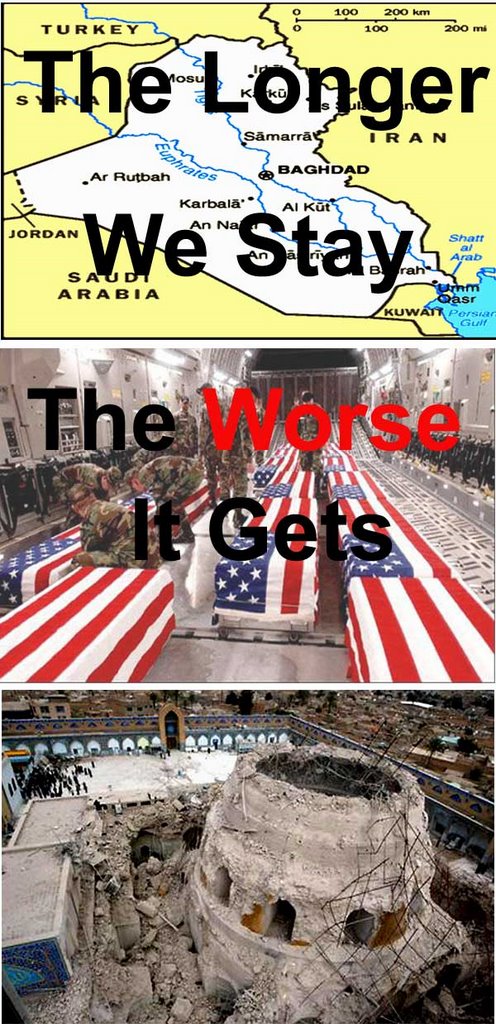
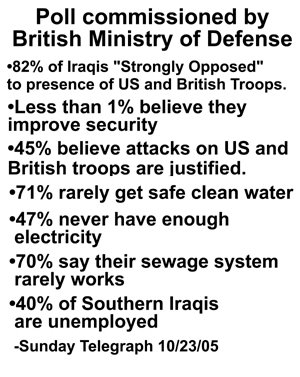
After 3 years of war in Iraq, it is abundantly clear that the occupation is actually making the situation worse. Last fall the British commissioned a poll that showed that 82% of Iraqis want our troops to leave. A recent poll of US soldiers there shows that over 70% think we should leave. Why? because they know that our presence is not helping.
The level of violence continues to increase. There are more attacks and reprisals every day, Amnesty International and others have documented continuing torture in American and Iraq government prisons. Death squads kill with impunity. Ordinary people are scared to go out on the streets due to the general lack of security. Basic services such as clean water and electricity are in very short supply. Promises of reconstruction remain mostly unfulfilled. Most people there blame the Americans.
Extremists are using the anger most people there feel at the mess to increase their own power. Ethnic Cleansing and Civil War are looking more and more likely. Rumsfeld says that the US would stay out of a civil way but it is hard to see how that would be possible.
In short, the first thing we need to do to improve the situation in Iraq is to leave. This will lower the level of tension and cut off support for the insurgency by removing their best recruiting tool, occupying Americans. Only then can the conditions for a settlement between all the parties be created.
February 01, 2006
Tridents at Indian Island
I live in Port Townsend, Washington, near the Indian Island Naval Magazine, the largest munitions depot on the West Coast. Many of the munitions headed for Iraq are loaded here. Not much further away is the Trident Submarine Base in Bangor, WA. Up until now, the Tridents have been exclusively a platform for nuclear missiles. The Navy is now retrofitting some of them to be able to launch cruise missiles, with either conventional high explosives or nuclear warheads. The conventional weapons will be loaded here at Indian Island. After years of refusing to discuss where nuclear weapons are stored, the Navy has said that nuclear weapons will not be loaded at Indian Island. This statement is apparently in response to local protests against the base.
The rest of this article originally appeared as a letter to the Editor in the Jefferson County Leader.
Bringing Trident submarines to Indian Island will not significantly change anything there. It will continue to be the major port used for shipping weapons from the West Coast. It is, however, a disturbing indication of the way our military will be used in the coming years. The Tridents that will be coming here are being refitted to carry cruise missiles, which are capable of carrying either conventional warheads or tactical nuclear weapons. The idea is to allow the submarine to creep up near any coast in the world and launch missiles that could reach their target within minutes. They are also rigged to put ashore commando units, in secret, anywhere they want. Submarines are used for this kind of mission, because, unlike other kinds of forces, they are largely invisible. Covert missions are used to carry out policies without the knowledge or consent of the American people.
The Administration has asserted the right to attack anybody, anytime, anywhere in the name of the "War on Terror". These subs are just the tool they need to do that. Judging by their record so far, most of those missiles will be hitting innocent people who are unlucky enough to be in the wrong place at the wrong time. These attacks will only fuel anti-American feelings.
Even worse, Bush clearly would like to be able use "limited" nuclear weapons in some situations. A nuclear warhead on a cruise missile launched from a Trident without warning only a few minutes from its target would be both devastating and destabilizing. How can we expect other countries to refrain from developing or using nuclear weapons when we keep a huge arsenal of our own and assert our right to bomb anybody we choose?
The rest of this article originally appeared as a letter to the Editor in the Jefferson County Leader.
Bringing Trident submarines to Indian Island will not significantly change anything there. It will continue to be the major port used for shipping weapons from the West Coast. It is, however, a disturbing indication of the way our military will be used in the coming years. The Tridents that will be coming here are being refitted to carry cruise missiles, which are capable of carrying either conventional warheads or tactical nuclear weapons. The idea is to allow the submarine to creep up near any coast in the world and launch missiles that could reach their target within minutes. They are also rigged to put ashore commando units, in secret, anywhere they want. Submarines are used for this kind of mission, because, unlike other kinds of forces, they are largely invisible. Covert missions are used to carry out policies without the knowledge or consent of the American people.
The Administration has asserted the right to attack anybody, anytime, anywhere in the name of the "War on Terror". These subs are just the tool they need to do that. Judging by their record so far, most of those missiles will be hitting innocent people who are unlucky enough to be in the wrong place at the wrong time. These attacks will only fuel anti-American feelings.
Even worse, Bush clearly would like to be able use "limited" nuclear weapons in some situations. A nuclear warhead on a cruise missile launched from a Trident without warning only a few minutes from its target would be both devastating and destabilizing. How can we expect other countries to refrain from developing or using nuclear weapons when we keep a huge arsenal of our own and assert our right to bomb anybody we choose?
July 17, 2005
Root Out the Evil
In Kathleen Parker’s Sunday (7/17/05) column in the Seattle Post-Intelligencer, “Modern Muslims must root out the evil”, Ms. Parker asserts that “moderate Muslims must be unrelenting in eliminating - not just condemning - Islam’s bad actors.” If that is so, then it also follows that Americans must be unrelenting in eliminating our own bad actors. Of course, our bad actors don’t support suicide bombers. They don’t have to because they have airplanes to drop the bombs, but the civilians are just as dead and their friends and families are just as grief-stricken. Whether they were killed by a stray bomb, or by a scared American soldier pulling the trigger a little too quickly at a checkpoint, or indeed by punitive sanctions during the 90s that never hurt Saddam Hussein but denied food, medicine and safe drinking water to the Iraqi population, far more innocent people have been killed by the US government than by terrorists.
You may argue that this is war and different standards apply. If so it is a war that was never declared. Congressional authorization was based on deliberate lies by an Administration that was determined, as the Downing Street Memo tells us, to make the intelligence fit the predetermined policy. The President’s justification for the war has changed with the political climate. Whether he is fighting to eliminate WMDs or to bring democracy to the Middle East or to “fight the terrorists over there so we don’t have to fight them here”, it doesn’t hold water.
If the US is fighting a war, then it follows that its enemies are also fighting a war. Al Quaida issued a declaration of war against the United States several years ago and they refer to their attacks as military operations. I don’t have any special insight into their thoughts but perhaps they see their attacks as similar to, on a much smaller scale, the strategic bombing of English, German and Japanese cities in WWII by all sides. In that case, civilians were seen as participants because of their support for their government’s war effort and the hope was that civilian casualties would undermine that support.
According to this morning’s paper, 1,763 American soldiers have been killed in Iraq. Thousands more have been injured and hundreds of thousands of Iraqis have been killed and injured. The occupation is widely hated and is used as a justification for continued insurgent attacks. The situation continues to deteriorate. Those who hope for a civil war are winning the battle. One can’t help but think that the American occupation is making things worse. Surely there must be an alternative but George Bush’s insistence that he cannot possibly have been wrong in any way stands in the way of finding a way out. Most Americans agree that the war was a mistake. Many have come to the conclusion that the road to peace starts with American withdrawal. That will undercut the appeal of the insurgency and open the door to negotiation among Iraqis. Perhaps peacekeepers can be recruited from other Arab countries as a transitional measure. One thing is certain. It is time to bring our troops home.
Those of us who believe this have an obligation not just to condemn this war but to act to end it. Letters and phone calls to our Senators and Congressional Representatives may prod them to action. Talking to our friends and writing letters to the editor can get more people involved. Join an organization working for peace. Demonstrate.
Go to Washington, DC for the September 24-26 massive mobilization against the war.
Bring the Troops Home.
You may argue that this is war and different standards apply. If so it is a war that was never declared. Congressional authorization was based on deliberate lies by an Administration that was determined, as the Downing Street Memo tells us, to make the intelligence fit the predetermined policy. The President’s justification for the war has changed with the political climate. Whether he is fighting to eliminate WMDs or to bring democracy to the Middle East or to “fight the terrorists over there so we don’t have to fight them here”, it doesn’t hold water.
If the US is fighting a war, then it follows that its enemies are also fighting a war. Al Quaida issued a declaration of war against the United States several years ago and they refer to their attacks as military operations. I don’t have any special insight into their thoughts but perhaps they see their attacks as similar to, on a much smaller scale, the strategic bombing of English, German and Japanese cities in WWII by all sides. In that case, civilians were seen as participants because of their support for their government’s war effort and the hope was that civilian casualties would undermine that support.
According to this morning’s paper, 1,763 American soldiers have been killed in Iraq. Thousands more have been injured and hundreds of thousands of Iraqis have been killed and injured. The occupation is widely hated and is used as a justification for continued insurgent attacks. The situation continues to deteriorate. Those who hope for a civil war are winning the battle. One can’t help but think that the American occupation is making things worse. Surely there must be an alternative but George Bush’s insistence that he cannot possibly have been wrong in any way stands in the way of finding a way out. Most Americans agree that the war was a mistake. Many have come to the conclusion that the road to peace starts with American withdrawal. That will undercut the appeal of the insurgency and open the door to negotiation among Iraqis. Perhaps peacekeepers can be recruited from other Arab countries as a transitional measure. One thing is certain. It is time to bring our troops home.
Those of us who believe this have an obligation not just to condemn this war but to act to end it. Letters and phone calls to our Senators and Congressional Representatives may prod them to action. Talking to our friends and writing letters to the editor can get more people involved. Join an organization working for peace. Demonstrate.
Go to Washington, DC for the September 24-26 massive mobilization against the war.
Bring the Troops Home.
February 11, 2005
Same Day Voter Registration Can Boost Participation
Voter turnout in the United States is among the lowest in the world. When people don't participate in the system, they tend to have less confidence in the political decisions that result.
Restrictive voter registration requirements make it difficult for many to vote. As usual, poor people have a harder time of it. Poor people tend to have less stable living arrangements and may have to move more often. Actually, anybody who moves is going to have a lot going on in their lives. Updating their voter registration may not be their top priority.
There have been efforts to simplify the process. Motor Voter laws that allow you to register to vote when you get a driver's license are one example. Mail in registration is another. Voting by mail works for many people.
Most states cut off voter registration about a month before the election. This is so the election department has time to compile and print up comprehensive lists ready to use on election day. But, this is just when things are getting interesting and new voters are most motivated to get involved. In Washington, mail in registrations have that 30 day cut off but a voter can register in person at their county auditor's office for another two weeks. Curiously, I was told at my local Auditor's office that a completed form from a voter registration drive turned in to the auditor by anyone other than the voter was considered a mail in registration and did not qualify for the extra time even though they had it in hand. I never did understand why it made a difference who handed the form over the counter. Certainly it is confusing and disappointing to a citizen who finally gets motivated to vote, only to be told that they missed the deadline.
Currently six states (Wisconsin, Minnesota, Idaho and 3 others) get around this problem by allowing election day registration. North Dakota abolished voter registration altogether 50 years ago. These states show higher rates of voter participation than the rest of the country. An analysis of voting trends from 1996-2000 showed the greatest increase in turnout in the states that have same day registration. When a 2002 Harris poll asked what would help get them to the polls, non-voters ranked same day registration at the top of the list.
Objectors to same day registration claim that it would promote voter fraud, but this has not been borne out by the experience of those states that use it. Voters are required to sign an affidavit that they are qualified to vote and show proof of identity and residence. This is basically the same as for advance registration. If there are concerns about somebody voting twice, same day registrants can be given a provisional ballot that will be counted after a cross-check of records show that there is no duplication. In fact, a better system for checking on eligibility could actually reduce fraud. Perhaps we could look towards Afghanistan and Iraq and use the finger dipped in indelible ink system to prevent double voting.
Following North Dakota's lead and abolishing voter registration would save the money currently spent on maintaining those records. Since it would also require each voter to show their current residence when they vote, it would automatically eliminate the problem of people neglecting to update their registration.
With voter confidence in the integrity of our electoral processes waning and budget shortfalls challenging us to find more efficient ways to operate our local governments, now is a great time to look into some form of same day voter registration.
Restrictive voter registration requirements make it difficult for many to vote. As usual, poor people have a harder time of it. Poor people tend to have less stable living arrangements and may have to move more often. Actually, anybody who moves is going to have a lot going on in their lives. Updating their voter registration may not be their top priority.
There have been efforts to simplify the process. Motor Voter laws that allow you to register to vote when you get a driver's license are one example. Mail in registration is another. Voting by mail works for many people.
Most states cut off voter registration about a month before the election. This is so the election department has time to compile and print up comprehensive lists ready to use on election day. But, this is just when things are getting interesting and new voters are most motivated to get involved. In Washington, mail in registrations have that 30 day cut off but a voter can register in person at their county auditor's office for another two weeks. Curiously, I was told at my local Auditor's office that a completed form from a voter registration drive turned in to the auditor by anyone other than the voter was considered a mail in registration and did not qualify for the extra time even though they had it in hand. I never did understand why it made a difference who handed the form over the counter. Certainly it is confusing and disappointing to a citizen who finally gets motivated to vote, only to be told that they missed the deadline.
Currently six states (Wisconsin, Minnesota, Idaho and 3 others) get around this problem by allowing election day registration. North Dakota abolished voter registration altogether 50 years ago. These states show higher rates of voter participation than the rest of the country. An analysis of voting trends from 1996-2000 showed the greatest increase in turnout in the states that have same day registration. When a 2002 Harris poll asked what would help get them to the polls, non-voters ranked same day registration at the top of the list.
Objectors to same day registration claim that it would promote voter fraud, but this has not been borne out by the experience of those states that use it. Voters are required to sign an affidavit that they are qualified to vote and show proof of identity and residence. This is basically the same as for advance registration. If there are concerns about somebody voting twice, same day registrants can be given a provisional ballot that will be counted after a cross-check of records show that there is no duplication. In fact, a better system for checking on eligibility could actually reduce fraud. Perhaps we could look towards Afghanistan and Iraq and use the finger dipped in indelible ink system to prevent double voting.
Following North Dakota's lead and abolishing voter registration would save the money currently spent on maintaining those records. Since it would also require each voter to show their current residence when they vote, it would automatically eliminate the problem of people neglecting to update their registration.
With voter confidence in the integrity of our electoral processes waning and budget shortfalls challenging us to find more efficient ways to operate our local governments, now is a great time to look into some form of same day voter registration.
February 04, 2005
Election Reform is Urgent
The irregularities, machine failures, paperless ballots,
disenfranchisement, lack of transparency, and a host of other issues in
the 2000 and 2004 elections underscore an electoral crisis that needs to
be fixed right away. Americans are losing confidence in the integrity of
our electoral system, and with good reason.
The Washington recount taught us some important lessons. First of all,
counties that used black box electronic voting machines had no way to
recount or validate their vote totals. We have to take their results on
faith. At the very least, machines should produce paper ballots for a
manual recount and for routine audits of results. It is extremely
disturbing to see proposed legislation (HB-1025) moving the deadline for
requiring electronic voting machines to produce a paper record of all
votes back from 2006 to 2007. Furthermore, this legislation would permit
the substitution of auditing software for an actual paper ballot. This
approach makes the problem worse, not better. What we need instead are
machines that produce paper ballots and a system to routinely audit the
results by comparing the machine results to the paper ballots in
randomly selected areas. If there is a significant difference, then more
investigation will be required, up to a full manual recount.
These machines are also lacking in security measures. A credit card
transaction on the internet is protected much better than our voting
machines. Voting machines are in many cases connected by modem.
Experienced hackers could obtain access by calling the modem. A small
group of hackers, or a single individual could alter the results in
hundreds of locations by as many votes as they thought they could get
away with. We donít know if this has actually happened but if it did, we
might never find out.
Second, there are counties still using punch cards. Punch cards are
notoriously prone to error. Voters have a hard time verifying that they
actually voted the way they intended. Hand counted paper ballots used to
be used everywhere and provide the greatest confidence in the integrity
of the system. Optical scan ballots are easy to mark and easy to read.
Voters can verify that they didnít make any mistakes before they turn in
their ballot and they can be easily recounted if necessary. Of course,
as with any voting system, there ought to be a routine audit as part of
the certification process to make sure that the count is accurate.
Machines are limited in their ability to interpret votes that any person
would understand instantly. For instance, a voter unfamiliar with
optical scan might circle their choice rather than fill in the little
blip or a punch card machine might leave a hanging or a pregnant chad.
The right to vote should not be denied due to a computerís limitations.
Third, there ought to be a guarantee that absentee ballots and
provisional ballots are actually counted. We saw during the recount that
these ballots are treated very differently in different counties. No
registration or vote should be disqualified without notifying the voter
of the problem and giving them an opportunity to correct the problem.
Provisional ballots were intended to insure that all voters will have a
opportunity to vote and have that vote counted. When a provisional
ballot is needed, it should trigger an investigation of what went wrong,
so that voting and registration procedures can be improved.
We call ourselves the greatest democracy in the world. We owe our
country no less than to make it so.
(Dan Goldstein lives in Port Townsend and is a member of Concerned
Voters of Jefferson County)
(Originally published as an Op-Ed in the Seattle Post Intelligencer)
disenfranchisement, lack of transparency, and a host of other issues in
the 2000 and 2004 elections underscore an electoral crisis that needs to
be fixed right away. Americans are losing confidence in the integrity of
our electoral system, and with good reason.
The Washington recount taught us some important lessons. First of all,
counties that used black box electronic voting machines had no way to
recount or validate their vote totals. We have to take their results on
faith. At the very least, machines should produce paper ballots for a
manual recount and for routine audits of results. It is extremely
disturbing to see proposed legislation (HB-1025) moving the deadline for
requiring electronic voting machines to produce a paper record of all
votes back from 2006 to 2007. Furthermore, this legislation would permit
the substitution of auditing software for an actual paper ballot. This
approach makes the problem worse, not better. What we need instead are
machines that produce paper ballots and a system to routinely audit the
results by comparing the machine results to the paper ballots in
randomly selected areas. If there is a significant difference, then more
investigation will be required, up to a full manual recount.
These machines are also lacking in security measures. A credit card
transaction on the internet is protected much better than our voting
machines. Voting machines are in many cases connected by modem.
Experienced hackers could obtain access by calling the modem. A small
group of hackers, or a single individual could alter the results in
hundreds of locations by as many votes as they thought they could get
away with. We donít know if this has actually happened but if it did, we
might never find out.
Second, there are counties still using punch cards. Punch cards are
notoriously prone to error. Voters have a hard time verifying that they
actually voted the way they intended. Hand counted paper ballots used to
be used everywhere and provide the greatest confidence in the integrity
of the system. Optical scan ballots are easy to mark and easy to read.
Voters can verify that they didnít make any mistakes before they turn in
their ballot and they can be easily recounted if necessary. Of course,
as with any voting system, there ought to be a routine audit as part of
the certification process to make sure that the count is accurate.
Machines are limited in their ability to interpret votes that any person
would understand instantly. For instance, a voter unfamiliar with
optical scan might circle their choice rather than fill in the little
blip or a punch card machine might leave a hanging or a pregnant chad.
The right to vote should not be denied due to a computerís limitations.
Third, there ought to be a guarantee that absentee ballots and
provisional ballots are actually counted. We saw during the recount that
these ballots are treated very differently in different counties. No
registration or vote should be disqualified without notifying the voter
of the problem and giving them an opportunity to correct the problem.
Provisional ballots were intended to insure that all voters will have a
opportunity to vote and have that vote counted. When a provisional
ballot is needed, it should trigger an investigation of what went wrong,
so that voting and registration procedures can be improved.
We call ourselves the greatest democracy in the world. We owe our
country no less than to make it so.
(Dan Goldstein lives in Port Townsend and is a member of Concerned
Voters of Jefferson County)
(Originally published as an Op-Ed in the Seattle Post Intelligencer)
Subscribe to:
Posts (Atom)


 Posts
Posts

