October 09, 2013
Dear President Obama Re: Government shutdown/debt limit
I am very concerned about reports that you are considering "negotiating" with the Republicans. You have done well, so far, responding to Republicans taking the government hostage. Much better than in previous instances. Experience shows us that if you give in to any of their unreasonable demands, and they are all unreasonable, that they will take that concession and wait for the next opportunity to replay the whole scenario. The only way to stop this cycle is to hold firm to your position. Negotiations either before or after ending the shutdown or extending the debt limit will only encourage them to continue their destructive tactics.
The press reports that there are enough moderate Republicans who are willing to re-open the government and extend the debt limit. You should make it clear that you are not going to budge and encourage them to take action to end this now.
The budget that is finally passed should not take away from those most in need, or cut Social Security or Medicare. These programs are the most efficient and beneficial in the entire Federal Government.
We should not cut regulation to protect our health, our environment or our economy. Well enforced regulations level the playing field, which is now tilted to favor those who would cut corners or throw their costs onto the public.
On the other hand, we could easily cut our bloated, corrupt and wasteful military and "National Security" programs without endangering our security one bit.
Republicans are being unreasonable and do not deserve serious consideration of their demands. The public is with you and will demonstrate that in the next election if you show some spine and stand up to these hooligans.


May 05, 2012
B of A Misdeeds
Your B of A – Lessons
Learned
Under the guise of B of A
repenting, a good summary of misdeeds.
This whole website is written as if Bank of America was being nationalized and reformed. So, B of A would now be Your B of A.
I especially like this page, where all the banks past transgressions are reported (well, maybe not ALL).
Lessons Learned
Today, we at Bank of America
are turning over a new leaf. Your Bank of America will be a Bank for America.
And much as we would show an incoming CEO our full balance sheet, giving him or
her the full knowledge needed to chart a new course, we are committed to
transparency with you as well, and to displaying for you our liabilities as
well as our assets.
Claim liabilities
We will, naturally, vigorously defend
ourselves in any and all of these cases and any others that may arise, so long
as we remain in command of our destiny. Still, it is obvious that this volume
of litigation will at the very least present a challenge for those seeking to
make positive business changes.
Investors claims
Our Bank is today
facing over a dozen major lawsuits for selling fraudulent securities to
institutional investors. Though we have settled for $8.5 billion in damages
with one such group
of investors, we still face a further $10 billion in similar claims from AIG,
and $700 million more from Allstate, as well as a fraud suit for just over $1
billion by U.S. Bancorp.
Insurer claims
We are being sued
for $1.4 billion by a major bond insurer, MBIA, which claims it was
fraudulently induced to insure worthless Countrywide mortgages. Another bond
insurer, Assured, is seeking $1.6 billion in damages in a very similar suit.
Additionally, Ambac, an insurance company which is now bankrupt, claims it lost
$466 million as a result of fraud by our Bank.
Pensioner claims
Last year, we
settled for $624 million in a case that claimed we had knowingly sold in
fraudulent securities to New York public pension funds. We also settled for
$315 million in a case involving the Mississippi state pension fund. Similar
cases from other states are unfortunately in the pipeline.
Depositor claims
A federal judge
ruled in May that Bank of America had systematically overcharged depositors
with inflated overdraft fees, forcing us to pay more than $410 million in
damages.
Federal Government claims
A federal case
alleges that our Bank sold over $3 billion of worthless securities to Fannie
Mae and Freddie Mac. The settlement in that case is pending.
Minority claims
Earlier this year we
paid $335 million to settle claims that Countrywide had systematically sold
minorities riskier adjustable “sub-prime” loans when they were, in fact,
well-qualified for safer, fixed-rate mortgages.
Homeowner claims
Our Bank faces over
a dozen class-action suits alleging improper foreclosure on thousands of
homeowners, some even alleging perjured, "robo-signed" evidence. We
have also been accused of deliberately slowing down mortgage modification
claims to avoid having to comply with programs to aid distressed families,
requirements imposed on us as one of the largest recipients of 2008 bailout
funds.
County and town claims
Dozens of
localities are alleging that Bank of America systematically evaded hundreds of
millions of dollars in local taxes by using MERS, an electronic mortgage
registration system that allows the avoidance of county-level
mortgage-registration fees.
Shareholder claims
After purchasing
the ailing Merrill Lynch with taxpayer funds, bonuses we paid Merrill
executives—in order to ease the merger approval process—came into question and
became the subject of a lawsuit. While we agreed to settle with the S.E.C. for
$33 million, a judge later quadrupled the fine to $125 million to resolve the
claim of fraud.
Other direct liabilities
Inherited liabilities
After acquiring
Merrill Lynch in 2009, along with its assortment of debt, toxic assets, and
junk investments, Bank of America has found itself beset by thousands of
complaints, class action lawsuits and even criminal charges brought by over a
dozen state attorneys general. In 2011 we paid out $5.6 billion in
litigation-related expenses, up from $2.6 billion for 2010. In 2012 those costs
are likely to continue to rise; in the first quarter of 2012 alone, for
example, Bank of America has committed to a $3.25 billion payout to the federal
government to satisfy a multi-state settlement in the fraudulent “robo-signing”
fiasco.
Service-charge reductions
A significant share
of our annual income is derived from the various service charges contributed by
our customers. Last year, service-charge revenue decreased by almost $2
billion, due to a populist “move your money” campaign which included a
highly-publicized internet petition. The aggregate effect has been devastating
to a core node of our business, and makes clear the need to rethink a model
that needs to sustain high overheads through such a wide variety of means.
Indirect liabilities
These are, essentially, factors that
make our Bank unpopular with the general public, and increase the difficulty of
doing business. These do not have a direct effect on our bottom line, but may
accentuate other effects—for example, by creating a hostile judicial environment
in which non-objective judges more readily accept claims against us.
Taxation issues
Due in part to our
continued losses, and the compensation imbalances outlined above, Bank of
America paid no federal tax for 2011, just as in 2010 and 2009. Part of this
can be tied to the immense complexity of our business and the global nature of
our client base, which has necessitated the creation of hundreds of foreign
subsidiaries, including many in traditionally tax-averse territories, such as
the Cayman Islands. It is also largely due to the ongoing efforts of our
world-class legal team. But regardless of the reasons, this great asset has,
with the advent of a more politicized public, become a liability. Many more
people have come to resent the fact that the bank with the most branches,
customers and checking accounts of any US bank pays no federal income tax, and
that public brand-tarnishing presents unknown risk. Even more, the fact that
even without taxes, we still don't turn a profit leads many to suggest that our
business model is fundamentally flawed.
Embroilment in the foreclosure
market
The
Bank of America never intended to become a used-home dealer. By finding
ourselves in a foreclosure-mill of unprecedented size, our Bank has come to
take charge of a vast stock of underwater homes that in many cases remain
vacant, eventually bringing the value of entire neighborhoods down. Perceived
abandonment of foreclosed homes, coupled with heartbreaking images of
evictions, has perpetuated a vast reservoir of ill-will about our brand which
also presents a hard-to-assess bottom-line risk. It has also created a platform
for critics, who have even gone so far as to engage in stunts that distort the
facts, like when one irate Florida mortgage holder, who had won a small court-ordered
financial judgment against our bank, mobilized their local sheriffs department
to “foreclose” on one of our branches in order to collect their judgment.
Environmental liabilities
unpopular
Part of our Bank's strength has come from our predominance
within key industries. From 2009 to 2010, for example, we invested more than $4 billion
in coal, more than any other bank. This has led some to claim
that we are responsible not only for exacerbating the global climate crisis,
but for contributing to thousands of deaths due to cardiac and respiratory
diseases, as well as 1.6 million lost work days due to heart attacks, chronic
bronchitis cases, asthma attacks, and the like.
Inequality
Finally, in this
time when the issue of "inequality" is so prominent for Americans,
much has been made of the contrast between our stock losses (40% in 2011) and
the year-end compensation of our senior executives (7% more than the year
before), as well as in the contrast between our CEO's rate of earning and that
of a typical teller (441 times more). Regardless of the merits of these points,
they do appeal to a wider and wider swath of the American public, creating a
deficit of good-will about the brand, which also exposes us to bottom-line
risk, especially in the retail banking sector.
Summary
Some
of the issues we have outlined above will be easier to address than others.
Some may even disappear on their own should there be a federal receivership
process, thus it may be premature to worry about them now. But we are committed
to demonstrating showing you that we have changed. We wish to provide you, the
American taxpayer—who even own our bank in the near future—with the information
you are likely to need in pursuing success of the sort you're defining. That
was then. This is now. Your Bank of America.
January 28, 2012
Slavoj Žižek speaks at Occupy Wall Street: Transcript
This summary is not available. Please
click here to view the post.
November 17, 2011
Tents
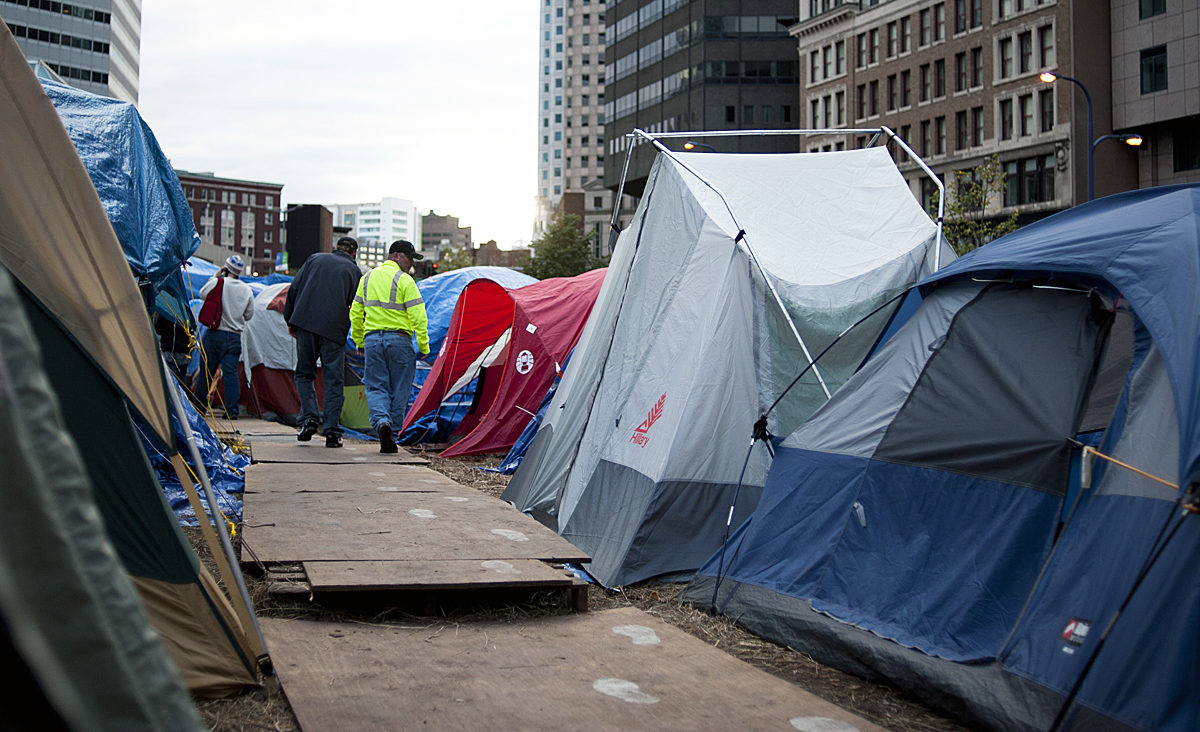
The law, in its majestic equality, forbids the rich as well as the poor, to sleep in the parks –Paraphrased from Anatole France
Police attacks on Occupy movements from Wall Street to
Oakland, Portland, Denver … have often been justified by the “need” to prevent
the use of tents or shelters in public places. Of course, we know that the real reason is that the powers
that be don’t like the political and social views that are being expressed by
the Occupations.
We’ll get back to tents in a minute, because I find this
part of the story fascinating, but lets look at the other pretexts that have
been used recently. From
Portland’s Mayor Sam Adams, to Oakland’s Jean Quan, to New York’s Michael
Bloomberg, suddenly there is a great concern for the “health and welfare” of
the protesters. Massive police
violence, pepper spray, beatings and “less lethal” projectiles leveled at
non-violent people does not arouse the same level of concern, although it is
without a doubt a far greater threat to “health and welfare” than anything that
goes on in the camps.
So, what does go on in those camps that is so terrible? Some of the allegations are so far off
base that they are just silly. For
one thing, after two months of occupations all these cities suddenly have terrible
problems of crime, drug use and homelessness going on in the camps. Obviously
caused by the Occupy movement(?)
And did I mention this is a few days before large demonstrations planned
for November 17 to mark two months of Occupy Wall Street? Jean Quan justified the attack on
Occupy Oakland by citing a murder. Actually that murder had nothing to do with
the occupation and was not in the camp. The most that could be said is that
somebody got killed near the camp. Unfortunately, people are killed pretty
frequently in Oakland. How does beating up a bunch of people that had nothing
to do with it, arresting them – not the
criminal - and throwing
away their possessions solve that problem?
Several cities justified their actions because homeless
people were moving into the camps. “That’s not protest” they say, “It’s just
dirty drug using homeless people taking the opportunity to move back into
public spaces. We can’t allow that”
Well, first of all having homeless people in the camps is a political
act. The whole point of the
movement is that a tiny minority has seized control over our economic and
political systems. They are enriching themselves and using the political system
to prevent any attempt to regulate or control their anti-social behavior. One of the results that we have been
seeing is that people are losing their jobs and their homes. They have nowhere
to go. Homelessness is one of the symptoms of our problem. As is drug use (and make no mistake,
alcohol is a drug). People are there to enrich themselves at the expense of the
hopeless. But the government ends
up criminalizing the victims because solving the problem would challenge the
entrenched system that relies on being able to keep people poor, keep wages
down and keep profits up for the 1%.
If people overdose, it would have happened wherever they were. It is not
because of the Occupy camps.
If those of us who have homes and some kind of jobs had to
really confront homelessness, we would want to change that system. And that
brings us back to why homeless people can’t be allowed in the camps. They become visible when they come out
of the hiding places they have been forced into by those who just don’t want us
to think about it. And that is why
there are laws against tents and against sleeping in public parks. This does
nothing to solve the problem. It just forces people to sleep under bridges or
deep in the bushes. It makes them invisible, which is, of course, the
point.
The authorities are using these same anti-tent or
anti-camping ordinances against the Occupy Movement. And for the same reason.
To make them invisible. To make
them go away. To keep them from challenging the system that makes some people
homeless, makes us all poorer (99% of us) and prevents the majority from
forming the more equitable society that most of us want to live in.
The movement can respond to the relatively rare crimes that
may be committed in their neighborhood.
When women were harassed at Occupy Wall Street they created a safe space
for themselves and set up women only tents. In general this movement has been
good about policing themselves. We wouldn’t raze a suburban street because
there was a crime committed there, and certainly not a gated community with the
stately homes of the wealthy. Why then use that excuse to tear down Occupy
camps? It has nothing to do with “health and welfare” and of course we all know
that.
July 20, 2011
WTF Obama!
Obama endorsed the Gang of Six budget plan that would cut Social Security, raise taxes on the Middle Class and CUT taxes on the rich. Yes, I said CUT. Read about it anywhere but here is a nice summary from Democracy Now
I kind of lost my cool and sent this letter..
Dear President Obama, What the #$%^& is wrong with you? Do you think you were elected to cut taxes on the rich and cut programs for the rest of us? Think again. You promised change but the only change you are giving us is change for the worse.
Let me be clear. Social Security and Medicare are in fine shape. We do NOT need to cut there and the people will not accept cuts. We need more government spending to create jobs and get us out of the recession. We need to roll back tax cuts to the rich and make sure that profitable corporations do not use off shore tax havens and loopholes to wiggle out of their fair share of taxes. Taxes on the rich are already the lowest in the world. Make them pay their fair share.
The budget crisis is only a crisis because nobody is standing up to Republican blackmail.
THEY DO NOT GIVE A DAMN ABOUT JOBS OR THE ECONOMY. THEY WANT TO WRECK THE ECONOMY SO THEY CAN BLAME IT ON YOU AND WIN THE NEXT ELECTION. THEY ARE ANTI-AMERICAN AND IT IS YOUR JOB TO EXPOSE THEIR LIES AND RALLY THE AMERICAN PEOPLE TO A SANE POLICY. WE ARE WAITING.
GET OFF YOUR %$#$%%$ ASS AND GIVE THEM HELL. You would be popular again and you would be doing the right thing.
I kind of lost my cool and sent this letter..
Dear President Obama, What the #$%^& is wrong with you? Do you think you were elected to cut taxes on the rich and cut programs for the rest of us? Think again. You promised change but the only change you are giving us is change for the worse.
Let me be clear. Social Security and Medicare are in fine shape. We do NOT need to cut there and the people will not accept cuts. We need more government spending to create jobs and get us out of the recession. We need to roll back tax cuts to the rich and make sure that profitable corporations do not use off shore tax havens and loopholes to wiggle out of their fair share of taxes. Taxes on the rich are already the lowest in the world. Make them pay their fair share.
The budget crisis is only a crisis because nobody is standing up to Republican blackmail.
THEY DO NOT GIVE A DAMN ABOUT JOBS OR THE ECONOMY. THEY WANT TO WRECK THE ECONOMY SO THEY CAN BLAME IT ON YOU AND WIN THE NEXT ELECTION. THEY ARE ANTI-AMERICAN AND IT IS YOUR JOB TO EXPOSE THEIR LIES AND RALLY THE AMERICAN PEOPLE TO A SANE POLICY. WE ARE WAITING.
GET OFF YOUR %$#$%%$ ASS AND GIVE THEM HELL. You would be popular again and you would be doing the right thing.
July 01, 2011
Debt as a moral issue
... we’re actually at a very strange historical moment because they’ve managed to convince people around the world that debt is somehow something sacred. I mean, a debt is just a promise, right? It has no greater moral standard than any other promise that you would make. Yet, here we have people accepting that it’s perfectly reasonable to say well, we can’t possibly keep our promise to the public, politicians say, to give you health care because it’s absolutely unthinkable we could break our sacred promises to bankers to give them a certain percentage of interest every year. How did that become a convincing argument? It’s utterly odd if you think about in terms of any kind of principle of democracy. As I say, if you look at the history of world religions, of social movements what you find is for much of world history what is sacred is not debt, but the ability to make debt disappear to forgive it and that’s where concepts of redemption originally come from.-David Graeber teaches anthropology at Goldsmiths College at the University of London. He is the author of several books, his newest book–"Debt: The First 5,000 Years" (Melville House) comes out later this month.
The quote was from Democracy Now 7/1/11
June 28, 2011
Israel Attacks Non-violent activists
Dear Secretary of State Clinton,
On January 28, 2011 you issued a strong statement to the Egyptian government urging it not to attack peaceful demonstrators, "We are deeply concerned about the use of violence by Egyptian police and security forces against protesters and we call on the Egyptian government to do everything in its power to restrain the security forces." (full text) I wrote you then thanking you for that statement. Today I am asking you to apply that same standard to Israel.
As you know, the Israeli government has threatened to violently attack the Freedom Flotilla to Gaza, including the US Boat to Gaza, The Audacity of Hope. As you also are very well aware, these are people committed to non-violent activism to aid Palestinians, especially in Gaza, to achieve basic human rights in the face of a punitive blockade. Israel's threats are credible because they have attacked previous boats, resulting in many unnecessary injuries and the deaths of nine people last year. Israel routinely violently attacks Palestinians engaged in non-violent protests with high velocity tear gas canisters, rubber coated bullets, clubs and live ammunition. Don't Palestinian democracy demonstrations deserve the same support as Egyptians or Libyans? Don't Americas traveling abroad deserve to be safe from unwarranted attack?
Just as the Egyptian, Libyan and Syrian governments spread lies about democracy demonstrators in order to justify attacking them, Israel is spreading lies about the flotilla. The flotilla carries no weapons and will not attack the Israeli soldiers who may well attack them. They are, I'll say it again, committed to non-violence. They are by no stretch of the imagination supporting terrorism. On the contrary, they and the many thousands of non-violent activists in Palestine are providing an alternative to violent resistance to the continued denial of basic human rights. They hope that non-violent means are more effective in convincing the world of the need for a just and equitable peace agreement. I hope that they are right. If Israel will respond there is now some hope for peace and justice.
Israel only undercuts it's own position and casts doubt on its desire for peace with the lies and unnecessary violence they have resorted to. The US should support peace and security for both Israelis and Palestinians. We should call upon Israel to respect human rights, just as we call on Egypt, Libya, Syria and other governments to do the same.
cc: President Obama
Rep Norm Dicks
Senator Patty Murray
Senator Maria Cantwell
On January 28, 2011 you issued a strong statement to the Egyptian government urging it not to attack peaceful demonstrators, "We are deeply concerned about the use of violence by Egyptian police and security forces against protesters and we call on the Egyptian government to do everything in its power to restrain the security forces." (full text) I wrote you then thanking you for that statement. Today I am asking you to apply that same standard to Israel.
As you know, the Israeli government has threatened to violently attack the Freedom Flotilla to Gaza, including the US Boat to Gaza, The Audacity of Hope. As you also are very well aware, these are people committed to non-violent activism to aid Palestinians, especially in Gaza, to achieve basic human rights in the face of a punitive blockade. Israel's threats are credible because they have attacked previous boats, resulting in many unnecessary injuries and the deaths of nine people last year. Israel routinely violently attacks Palestinians engaged in non-violent protests with high velocity tear gas canisters, rubber coated bullets, clubs and live ammunition. Don't Palestinian democracy demonstrations deserve the same support as Egyptians or Libyans? Don't Americas traveling abroad deserve to be safe from unwarranted attack?
Just as the Egyptian, Libyan and Syrian governments spread lies about democracy demonstrators in order to justify attacking them, Israel is spreading lies about the flotilla. The flotilla carries no weapons and will not attack the Israeli soldiers who may well attack them. They are, I'll say it again, committed to non-violence. They are by no stretch of the imagination supporting terrorism. On the contrary, they and the many thousands of non-violent activists in Palestine are providing an alternative to violent resistance to the continued denial of basic human rights. They hope that non-violent means are more effective in convincing the world of the need for a just and equitable peace agreement. I hope that they are right. If Israel will respond there is now some hope for peace and justice.
Israel only undercuts it's own position and casts doubt on its desire for peace with the lies and unnecessary violence they have resorted to. The US should support peace and security for both Israelis and Palestinians. We should call upon Israel to respect human rights, just as we call on Egypt, Libya, Syria and other governments to do the same.
cc: President Obama
Rep Norm Dicks
Senator Patty Murray
Senator Maria Cantwell
May 23, 2011
Tough Love for Israel
This is my letter to the President and Congress about the need for a viable Palestinian state.
I hope that you support President Obama's statement that for the peace and security of Israel and Palestine, Palestinians must have a sovereign state with contiguous territory based on the 1967 borders with mutually agreed swaps.
Israel truly will never have peace until they are willing to end their occupation and support a viable Palestinian state. Unfortunately Netanyahu made it clear that Israel is not yet ready to accept the existence of such a state.
I hope that you will use the considerable influence the US has with Israel because of the billions of dollars in aid that we give to them every year. Israel needs help to find the way to peace, call it tough love if you will. Because of our close ties to Israel and because of the substantial aid we give them, the United States is in the best position to give them that help. We can do that by making it very clear that while we do support Israel, we will not continue our aid while they are on their present self-destructive course.
Please let me know what actions you will be taking to bring about a just settlement for both Israel and Palestine.
May 04, 2011
May 4 - Student mobilizations
As it happens May 4 has been a significant date for several social justice movements led by students.
On May 4, 1919 a large demonstration in Beijing protested against the treatment of China in the Versailles treaty. The movement that this was a part of became known as the May 4 Movement. It was largely led by students who supported a broad liberalization of their society. They wanted to adopt western values of democracy and an end to the strict class divisions of traditional Chinese society. They supported literature in the vernacular language of the the people, rather than just being for the intellectual class. Politically they opposed foreign domination of China and thought that by adopting western values, China could become a self-reliant nation that could control its own destiny. This movement was very influential among intellectuals and students who later went on to reshape Chinese society.
On May 4, 1989 the democracy movement centered around Tienanmen Square in Beijing was building strength and marked the 70th anniversary of the May 4th Movement with a rally that brought out 100,000 people into Tienanmen Square. The Democracy Movement advocated an end to the domination of the Communist Party and the institution of democratic institutions and free speech. The movement paralleled similar movements in other Communist countries that led to the collapse of Communism in the Soviet Union and Eastern Europe. In China, however, the movement was crushed when the military marched on Tienanmen Square on June 4, killing anywhere from several hundred to several thousand people.
On May 4, 1961 in the United States, the first of the Freedom Rides began. Students from around the country came to the South to challenge segregation of interstate transportation. They rode Greyhound and Trailways buses in groups of black and white people riding together and using the facilities at bus stations together in defiance of segregation laws. They were met with mob violence and eventually the governor of Alabama had to call out the National Guard to protect them and to forestall the use of federal troops. These rides were an important milestone for the Civil Rights movement and eventually forced the end of segregation in public transportation.
On May 4, 1970 four students at Kent State University were shot by the Ohio National Guard while protesting the Vietnam War following President Nixon's announcement that he was expanding the war into Cambodia. Their deaths and the death of two more students at Jackson State in Mississippi the night of May 14 sparked a nationwide student strike by as many as 4 millions students and mobilization against the war. Hundreds of universities closed down in the face of the protests. Many students were galvanized into action by the thought that "it could have been me". They were in danger if they were drafted to fight in Vietnam and now they were in danger if they stayed in school. They felt personally threatened and responded with renewed action against the war.
On May 4, 1919 a large demonstration in Beijing protested against the treatment of China in the Versailles treaty. The movement that this was a part of became known as the May 4 Movement. It was largely led by students who supported a broad liberalization of their society. They wanted to adopt western values of democracy and an end to the strict class divisions of traditional Chinese society. They supported literature in the vernacular language of the the people, rather than just being for the intellectual class. Politically they opposed foreign domination of China and thought that by adopting western values, China could become a self-reliant nation that could control its own destiny. This movement was very influential among intellectuals and students who later went on to reshape Chinese society.
On May 4, 1989 the democracy movement centered around Tienanmen Square in Beijing was building strength and marked the 70th anniversary of the May 4th Movement with a rally that brought out 100,000 people into Tienanmen Square. The Democracy Movement advocated an end to the domination of the Communist Party and the institution of democratic institutions and free speech. The movement paralleled similar movements in other Communist countries that led to the collapse of Communism in the Soviet Union and Eastern Europe. In China, however, the movement was crushed when the military marched on Tienanmen Square on June 4, killing anywhere from several hundred to several thousand people.
On May 4, 1961 in the United States, the first of the Freedom Rides began. Students from around the country came to the South to challenge segregation of interstate transportation. They rode Greyhound and Trailways buses in groups of black and white people riding together and using the facilities at bus stations together in defiance of segregation laws. They were met with mob violence and eventually the governor of Alabama had to call out the National Guard to protect them and to forestall the use of federal troops. These rides were an important milestone for the Civil Rights movement and eventually forced the end of segregation in public transportation.
On May 4, 1970 four students at Kent State University were shot by the Ohio National Guard while protesting the Vietnam War following President Nixon's announcement that he was expanding the war into Cambodia. Their deaths and the death of two more students at Jackson State in Mississippi the night of May 14 sparked a nationwide student strike by as many as 4 millions students and mobilization against the war. Hundreds of universities closed down in the face of the protests. Many students were galvanized into action by the thought that "it could have been me". They were in danger if they were drafted to fight in Vietnam and now they were in danger if they stayed in school. They felt personally threatened and responded with renewed action against the war.
May 02, 2011
Obama’s Mission Accomplished Moment

Now is President Obama’s moment when he could declare that our mission to capture Osama Bin Laden has been accomplished and it is now time to withdraw our troops from Afghanistan and let the people there negotiate a peace agreement. That is the message of an ex-Marine who fought in Afghanistan and Iraq and came out to the White House Sunday night to urge us to Rethink Afghanistan.
It took 10 years but they finally killed Osama Bin Laden. Its being presented as a victory for our side but really, 10 years for the largest and most sophisticated military machine in the world backed by the largest and most sophisticated intelligence service in the world to track down and assassinate one man is more of an embarrassment than a great victory.
What should be more embarrassing is the fact in the past 10 years we have killed far more innocent people than al Qaeda did on September 11 and in the decade since then. And the wars we started on the pretext of seeking revenge have escalated the violence, escalated the suffering and lent credence to al Qaeda’s strategy of violence. When Bin Laden conceived of the attacks on September 11, he hoped to lure the United States into a war in Afghanistan that would destroy its empire. This was, after all, a strategy that played a major part in bringing down the Soviet Union. Bin Laden hit the jackpot. He got the US into not one but two wars, in Afghanistan AND Iraq. Of course, he didn’t care about the devastation these wars would cause. He thought that that devastation would further his cause. And he found an enemy in George W Bush who also thought that war would further his cause without concern for the innocent people caught on the battlefield who died by the hundreds of thousands and were driven from their homes by the millions.
When President Obama stood before the cameras May 1 and announced his victory, I thought of the day in 2003, 8 years to the day earlier, when President Bush flew out to an aircraft carrier to speak under the now famous “Mission Accomplished” banner. Bush’s mistake was that he wasn’t satisfied to declare victory with the destruction of Saddam Hussein’s regime. If he had been able to declare victory and leave Iraq at that moment, he might now be remembered as the man who liberated Iraq, rather than the one who brought devastation to it. It is impossible to say for sure how that historical moment would have played out but it doesn’t matter because what Bush, and when I say Bush I mean the whole neo-con ensemble he fronted for, really wanted was occupation and economic domination by his corporate buddies of that country. The rest of the Middle East and the rest of the world was to follow. President Obama promised change but by and large he has followed the same policies in regard to the wars.
I was shocked and embarrassed for my country by the behavior of the crowds I saw on TV Sunday night. It looked like their team had won the Super Bowl, down to the guy with no shirt and a can of beer and the chants of “USA USA USA!” When some people celebrated after September 11, it was shocking and outrageous to us. Now more people have been killed and I can only think about how people in other parts of the world are going to react to our reaction. It is bound to boost the standing of terrorists just as their power was being undercut by the nonviolent power of the Arab Awakening in Tunisia, Egypt, Yemen and elsewhere.
Our President tells us that our act of revenge will now likely lead to acts of revenge against us. And we will no doubt exact revenge for them. This leads nowhere. War is not the answer.
April 30, 2011
If Obama had only followed through on that Change thing
The Democrats are gearing up for the next election and so, I just got an email asking me what I think they should do to get ready. So, I thought I would tell them. Will they listen? I'm not too hopeful at this point. This is what I sent them.
The Democrats should pay attention to what the people, not just the donors, want. Polls show that we want an end to the wars and cuts to the bloated military budget. We want the rich to pay their share and corporations are included in that. They are paying the lowest income tax rate in many decades. We want to be able to count on Social Security, Medicare and other social programs. These are cost effective and benefit all Americans, contributing to a prosperous America.
President Obama was elected by a landslide of enthusiasm for "change". That was his slogan and people went for it big time. The trouble is that the Democrats didn't stand up and fight for change. Instead on issue after issue, they tried to compromise with Republicans who had no interest in compromise or solutions. All they want is to protect the rich, at the expense of the rest of us, and to make the Democrats look bad. Well, their strategy is working like a charm. We have lost faith that the Democrats even want to change anything, after watching them refuse to stand up for what the people of this country believe in.
I don't know if it is too late to turn things around for the party. You can't just count on the Republicans imploding. There is a movement for democracy in this country. A movement against scofflaw corporations and tax dodging rich people. A movement against cutting the most effective government programs. Do you really think it makes sense in the long run to cut education? What about Medical care for the poor and middle class. For gosh sakes, Medicare is the most cost effective healthcare system around. Don't cut it. Expand it. Healthcare costs will go down, budget deficits will go down, if we let Medicare expand to cover everybody. Why won't the Democrats go there? People would flock to your banner if they thought that's what you stood for, as they did in 2008. Instead you look more and more like another party of the rich, only not as committed to, well, anything.
The Democrats should pay attention to what the people, not just the donors, want. Polls show that we want an end to the wars and cuts to the bloated military budget. We want the rich to pay their share and corporations are included in that. They are paying the lowest income tax rate in many decades. We want to be able to count on Social Security, Medicare and other social programs. These are cost effective and benefit all Americans, contributing to a prosperous America.
President Obama was elected by a landslide of enthusiasm for "change". That was his slogan and people went for it big time. The trouble is that the Democrats didn't stand up and fight for change. Instead on issue after issue, they tried to compromise with Republicans who had no interest in compromise or solutions. All they want is to protect the rich, at the expense of the rest of us, and to make the Democrats look bad. Well, their strategy is working like a charm. We have lost faith that the Democrats even want to change anything, after watching them refuse to stand up for what the people of this country believe in.
I don't know if it is too late to turn things around for the party. You can't just count on the Republicans imploding. There is a movement for democracy in this country. A movement against scofflaw corporations and tax dodging rich people. A movement against cutting the most effective government programs. Do you really think it makes sense in the long run to cut education? What about Medical care for the poor and middle class. For gosh sakes, Medicare is the most cost effective healthcare system around. Don't cut it. Expand it. Healthcare costs will go down, budget deficits will go down, if we let Medicare expand to cover everybody. Why won't the Democrats go there? People would flock to your banner if they thought that's what you stood for, as they did in 2008. Instead you look more and more like another party of the rich, only not as committed to, well, anything.
November 03, 2010
What happened?
The overwhelming reaction among some people I know to the election has been primordial despair. They flocked to Obama two years ago and allowed themselves to hope that the Bush Administration was a transitory phenomenon, an evil that could be overturned. Change was in the air and they dared to hope that the American political system had simply lost its way and could be reformed. After two years their hopes have been dashed, without the Democrats even really trying to roll back the damage done by the Republicans under Bush and Cheney, let alone move forward on the real reforms their supporters hoped for. The choice we faced this time around was between Democrats who will do nothing to help us and Republicans who will actively screw us. It seems Americans prefer an active agenda, even if it is wrong, to a passive one.
The general consensus is that anger at politics as usual in Washington fueled the Tea Party successes this year. There is no doubt that there is a deep and abiding anger at the grassroots on both the right and the left. In 2008 this anger fueled the Obama campaign bringing in the Democratic sweep of Congress on his coat tails. This year it brought in the Tea Party. However, it would be wrong for the Democrats to respond by trying to imitate Republican policies. Rather they should realize that they should have used their majority to push through the changes they promised in 2008. Even now, they can energize their base with a program of re-regulation, balancing the budget by rolling back the Bush tax cuts for the rich and reducing the huge bite the wars take by ending them. They can put some muscle behind greenhouse gas reduction, alternative energy and environmental restoration, putting people to work in the process.
After the Obama victory, it was up to the Democrats to exert their newly found political muscle to enact a program that would justify their claim to be the party of change. Without concrete results to show for their efforts, they were vulnerable to being blamed for the problems they failed to solve. Problems that were caused by the Republican policies of the previous eight years. We are talking about 2 unpopular wars, a huge federal budget deficit, and the economic collapse that began in 2008, during the Bush Administration, and continues today. We are talking about massive federal bailouts of the Wall Street banks whose shady practices brought on the recession while their overpaid executives walked away with millions. All of this happened under the Republicans. Although the Democrats have given lip service to changing some of this, they have done almost nothing to change any of it and actively pursued some of the failed policies they were elected to change. So now the Republicans can come back and blame it all on the Democrats.
To be fair, the Republicans have pursued a relentless program of opposition to everything. Their strategy has been to paralyze the government and prevent any possibility of improvement in people’s lives so they can pin it all on the Democrats and win the next election. It was a sociopathic strategy but politically brilliant. And the Democratic response has been to repeatedly give in to Republican demands. They have moved steadily to the right to try to gain bi-partisan support. It was a fatal miscalculation because the Republicans never had any intention of compromising on anything.
The Democratic base of progressive voters feels abandoned. The debate on healthcare reform didn’t even allow their preference for single payer to be heard, let alone adopted. Obama has made a show of following George W Bush’s timetable for “withdrawing” from Iraq but even if he completes it, will leave a mercenary army of “contractors” even less accountable to anybody than the troops they replace. In Afghanistan, he proudly escalates the conflict without seeming to see that he is just adding fuel to the fire. The military budget continues to eat up half of our tax dollars. Bush may have started the bailouts but Obama continued them. And while Obama’s stimulus was a good idea, it wasn’t big enough to pull us out of the recession. Then he backed off.
But all is not lost. If the Democrats take this election as a wake up call, they can use the next two years to re-build their program and their base. Then they will have a chance to come back in 2012. But in order to do that they will have to convince people that they will follow through when they get the chance. Can they do it? Will they do it? I wouldn’t bet on it but I will be watching.
The general consensus is that anger at politics as usual in Washington fueled the Tea Party successes this year. There is no doubt that there is a deep and abiding anger at the grassroots on both the right and the left. In 2008 this anger fueled the Obama campaign bringing in the Democratic sweep of Congress on his coat tails. This year it brought in the Tea Party. However, it would be wrong for the Democrats to respond by trying to imitate Republican policies. Rather they should realize that they should have used their majority to push through the changes they promised in 2008. Even now, they can energize their base with a program of re-regulation, balancing the budget by rolling back the Bush tax cuts for the rich and reducing the huge bite the wars take by ending them. They can put some muscle behind greenhouse gas reduction, alternative energy and environmental restoration, putting people to work in the process.
After the Obama victory, it was up to the Democrats to exert their newly found political muscle to enact a program that would justify their claim to be the party of change. Without concrete results to show for their efforts, they were vulnerable to being blamed for the problems they failed to solve. Problems that were caused by the Republican policies of the previous eight years. We are talking about 2 unpopular wars, a huge federal budget deficit, and the economic collapse that began in 2008, during the Bush Administration, and continues today. We are talking about massive federal bailouts of the Wall Street banks whose shady practices brought on the recession while their overpaid executives walked away with millions. All of this happened under the Republicans. Although the Democrats have given lip service to changing some of this, they have done almost nothing to change any of it and actively pursued some of the failed policies they were elected to change. So now the Republicans can come back and blame it all on the Democrats.
To be fair, the Republicans have pursued a relentless program of opposition to everything. Their strategy has been to paralyze the government and prevent any possibility of improvement in people’s lives so they can pin it all on the Democrats and win the next election. It was a sociopathic strategy but politically brilliant. And the Democratic response has been to repeatedly give in to Republican demands. They have moved steadily to the right to try to gain bi-partisan support. It was a fatal miscalculation because the Republicans never had any intention of compromising on anything.
The Democratic base of progressive voters feels abandoned. The debate on healthcare reform didn’t even allow their preference for single payer to be heard, let alone adopted. Obama has made a show of following George W Bush’s timetable for “withdrawing” from Iraq but even if he completes it, will leave a mercenary army of “contractors” even less accountable to anybody than the troops they replace. In Afghanistan, he proudly escalates the conflict without seeming to see that he is just adding fuel to the fire. The military budget continues to eat up half of our tax dollars. Bush may have started the bailouts but Obama continued them. And while Obama’s stimulus was a good idea, it wasn’t big enough to pull us out of the recession. Then he backed off.
But all is not lost. If the Democrats take this election as a wake up call, they can use the next two years to re-build their program and their base. Then they will have a chance to come back in 2012. But in order to do that they will have to convince people that they will follow through when they get the chance. Can they do it? Will they do it? I wouldn’t bet on it but I will be watching.
February 18, 2010
If they are going to Filibuster…Make ‘em really Filibuster
Now with all this talk about the 60 votes needed to pass anything in the Senate, I got to thinking. It turns out that the Republicans' so-called filibuster of everything the Dems want isn't really a filibuster at all. The Majority Leader could refuse to put a "hold" on a bill and force the Republicans into a real stand up and talk filibuster with real political risks if they want to block it.
First of all I was surprised because we never heard about this when the Republicans were in control with fewer than 60 Senators, and the Democrats were in the minority. I couldn’t help but wonder why the Democrats didn’t avail themselves of this rule to block the many abuses of the Bush Administration. There wasn’t any filibuster to block the Patriot Act (oh sorry, the Dems voted for that one en masse.), or the war in Afghanistan (they liked that one too); Going to war in Iraq; funding the war year after year; massive tax cuts for the rich and huge defense budgets that produced record deficits. The Dems never filibustered Supreme Court nominations of Scalia, Roberts, Thomas or Alito even though it was obvious they would lead the court in the wrong direction. And they have, with, most recently, the decision that rolls back a century of campaign finance reform, allowing faceless corporations to flood the political landscape with cash.
So, the Democrats are to be faulted for not doing everything they could, but to be fair, the Republicans’ use of the filibuster is unprecedented. They are using it to stop the majority from doing anything at all and then blaming the Democrats for not getting anything done. This strategy may not make friends for Republicans but it does appear to be alienating the Democrats from ordinary voters. With only two political parties, a negative image of the Democrats helps the Republicans. Although I hate what they are doing, I have to admire their organization and party discipline. If the Democrats had the same determination and discipline to carry out the mandate conferred on them by the voters in 2006 and 2008, they could achieve wonders. At least they could if they wanted to. Unfortunately, it appears that they don’t want to. You can speculate why all night but the fact remains that if they haven’t exercised party discipline or used every tool available to get their program passed.
Now, back to the 60 vote rule. What this refers to is a long Senate tradition of not limiting debate. In the House of Representatives, there are strict limits on how long a member can speak on a particular item before it comes to a vote. Not so in the Senate. One Senator can hold up a vote for as long as they can talk day and night. That is a filibuster. However, Senate Rule 22, Part 2, allows 3/5 of the Senate, or 60 Senators, to overcome this tradition and limit the debate, so a bill can come to a vote. Over the years, filibusters have been relatively rare, most often to oppose Civil Rights legislation. Since a filibuster can only oppose, it is most effectively used to support the status quo. Thus it is essentially a conservative tool, and that is how it has most often been used. It is anti-democratic because it can be used to thwart the will of the majority, as is happening now.
It is difficult to pull off because it requires a lot of stamina to keep going. One person will eventually have to stop. A group could theoretically take turns and keep going but at a price. They very visibly paralyze the Senate, actually all of Congress because nothing gets done without the Senate. If you saw Jimmy Stewart in “Mr. Smith Goes to Washington”, you get the picture. The majority has to decide, if they can’t get the votes to stop it, how long they are willing to let everything stop. Eventually somebody gives.
But, this isn’t the way its been working. It turns out that since 1975, the Majority Leader has extended a courtesy to any Senator to put a “hold” on any bill or nomination. As long as the Senator continues the “hold” nothing happens with that bill. It gives any Senator the power to filibuster without having to actually keep talking and without blocking the rest of the Senate’s business.
Here is the Definition of a “hold” from the Senate website:
Note that this is an informal process and “The Majority Leader need not follow the Senator's wishes”. This process is not part of Rule 22, or any other Rule of the Senate. It is entirely up to the Majority Leader. Senator Reid could wake up tomorrow and declare an end to the “hold”. He could bring up a Healthcare bill with Single Payer or a strong public option, the strongest bill that he could get 51 Senators to vote for, and bring it to a vote. Of course, the Republicans would still be able to filibuster it for real, (that is in the Senate Rules) and without 60 votes the filibuster could last for a while. However their game of blocking progress and then blaming the Democrats would be harder when the Republicans were forced to do their blocking in the glare of publicity.
Activists on both sides would be mobilized, which is good for our democracy. (Its always good when people break out of their political passivity) The next election might actually be decided by a spirited debate on the issues. Remember, the Democrats’ positions agree with the voters. The right is already mobilizing, so the Democrats had better find a way to mobilize their base or they could be in trouble. Progressives have become disaffected from Democratic leaders because they haven’t delivered on their campaign promise of Change. If the Dems stuck it out and passed a strong bill with a mobilized electorate behind them it could be even better than Obama’s promise of “Hope” in 2008. (and we would have a better healthcare system)
First of all I was surprised because we never heard about this when the Republicans were in control with fewer than 60 Senators, and the Democrats were in the minority. I couldn’t help but wonder why the Democrats didn’t avail themselves of this rule to block the many abuses of the Bush Administration. There wasn’t any filibuster to block the Patriot Act (oh sorry, the Dems voted for that one en masse.), or the war in Afghanistan (they liked that one too); Going to war in Iraq; funding the war year after year; massive tax cuts for the rich and huge defense budgets that produced record deficits. The Dems never filibustered Supreme Court nominations of Scalia, Roberts, Thomas or Alito even though it was obvious they would lead the court in the wrong direction. And they have, with, most recently, the decision that rolls back a century of campaign finance reform, allowing faceless corporations to flood the political landscape with cash.
So, the Democrats are to be faulted for not doing everything they could, but to be fair, the Republicans’ use of the filibuster is unprecedented. They are using it to stop the majority from doing anything at all and then blaming the Democrats for not getting anything done. This strategy may not make friends for Republicans but it does appear to be alienating the Democrats from ordinary voters. With only two political parties, a negative image of the Democrats helps the Republicans. Although I hate what they are doing, I have to admire their organization and party discipline. If the Democrats had the same determination and discipline to carry out the mandate conferred on them by the voters in 2006 and 2008, they could achieve wonders. At least they could if they wanted to. Unfortunately, it appears that they don’t want to. You can speculate why all night but the fact remains that if they haven’t exercised party discipline or used every tool available to get their program passed.
Now, back to the 60 vote rule. What this refers to is a long Senate tradition of not limiting debate. In the House of Representatives, there are strict limits on how long a member can speak on a particular item before it comes to a vote. Not so in the Senate. One Senator can hold up a vote for as long as they can talk day and night. That is a filibuster. However, Senate Rule 22, Part 2, allows 3/5 of the Senate, or 60 Senators, to overcome this tradition and limit the debate, so a bill can come to a vote. Over the years, filibusters have been relatively rare, most often to oppose Civil Rights legislation. Since a filibuster can only oppose, it is most effectively used to support the status quo. Thus it is essentially a conservative tool, and that is how it has most often been used. It is anti-democratic because it can be used to thwart the will of the majority, as is happening now.
It is difficult to pull off because it requires a lot of stamina to keep going. One person will eventually have to stop. A group could theoretically take turns and keep going but at a price. They very visibly paralyze the Senate, actually all of Congress because nothing gets done without the Senate. If you saw Jimmy Stewart in “Mr. Smith Goes to Washington”, you get the picture. The majority has to decide, if they can’t get the votes to stop it, how long they are willing to let everything stop. Eventually somebody gives.
But, this isn’t the way its been working. It turns out that since 1975, the Majority Leader has extended a courtesy to any Senator to put a “hold” on any bill or nomination. As long as the Senator continues the “hold” nothing happens with that bill. It gives any Senator the power to filibuster without having to actually keep talking and without blocking the rest of the Senate’s business.
Here is the Definition of a “hold” from the Senate website:
hold - An informal practice by which a Senator informs his or her floor leader that he or she does not wish a particular bill or other measure to reach the floor for consideration. The Majority Leader need not follow the Senator's wishes, but is on notice that the opposing Senator may filibuster any motion to proceed to consider the measure.
Note that this is an informal process and “The Majority Leader need not follow the Senator's wishes”. This process is not part of Rule 22, or any other Rule of the Senate. It is entirely up to the Majority Leader. Senator Reid could wake up tomorrow and declare an end to the “hold”. He could bring up a Healthcare bill with Single Payer or a strong public option, the strongest bill that he could get 51 Senators to vote for, and bring it to a vote. Of course, the Republicans would still be able to filibuster it for real, (that is in the Senate Rules) and without 60 votes the filibuster could last for a while. However their game of blocking progress and then blaming the Democrats would be harder when the Republicans were forced to do their blocking in the glare of publicity.
Activists on both sides would be mobilized, which is good for our democracy. (Its always good when people break out of their political passivity) The next election might actually be decided by a spirited debate on the issues. Remember, the Democrats’ positions agree with the voters. The right is already mobilizing, so the Democrats had better find a way to mobilize their base or they could be in trouble. Progressives have become disaffected from Democratic leaders because they haven’t delivered on their campaign promise of Change. If the Dems stuck it out and passed a strong bill with a mobilized electorate behind them it could be even better than Obama’s promise of “Hope” in 2008. (and we would have a better healthcare system)
January 22, 2010
Granny D responds to the Supreme Court
When Granny D was 90 she got a lot of attention as she traveled around the country promoting campaign finance reform. Well, she turns 100 on Sunday and she still says it all so well. Here is her response to the Supreme Court decision allowing corporations to spend all they want on our elections. Click on the headline to see the article on her blog.
Supreme Court sends Doris a Birthday Greeting
Supreme Court sends Doris a Birthday Greeting
January 21, 2010 statement from Doris “Granny D” Haddock in response to the Supreme Court’s decision today to kill campaign finance reform.
Ten years ago, I walked from California to Washington, D.C. to help gather support for campaign finance reform. I used the novelty of my age (I was 90), to garner attention to the fact that our democracy, for which so many people have given their lives, is being subverted to the needs of wealthy interests, and that we must do something about it. I talked to thousands of people and gave hundreds of speeches and interviews, and, in every section of the nation, I was deeply moved by how heartsick Americans are by the current state of our politics.
Well, we got some reform bills passed, but things seem worse now than ever. Our good government reform groups are trying to staunch the flow of special-interest money into our political campaigns, but they are mostly whistling in a wind that has become a gale force of corrupting cash. Conditions are so bad that people now assume that nothing useful can pass Congress due to the vote-buying power of powerful financial interests. The health care reform debacle is but the most recent example.
The Supreme Court, representing a radical fringe that does not share the despair of the grand majority of Americans, has today made things considerably worse by undoing the modest reforms I walked for and went to jail for, and that tens of thousands of other Americans fought very hard to see enacted. So now, thanks to this Court, corporations can fund their candidates without limits and they can run mudslinging campaigns against everyone else, right up to and including election day.
The Supreme Court now opens the floodgates to usher in a new tsunami of corporate money into politics. If we are to retain our democracy, we must go a new direction until a more reasonable Supreme Court is in place. I would propose a one-two punch of the following nature:
A few states have adopted programs where candidates who agree to not accept special-interest donations receive, instead, advertising funds from their state. The programs work, and I would guess that they save their states more money than they cost by reducing corruption. Moving these reforms in the states has been very slow and difficult, but we must keep at it.
But we also need a new approach––something of a roundhouse punch. I would like to propose a flanking move that will help such reforms move faster: We need to dramatically expand the definition of what constitutes an illegal conflict of interest in politics.
If your brother-in-law has a road paving company, it is clear that you, as an elected official, must not vote to give him a contract, as you have a conflict of interest. Do you have any less of an ethical conflict if you are voting for that contract not because he is a brother-in-law, but because he is a major donor to your campaign? Should you ethically vote on health issues if health companies fund a large chunk of your campaign? The success of your campaign, after all, determines your future career and financial condition. You have a conflict.
Let us say, through the enactment of new laws, that a politician can no longer take any action, or arrange any action by another official, if the action, in the opinion of that legislative body’s civil service ethics officer, would cause special gain to a major donor of that official’s campaign. The details of such a program will be daunting, but we need to figure them out and get them into law.
Remarkably, many better corporations have an ethical review process to prevent their executives from making political contributions to officials who decide issues critical to that corporation. Should corporations have a higher standard than the United States Congress? And many state governments have tighter standards, too. Should not Congress be the flagship of our ethical standards? Where is the leadership to make this happen this year?
This kind of reform should also be pushed in the 14 states where citizens have full power to place proposed statutes on the ballot and enact them into law. About 70% of voters would go for a ballot measure to “toughen our conflict of interest law,” I estimate. In the scramble that would follow, either free campaign advertising would be required as a condition of every community’s contract with cable providers (long overdue), or else there would be a mad dash for public campaign financing programs on the model of Maine, Arizona, and Connecticut. Maybe both things would happen, which would be good.
I urge the large reform organizations to consider this strategy. They have never listened to me in the past, but they also have not gotten the job done and need to come alive or now get out of the way.
And to the Supreme Court, you force us to defend our democracy––a democracy of people and not corporations––by going in breathtaking new directions. And so we shall.
Doris “Granny D” Haddock
Dublin, New Hampshire
August 14, 2009
Socialized Medicine? I Wish!
A majority of the American people support single payer healthcare, according to any number of polls. People want a better system and truly universal coverage. Yet Congress has refused to seriously talk about it. Why? I can only surmise that the insurance and pharmaceutical lobby is too powerful to allow that option. By that I mean that their money is corrupting the political process because the Democrats and Republicans alike are in their pocket. It is clear that the desire of a few mega-corporations to make huge profits overrules the need for all Americans to receive the health care they need.
Now it appears that even the small reforms that are left on the table are in danger because of disruptive behavior of right wing zealots. That just shows that compromise is no way to win this battle. Obama could rally millions behind him with real enthusiasm if he would advocate for Single Payer, the only meaningful reform. Instead he is losing momentum, as his plan gets weaker by the minute.
I am wondering why I should support a plan that accomplishes so little, other than insuring that we won’t have another chance at real change for decades, maybe not in my lifetime. On the other hand it really galls me that right wingers can torpedo any reform with intimidation tactics. I can guarantee you that if the left acted like that, the billy clubs would be out, the tear gas would be flying and people would be hauled off to jail, before they could say “corporate death panels”.
Make no mistake, everything the right wing is saying, untruthfully, about this plan is actually just what the insurance companies are doing now in the name of profits. Care is rationed in two ways. People who cannot afford insurance are denied care until they are in a life threatening situation and then they are relegated to a 2nd class system. Faceless insurance company bureaucrats deny care, often arbitrarily in order to save money. Anybody who has tried to argue with an insurance company knows that sinking feeling of being unable to break through the red tape to find somebody who is willing to listen and able to rectify an error. Anybody who has tried to read the small type in their policy and keep up with the ever changing restrictions on what care you can get will also understand. Socialized medicine? I wish it were true. What we have now is anti-social medicine.
Meanwhile budget cuts are decimating the government programs that we do have. Medicaid and state programs can’t meet the need. The political system is geared towards those with money, so programs to help the poor, however well meaning, tend to get cut when times get tough. Of course that is when they are needed most. And that is when the government starts acting like private insurance, restricting who can be on the program and how much they will pay providers.
Medicare is in better shape because it covers everybody over 65 and thus has a good political base of support. However it has been weakened in the last few years by bringing in private insurance companies, who take the “good risks” and leave the rest. The refusal to negotiate prices makes it impossible to control costs.
Isn’t it appalling that people are being forced into bankruptcy and losing their homes because they get sick? Even with insurance. Our current system is upside down. It will pay for the small stuff, but if you get seriously ill, the “insurance” leaves many with bills they cannot hope to pay for the percentage that the policy doesn’t cover. In the meantime, just paying the premiums is beyond reach for many.
Healthcare in the US is a scandal that should not be tolerated. By any measure of health, the US is in worse shape that any other industrialized country, and worse than some in the third world. And for that level of care, we pay more than any other country. The only people who benefit from this system are a few executives and shareholders of a few giant corporations, whose only interest is making money off of suffering people.
Congressman Norm Dicks just wrote me a letter pointing out that, “there are more than 46 million Americans who have no health insurance coverage at all, and another 14,000 who are losing coverage every day during the current economic crisis. The other discouraging aspect of this growing problem is the enormous amount of money that is spent on health care in our country - almost twice as much per capita than any other industrialized nation.’ These are truly alarming numbers. It is alarming that knowing these facts, Congress is looking like it won’t do anything that is going to solve the problem.
Physicians for a National Health Program FAQs
Demonstrators Disrupt Health Care Forums (AP 8/8/09)
Are Liberal Netroots Groups Helping Obama Fail? (Truthout 7/30/09)
Obama gives powerful drug lobby a seat at healthcare table (LA Times 8/4/09)
The Incredible Shrinking Health Care Reform (Norman Solomon 8/5/09)
Now it appears that even the small reforms that are left on the table are in danger because of disruptive behavior of right wing zealots. That just shows that compromise is no way to win this battle. Obama could rally millions behind him with real enthusiasm if he would advocate for Single Payer, the only meaningful reform. Instead he is losing momentum, as his plan gets weaker by the minute.
I am wondering why I should support a plan that accomplishes so little, other than insuring that we won’t have another chance at real change for decades, maybe not in my lifetime. On the other hand it really galls me that right wingers can torpedo any reform with intimidation tactics. I can guarantee you that if the left acted like that, the billy clubs would be out, the tear gas would be flying and people would be hauled off to jail, before they could say “corporate death panels”.
Make no mistake, everything the right wing is saying, untruthfully, about this plan is actually just what the insurance companies are doing now in the name of profits. Care is rationed in two ways. People who cannot afford insurance are denied care until they are in a life threatening situation and then they are relegated to a 2nd class system. Faceless insurance company bureaucrats deny care, often arbitrarily in order to save money. Anybody who has tried to argue with an insurance company knows that sinking feeling of being unable to break through the red tape to find somebody who is willing to listen and able to rectify an error. Anybody who has tried to read the small type in their policy and keep up with the ever changing restrictions on what care you can get will also understand. Socialized medicine? I wish it were true. What we have now is anti-social medicine.
Meanwhile budget cuts are decimating the government programs that we do have. Medicaid and state programs can’t meet the need. The political system is geared towards those with money, so programs to help the poor, however well meaning, tend to get cut when times get tough. Of course that is when they are needed most. And that is when the government starts acting like private insurance, restricting who can be on the program and how much they will pay providers.
Medicare is in better shape because it covers everybody over 65 and thus has a good political base of support. However it has been weakened in the last few years by bringing in private insurance companies, who take the “good risks” and leave the rest. The refusal to negotiate prices makes it impossible to control costs.
Isn’t it appalling that people are being forced into bankruptcy and losing their homes because they get sick? Even with insurance. Our current system is upside down. It will pay for the small stuff, but if you get seriously ill, the “insurance” leaves many with bills they cannot hope to pay for the percentage that the policy doesn’t cover. In the meantime, just paying the premiums is beyond reach for many.
Healthcare in the US is a scandal that should not be tolerated. By any measure of health, the US is in worse shape that any other industrialized country, and worse than some in the third world. And for that level of care, we pay more than any other country. The only people who benefit from this system are a few executives and shareholders of a few giant corporations, whose only interest is making money off of suffering people.
Congressman Norm Dicks just wrote me a letter pointing out that, “there are more than 46 million Americans who have no health insurance coverage at all, and another 14,000 who are losing coverage every day during the current economic crisis. The other discouraging aspect of this growing problem is the enormous amount of money that is spent on health care in our country - almost twice as much per capita than any other industrialized nation.’ These are truly alarming numbers. It is alarming that knowing these facts, Congress is looking like it won’t do anything that is going to solve the problem.
Physicians for a National Health Program FAQs
Demonstrators Disrupt Health Care Forums (AP 8/8/09)
Are Liberal Netroots Groups Helping Obama Fail? (Truthout 7/30/09)
Obama gives powerful drug lobby a seat at healthcare table (LA Times 8/4/09)
The Incredible Shrinking Health Care Reform (Norman Solomon 8/5/09)
January 12, 2009
Hamas’ Changing Position
The following article by Phan Nguyen talks about what Hamas’ position really is, as opposed to what most of the news coverage, at least in the US, portrays. This is incredibly important in order to understand what the parties involved hope to achieve. After all, why should Hamas give up any negotiating points in the absence of any concessions from Israel?
Of course, what is needed right now is an immediate unconditional ceasefire and free access for humanitarian workers to alleviate the disaster area that Gaza has become.
The current attack on Gaza amounts to collective punishment of the entire population of Gaza. Israel says they want to dismantle Hamas but they guarantee increased hatred of Israel and, sad to say, increased terrorism.
Beyond that, most Israelis and most Palestinians would agree to a two state solution. The details are what has to be negotiated but the Israeli government appears to be in the grip of rejectionist hardliners and refuses to seriously negotiate. The main sticking point, of course, is the presence, and continuing expansion of, Jewish settlements in the West Bank. When the settlements were first established in the 1980s, many observers predicted that they would be a destabilizing influence that would make any solution much more difficult. This is exactly what has happened. The settlers have become a powerful political force in Israel. Naturally, having established themselves in the West Bank, they don’t want to move. But their presence breaks up Palestinian territory into an impossible patchwork of areas separated by Israeli settlements, roads connecting the settlements with each other and with Israel and now the so-called “Security Wall”. Many have compared this situation with the Bantustans created by the apartheid regime in South Africa.
The US involvement is another complicating factor. By uncritically supplying Israel with $3 billion per year in aid and weapons, the US government is actually standing in the way of a solution. On the other hand, if the US were to insist on serious negotiations, it could use the aid as leverage to strengthen moderate Israelis and push both sides to make the concessions necessary for a “durable” solution.
When discussing Hamas’ position towards Israel, it’s important to recognize that like any other group, Hamas is not static. It changes with the conditions on the ground and with popular sentiment.
It is ridiculous to continuously refer to the Hamas charter of 1988 in order to detemine Hamas’ stances in 2008.
In 1988, Israel did not accept a 2-state solution. In 1988, the US did not accept a 2-state solution. However, in 1988, the PLO was calling for a 2-state solution, but in 1988, the PLO was not considered a legitimate negotiating party. In 1988, there was no Oslo. In 1988, official IDF policy was to “break the bones” of Palestinian nonviolent demonstrators. In 1988, Israel was just beginning to learn that there really were Palestinians.
Since then, as it has become more apparent that Palestinians were willing to recognize Israel’s “right to exist” (whatever that means), the question has been modified from “Do you support Israel’s right to exist?” to “Do you support Israel’s right to exist as a Jewish state?” And if Palestinians concede to that (which will require accepting that Palestinians will always be second-class citizens in Israel, and there will be no acknowledgement of the Right to Return), then the question will probably change to something even more convoluted, like “Do you support Israel’s right to exist as a Jewish state with a cherry on top?” Meanwhile, Israel will make no concessions, using the “right to exist” question as a requirement prior to any negotiations.
It is important to stress that the whole “right to exist” argument is a canard to avoid bilateral negotiations. Israel already exists, regardless of whether Hamas recognizes it. Hamas is incapable of destroying Israel. If you tally the number of rockets and mortar shells fired from the Gaza Strip into Israel, you will find that each rocket or mortar shell has a 0.2 to 0.3% chance of killing someone. At the rate in which Hamas and other militant groups been launching projectiles, it would take 1,925,000 years and 2,750,000,000 rockets and mortar shells to kill all the Jews in Israel. That’s assuming that Israel’s Jewish population doesn’t increase. And of course we would need to factor in the limited range of the projectiles, which would require Israel's non-growing Jewish population to all congregate in the western Negev by the year 1927008 CE, give or take a few years.*
In other words, this “right to exist” argument is a distraction from a possible practical solution to the conflict. It’s Israel’s way of saying, “I won’t negotiate with you until you agree to all my terms.” If that’s the case, what is there to negotiate?
“Right to exist” is an abstraction. Israel doesn’t even accept Israel’s own right to exist, since it can’t make up its mind where its territorial borders are. Just take a look at the path of the West Bank wall—they must have taken a wrong turn in Albuquerque or something. And look at Israeli maps and Israeli textbooks.
Israel and the US never recognized Hamas’ win in the 2006 Palestinian democratic elections, and have since then sought to undermine Hamas’ role as a governing authority by arming and training Fatah to defeat Hamas, by imposing a siege on the 1.5 million people living in the Gaza Strip, and now by waging a one-sided war against Hamas along with destroying Gaza’s civil infrastructure and population.
If they really want to “moderate” Hamas, they should give Hamas reasons to moderate.
We should not accept the parameters of discourse established by our opponents (AIPAC talking points, for example). If we were speaking their language, we wouldn’t be talking about peace and justice but engaging in mind-numbing sophistry. Most “pro-Israel” arguments are non sequiturs, and they need to be acknowledged as such. We will not negotiate with Hamas until they recognize that Pepsi is the choice of a new generation.
Okay, all that aside, if you’re still looking for proof that Hamas’ positions are a lot more nuanced and a lot more flexible than how its opponents want to portray it, you can find some info here:
But you know, there will always be some smartass who, after you give them mountains of incontrovertible evidence, will act like they didn’t hear a thing you said, and then quip, “But what about the Hamas charter?” – as if that’s some sort of zinger.
* (Forgive my quick and sloppy math)
Of course, what is needed right now is an immediate unconditional ceasefire and free access for humanitarian workers to alleviate the disaster area that Gaza has become.
The current attack on Gaza amounts to collective punishment of the entire population of Gaza. Israel says they want to dismantle Hamas but they guarantee increased hatred of Israel and, sad to say, increased terrorism.
Beyond that, most Israelis and most Palestinians would agree to a two state solution. The details are what has to be negotiated but the Israeli government appears to be in the grip of rejectionist hardliners and refuses to seriously negotiate. The main sticking point, of course, is the presence, and continuing expansion of, Jewish settlements in the West Bank. When the settlements were first established in the 1980s, many observers predicted that they would be a destabilizing influence that would make any solution much more difficult. This is exactly what has happened. The settlers have become a powerful political force in Israel. Naturally, having established themselves in the West Bank, they don’t want to move. But their presence breaks up Palestinian territory into an impossible patchwork of areas separated by Israeli settlements, roads connecting the settlements with each other and with Israel and now the so-called “Security Wall”. Many have compared this situation with the Bantustans created by the apartheid regime in South Africa.
The US involvement is another complicating factor. By uncritically supplying Israel with $3 billion per year in aid and weapons, the US government is actually standing in the way of a solution. On the other hand, if the US were to insist on serious negotiations, it could use the aid as leverage to strengthen moderate Israelis and push both sides to make the concessions necessary for a “durable” solution.
Hamas’ Changing Position
By Phan Nguyen
By Phan Nguyen
When discussing Hamas’ position towards Israel, it’s important to recognize that like any other group, Hamas is not static. It changes with the conditions on the ground and with popular sentiment.
It is ridiculous to continuously refer to the Hamas charter of 1988 in order to detemine Hamas’ stances in 2008.
In 1988, Israel did not accept a 2-state solution. In 1988, the US did not accept a 2-state solution. However, in 1988, the PLO was calling for a 2-state solution, but in 1988, the PLO was not considered a legitimate negotiating party. In 1988, there was no Oslo. In 1988, official IDF policy was to “break the bones” of Palestinian nonviolent demonstrators. In 1988, Israel was just beginning to learn that there really were Palestinians.
Since then, as it has become more apparent that Palestinians were willing to recognize Israel’s “right to exist” (whatever that means), the question has been modified from “Do you support Israel’s right to exist?” to “Do you support Israel’s right to exist as a Jewish state?” And if Palestinians concede to that (which will require accepting that Palestinians will always be second-class citizens in Israel, and there will be no acknowledgement of the Right to Return), then the question will probably change to something even more convoluted, like “Do you support Israel’s right to exist as a Jewish state with a cherry on top?” Meanwhile, Israel will make no concessions, using the “right to exist” question as a requirement prior to any negotiations.
It is important to stress that the whole “right to exist” argument is a canard to avoid bilateral negotiations. Israel already exists, regardless of whether Hamas recognizes it. Hamas is incapable of destroying Israel. If you tally the number of rockets and mortar shells fired from the Gaza Strip into Israel, you will find that each rocket or mortar shell has a 0.2 to 0.3% chance of killing someone. At the rate in which Hamas and other militant groups been launching projectiles, it would take 1,925,000 years and 2,750,000,000 rockets and mortar shells to kill all the Jews in Israel. That’s assuming that Israel’s Jewish population doesn’t increase. And of course we would need to factor in the limited range of the projectiles, which would require Israel's non-growing Jewish population to all congregate in the western Negev by the year 1927008 CE, give or take a few years.*
In other words, this “right to exist” argument is a distraction from a possible practical solution to the conflict. It’s Israel’s way of saying, “I won’t negotiate with you until you agree to all my terms.” If that’s the case, what is there to negotiate?
“Right to exist” is an abstraction. Israel doesn’t even accept Israel’s own right to exist, since it can’t make up its mind where its territorial borders are. Just take a look at the path of the West Bank wall—they must have taken a wrong turn in Albuquerque or something. And look at Israeli maps and Israeli textbooks.
Israel and the US never recognized Hamas’ win in the 2006 Palestinian democratic elections, and have since then sought to undermine Hamas’ role as a governing authority by arming and training Fatah to defeat Hamas, by imposing a siege on the 1.5 million people living in the Gaza Strip, and now by waging a one-sided war against Hamas along with destroying Gaza’s civil infrastructure and population.
If they really want to “moderate” Hamas, they should give Hamas reasons to moderate.
We should not accept the parameters of discourse established by our opponents (AIPAC talking points, for example). If we were speaking their language, we wouldn’t be talking about peace and justice but engaging in mind-numbing sophistry. Most “pro-Israel” arguments are non sequiturs, and they need to be acknowledged as such. We will not negotiate with Hamas until they recognize that Pepsi is the choice of a new generation.
Okay, all that aside, if you’re still looking for proof that Hamas’ positions are a lot more nuanced and a lot more flexible than how its opponents want to portray it, you can find some info here:
- http://www.palestinejournal.net/gaza/Jennifer_Loewenstein_Setting_the_Record_Straight_on_Hamas_CP1.htm
- http://www.palestinejournal.net/gaza/Jennifer_Loewenstein_Hamas_Leadership_QUOTES.htm
- http://www.palestinejournal.net/gaza/maria-jose-lera_hamas-quotes.htm
But you know, there will always be some smartass who, after you give them mountains of incontrovertible evidence, will act like they didn’t hear a thing you said, and then quip, “But what about the Hamas charter?” – as if that’s some sort of zinger.
* (Forgive my quick and sloppy math)
December 28, 2008
Stop Israel's Attacks Against Palestinians
Letter to my Senators and Representative, President-elect Obama and the US State Department in response to Israel's attacks on Gaza.
The US claims to favor a just settlement of the conflict between Palestinians and Israel. However, continuation of billions of dollars of uncritical US aid to Israel is counter-productive. Israel has repeatedly used our aid to launch attacks on Palestinians. The most generous interpretation of their actions is that they have a reckless disregard for civilian casualties. Hundreds have been killed by the bombing of Gaza, but perhaps worse is the effects of the blockade on the people who live there. I do not condone Hamas attacks but Israel's attacks are disproportionate to the provocation. Attacks on civilians are a violation of International Law and US law.
Hamas attacks are a response to the continued illegal occupation of their land and the daily violence the Palestinians experience.
Israel will never see peace unless they are willing to end the occupation, and allow the formation of a Palestinian state with a territory that is not broken up by Israeli settlements. The first step to peace has to be a real and immediate end to settlements and to the so called "security wall", which puts land and water supplies in the West Bank on the Israeli side. Many Israelis agree that their own security is not served by their government's militaristic policy.
I trust that the US will use the leverage we have with our substantial aid to help end the violence by persuading Israel to negotiate a just and lasting settlement.
Resources:
US Campaign to End the Israeli Occupation
United for Peace and Justice Palestine/Israel Just Peace Campaign
The US claims to favor a just settlement of the conflict between Palestinians and Israel. However, continuation of billions of dollars of uncritical US aid to Israel is counter-productive. Israel has repeatedly used our aid to launch attacks on Palestinians. The most generous interpretation of their actions is that they have a reckless disregard for civilian casualties. Hundreds have been killed by the bombing of Gaza, but perhaps worse is the effects of the blockade on the people who live there. I do not condone Hamas attacks but Israel's attacks are disproportionate to the provocation. Attacks on civilians are a violation of International Law and US law.
Hamas attacks are a response to the continued illegal occupation of their land and the daily violence the Palestinians experience.
Israel will never see peace unless they are willing to end the occupation, and allow the formation of a Palestinian state with a territory that is not broken up by Israeli settlements. The first step to peace has to be a real and immediate end to settlements and to the so called "security wall", which puts land and water supplies in the West Bank on the Israeli side. Many Israelis agree that their own security is not served by their government's militaristic policy.
I trust that the US will use the leverage we have with our substantial aid to help end the violence by persuading Israel to negotiate a just and lasting settlement.
Resources:
US Campaign to End the Israeli Occupation
United for Peace and Justice Palestine/Israel Just Peace Campaign
December 06, 2008
Re: Your plan for Iraq
Message sent to the Obama Transition at change.gov 12/6/08
Re: Your plan for Iraq
I would like to see our troops withdrawn from the streets immediately and brought home.
I am concerned that your plan to withdraw troops from Iraq doesn't go far enough. As you know, the presence of US troops is an obstacle to peace. The US lacks any clear mission and is basically one of many militias operating in Iraq. Insurgents will continue to receive support from Iraqis who, quite naturally, object to the foreign soldiers conducting missions, breaking down doors, taking prisoners and dropping bombs, with many innocent victims. Our presence is used to justify the violence that other militias use. We get the blame for that, as well.
Your idea of a residual force is a bad idea because it provides for continued US operations there and therefore will not ease the worries of Iraqis who overwhelming want the foreign troops out. Continuing operations will lead to continuing “collateral damage”, which will only weaken the ability of Iraqis to find reconciliation. You will find yourself in the position later on of being pressured to expand that force and we will be right back where we are now.
Likewise I object to your expansion of military action in Afghanistan. Now is a great time to expand diplomatic efforts instead. People around the world are looking to you to change the way that the US relates to the rest of the world. Elements of the Taliban are ready for negotiations. Lets encourage that trend and be ready to withdraw our troops and increase our reconstruction aid, using local contractors and international organizations to show that our goal is not domination but peace. This will undermine the hardliners.
We have to understand that the US cannot control the people of other countries. If they are not friendly to our government or corporations, I can't say I blame them. We need to earn their trust and we need to trust them. You talk a lot about diplomacy. It is crucial. I hope you don't forget it.
Re: Your plan for Iraq
I would like to see our troops withdrawn from the streets immediately and brought home.
I am concerned that your plan to withdraw troops from Iraq doesn't go far enough. As you know, the presence of US troops is an obstacle to peace. The US lacks any clear mission and is basically one of many militias operating in Iraq. Insurgents will continue to receive support from Iraqis who, quite naturally, object to the foreign soldiers conducting missions, breaking down doors, taking prisoners and dropping bombs, with many innocent victims. Our presence is used to justify the violence that other militias use. We get the blame for that, as well.
Your idea of a residual force is a bad idea because it provides for continued US operations there and therefore will not ease the worries of Iraqis who overwhelming want the foreign troops out. Continuing operations will lead to continuing “collateral damage”, which will only weaken the ability of Iraqis to find reconciliation. You will find yourself in the position later on of being pressured to expand that force and we will be right back where we are now.
Likewise I object to your expansion of military action in Afghanistan. Now is a great time to expand diplomatic efforts instead. People around the world are looking to you to change the way that the US relates to the rest of the world. Elements of the Taliban are ready for negotiations. Lets encourage that trend and be ready to withdraw our troops and increase our reconstruction aid, using local contractors and international organizations to show that our goal is not domination but peace. This will undermine the hardliners.
We have to understand that the US cannot control the people of other countries. If they are not friendly to our government or corporations, I can't say I blame them. We need to earn their trust and we need to trust them. You talk a lot about diplomacy. It is crucial. I hope you don't forget it.
November 13, 2008
My advice to Obama
President-elect Obama is asking us, the American people, to give him some input on what we would like to see in the next few years. He has set up a website for his transition:
President-Elect Obama Transition site- Share Your Vision http://change.gov/page/s/yourvision
Share your vision for what America can be, where President-Elect Obama should lead this country. Where should we start together?
I hope that lots of people take advantage of this opportunity to have our say. Here is what I sent in. There is lots more that could be said, and will be said, but this is a start.
1. We need to end the wars in Iraq and Afghanistan. These wars are draining our economy, killing and wounding thousands of our troops and antagonizing the people we are supposed to be helping. A better approach would be to put some of that money, a substantial amount, into building schools, clinics, housing and infrastructure that is desperately needed. Make the money available for the Iraqi and Afghani governments to spend on their own country. Use local contractors and local workers to get their economies going. Negotiate with all parties to end the fighting. Ordinary people will benefit and support for insurgents will wither.
2. We need universal healthcare here. Lets follow the lead of the rest of the industrialized world in order to insure that everybody gets the healthcare they need. Your plan falls short because it relies on the flawed private insurance system that is failing us now. Even people with insurance are hit with ever rising premiums, deductible and co-pays. Most bankruptcies are caused by healthcare bills, even for people with insurance. We need a single payer system similar to Canada’s.
3. We need to fight the deepening recession with programs to provide jobs for the unemployed, renegotiation of problem debt with predatory lenders held to account and forced to assume their share of the burden, a moratorium on foreclosures and re-regulation of financial markets. De-regulation is a failed experiment. There needs to be strong regulation, not just in the financial sector but everywhere, to moderate destructive boom and bust cycles and rein in shady operators who will inevitable step in to make big bucks at the expense of ordinary people if we let them.
4. We need to reverse the trend towards consolidation and monopoly that is inevitable under unregulated capitalism. Without strong anti-trust laws, big companies will buy out those less strong until we are left with nothing but monopolies and oligopolies. These giants will then be able to blackmail us, as we just saw, because they are “too big to be allowed to fail”. At that point there is no longer competition and corruption takes over. I am disturbed to see the government now using the recession as an excuse to encourage further consolidation of already monopolistic industries. Rather, we should be encouraging a diverse, competitive marketplace.
5. Combat the recession, free ourselves from foreign oil and slow down global warming by investing in alternative energy. Support research and development, commit to using alternative energy in government buildings and fleets and help individuals and businesses convert to more sustainable technologies.
President-Elect Obama Transition site- Share Your Vision http://change.gov/page/s/yourvision
Share your vision for what America can be, where President-Elect Obama should lead this country. Where should we start together?
I hope that lots of people take advantage of this opportunity to have our say. Here is what I sent in. There is lots more that could be said, and will be said, but this is a start.
1. We need to end the wars in Iraq and Afghanistan. These wars are draining our economy, killing and wounding thousands of our troops and antagonizing the people we are supposed to be helping. A better approach would be to put some of that money, a substantial amount, into building schools, clinics, housing and infrastructure that is desperately needed. Make the money available for the Iraqi and Afghani governments to spend on their own country. Use local contractors and local workers to get their economies going. Negotiate with all parties to end the fighting. Ordinary people will benefit and support for insurgents will wither.
2. We need universal healthcare here. Lets follow the lead of the rest of the industrialized world in order to insure that everybody gets the healthcare they need. Your plan falls short because it relies on the flawed private insurance system that is failing us now. Even people with insurance are hit with ever rising premiums, deductible and co-pays. Most bankruptcies are caused by healthcare bills, even for people with insurance. We need a single payer system similar to Canada’s.
3. We need to fight the deepening recession with programs to provide jobs for the unemployed, renegotiation of problem debt with predatory lenders held to account and forced to assume their share of the burden, a moratorium on foreclosures and re-regulation of financial markets. De-regulation is a failed experiment. There needs to be strong regulation, not just in the financial sector but everywhere, to moderate destructive boom and bust cycles and rein in shady operators who will inevitable step in to make big bucks at the expense of ordinary people if we let them.
4. We need to reverse the trend towards consolidation and monopoly that is inevitable under unregulated capitalism. Without strong anti-trust laws, big companies will buy out those less strong until we are left with nothing but monopolies and oligopolies. These giants will then be able to blackmail us, as we just saw, because they are “too big to be allowed to fail”. At that point there is no longer competition and corruption takes over. I am disturbed to see the government now using the recession as an excuse to encourage further consolidation of already monopolistic industries. Rather, we should be encouraging a diverse, competitive marketplace.
5. Combat the recession, free ourselves from foreign oil and slow down global warming by investing in alternative energy. Support research and development, commit to using alternative energy in government buildings and fleets and help individuals and businesses convert to more sustainable technologies.
November 10, 2008
A Mandate for Real Change
Barrack Obama won the Presidential election in a landslide. That landslide was a mandate for the policies that Obama supported.
In his speech on Election Night, Barack Obama said, "This victory alone is not the change we seek. It is only the chance for us to make that change."
In the South Carolina Democratic primary debate (held on Martin Luther King Day), Obama said, "I don't think Dr. King would endorse any of us. I think what he would call upon the American people to do is to hold us accountable...I believe change does not happen from the top down. It happens from the bottom up. Dr. King understood that.”
2008 Election: The First Step of a Movement?
By Joe Volk, Executive Secretary
November 6, 2008
http://www.fcnl.org/action/08peacevoter.htm
Historic Changes Have Not Come Easy
* British MP William Wilberforce didn’t volunteer to lead and win the anti-slavery law, he responded to a grassroots movement to translate protest into policy.
* Eloquent as he was, President Abraham Lincoln wasn’t an eager opponent of slavery, and the Civil War was not fought to free the slaves. That took a grassroots movement to translate protest into policy.
* As we "gray hairs" who watched the signing of the Voting Rights Act recall, President Lyndon Johnson, though he deserves credit, did not lead the way. That took a civil rights movement of people who gave everything they had, including sometimes their lives, so that our country would do the right thing.
* Barack Obama, as he himself acknowledged Tuesday night, didn’t win this election on his own. It took a movement to take him to the White House and to make history.
President-Elect Obama Transition site http://change.gov/
Share your vision for what America can be, where President-Elect Obama should lead this country. Where should we start together?
Obama won a resounding victory not just for his charismatic personality, but for his policies. His message of Change captured the mood of America in a single word. A slogan can mean many things to many people but he gave the voters an idea of where that change might happen. He championed Hope when many had just about lost hope after eight years of Bush’s attacks on the Constitution, failed policies and disastrous wars. Before that we had eight years of Clinton, whose tawdry affairs undermined respect for the Presidency, whose pro-corporate policies undermined ordinary Americans’ security and whose sanctions and attacks on Iraq killed hundreds of thousands and set the stage for Bush’s war. Meanwhile, Congressional Republicans perfected attack politics and Democrats rolled over and played dead, refusing to hold them accountable.
But Obama didn’t just run against all this. He laid out a series of proposals during the campaign that would make up the change he stood for. First of all was his opposition to the war in Iraq. He opposed it from the start, which set him apart from his Democratic rivals for the nomination. He can be faulted for the details of his plan to end the war, which doesn’t go as far as most Americans would like, but there can be no doubt that they voted for peace, both in 2006 and in 2008.
Obama brought forward a plan for Universal Healthcare. Again, there can be questions about the details but it is the concept that is important. Congress will have to hammer out the details and Obama’s plan will undoubtedly be changed in the process. Polls indicate that most Americans favor a single payer system, similar to Canada’s.
Obama’s rhetoric in response to the economic collapse stressed the importance of helping the middle class, rather than just pouring money into Wall Street’s pockets. He did support the bailout plan but he also called for middle class tax cuts and rolling back Bush’s cuts for the rich. He urged greater governmental oversight and re-regulation of financial markets. He talked about the country as a community in which people used government policies to help each other. He said that those who were better off shouldn’t mind policies that “spread the wealth around” and helped those who were struggling.
The Republicans attacked him mercilessly for these proposals. They said that his modest proposal to draw down our forces in Iraq would throw away victory and help terrorists. They said that his economic policies were “class warfare” and they called him a socialist. These attacks didn’t resonate with the voters, who elected him nonetheless in a landslide. That landslide was a mandate for the policies that Obama advocated and a stinging rejection of the Republican attacks. The President-elect should take note and press forward with his program.
The Republicans ridiculed Obama for being a community organizer but it was precisely his realization that the way to win was by organizing a grassroots campaign that led to his victory. In this he dovetailed with Democratic National Committee Chair Howard Dean’s strategy. Dean developed his 50 state strategy of grassroots organizing everywhere, rather than just contesting swing states, in his 2004 Presidential campaign. Although that campaign was not successful it did develop a group of committed activists who were able to secure his election as DNC Chair. Their support also helped Obama win election to the Senate, as part of an effort to support progressive candidates across the country.
Of course, Obama also raised an unprecedented amount of money from corporate interests, who will hope for sympathetic treatment from his Administration in return. His proposals aim in the right direction but tend to fall short of public expectations. This sets up a political conflict at the heart of his Presidency. It could go either way. It would be easy for Obama to roll back some of the Bush excesses and return to Clinton era policies. His early appointments tend to point in that direction. On the other hand he has created a huge grassroots movement inflamed with the hope for real change. The question is whether that movement will persist after the election and whether it will be able to push him in a more progressive direction.
Franklin Roosevelt is reported to have told an activist who came to him with a proposal, “I agree with you. Now go out and make me do it.” There are indications that Obama is receptive to that kind of pressure. Time and again he has stressed that change does not happen from the top down, but from the bottom up. That is his community organizing experience speaking. He has even set up a transition website: http://change.gov/ where people can, among other things, “Share your vision for what America can be, where President-Elect Obama should lead this country. Where should we start together?” I find this a very hopeful sign. Even the “change.gov” URL speaks of using the government to help bring about change. And asking for grassroots input invites ordinary people to join the process and stay involved in setting policy. I hope that it is widely used. And I hope that the Obama Administration pays attention to the input they are getting from the bottom up.
My impression is that Obama does not feel strong enough to push through the kind of changes Americans want. After all, Congress is still more conservative than the voters and very much beholden to corporate money. He has said that he wants to be President of all the people and not get bogged down in partisanship. Given the history of Republican negativity, that will be a difficult task. Pressure from the voters on a large scale will strengthen his hand and push him towards real change. Activists can help by continuing their work on the issues of peace and justice. It will undoubtedly be frustrating if Obama moves too slowly or not far enough to deal with our problems but there is hope that after the last eight years of being shut out, there is a chance to influence policy. Activists should redouble their efforts, in order to push Obama and the Democratic Congress as far as possible.

This is a representation of the final paragraph in graphic form created at http://www.wordle.net/.
Subscribe to:
Posts (Atom)


 Posts
Posts

