Last August I was one of 19 protesters arrested at the gates of the Trident Submarine Base in Bangor, Washington. The protest, sponsored by Ground Zero Center for Nonviolent Action, was intended to call attention to the nuclear weapons based here on the scenic Hood Canal. The Cold War may be over but these Cold War weapons still set sail from here to cruise the world's oceans, ready to inflict unimaginable destruction on the world. Each one of the 9 nuclear armed submarines based here carries 24 missiles. Each missile carries 6-8 nuclear warheads. Another group of 5 Tridents is based on the East Coast. A Seattle Times article says, "scientists believe a single Trident submarine could destroy all life on Earth".
For the past 30 years, the Ground Zero Center has maintained their protest against this horror with a peace park on property they own just down the street from the main gate. On Martin Luther King's birthday, Mother's Day and the anniversary of the Hiroshima and Nagasaki bombings, people can be counted on to block the entrance to the base and risk arrest. In the late 90s three successive groups of protesters were acquitted in Kitsap County courts and prosecutors had declined to press charges since February 2000.
We chose to commemorate the 60th anniversary of the Hiroshima and Nagasaki bombings by calling attention to these all too real weapons of mass destruction in our own backyard. This time 4 of the 19 arrested were brought to trial on charges of Failure to Disperse. This charge requires that the action creates a "substantial risk" of injury to persons or to property. The trial on April 10-12, ended in a mistrial when the jury of 6 found itself split 3-3. Those voting to acquit were apparently convinced by testimony showing the great concern for safety that went into the planning for this action and all the Ground Zero actions. The government had tried to exclude all mention of why we were there, the destructive power of nuclear weapons and international law but the 4 on trial were able to speak about their deeply held beliefs about the threat of nuclear weapons and the Trident submarines. After failing to convict protesters for the fourth time in a row, county prosecutors have to decide whether to retry these four, select another group from the 15 still uncharged in the August 2005 protest or the 17 arrested January 16, 2006, or save their time and money for more important things.
The Bush administration has informed us that Iran is trying to acquire nuclear weapons, which could threaten us, or Israel. There isn't actually any evidence that this is so, just repeated assertions. Of course we have heard this story before with Iraq's supposed weapons of mass destruction. There was nothing that Saddam Hussein could say to deny it, since any denial was just taken as proof that he was lying. Iran finds itself in a similar situation today when they assert that they want nuclear power but not weapons. They can hardly be blamed for resisting intrusive inspections when they have heard Scott Ritter and others explain how inspections, even under UN auspices, in Iraq were used as cover for US spies to plan bombing campaigns and even back a coup attempt. Bush denies leaks from his administration that he is contemplating an attack on suspected nuclear sites with the statement that he is pursuing diplomatic solutions so he won't have to use force. This can hardly be reassuring to a regime that Bush wants to change. On the other hand, the Iranian government seems to delight in defying the US and probably finds these threats useful as they rally Iranians to defend their country. Internal opposition appears to have quieted down recently. Who knows, maybe they are coming to the conclusion that they should have a secret nuclear program because an actual bomb is apparently the only thing that will stop the US administration from "preemptive" attacks any time they think they will get some political advantage out of it.
Perhaps the leaks about attacks on Iran are no accident but are intended to plant the idea of an attack in the American public's mind. Just as with Iraq, repeated assertions are intended to convince people of its inevitability, and to cement the idea of Iranian nuclear weapons into the American mind. They may have leaked and quickly denied the nuclear plan just to make a "conventional" attack more palatable.
The United States is in a very weak position when it comes to opposing nuclear proliferation. They have by far the largest nuclear arsenal in the world, any one bomb being capable of destruction on a scale almost beyond imagining. They have never given up the option of being the first to use nuclear weapons. They are the only country that has ever used them. They tacitly support Israel's nuclear weapons, despite its destabilizing effect on the Middle East. They support the wide use of nuclear power, which can be a stepping stone to acquire weapons, if a country decides to go that route. They are developing a new generation of "smaller" weapons that will be more likely to actually be used. And they have done nothing to live up to their obligations under the Nuclear Non-Proliferation Treaty. While the treaty prohibits non-nuclear countries from developing them, it also requires countries that already have them to move towards abolition.
The Ground Zero Actions call attention to the necessity for all countries to renounce the use of nuclear weapons, including the United States. It is discouraging that political leaders of both of the major political parties refuse to even discuss this issue but public opinion is firmly against the first use of nuclear weapons and would like to see fewer of them. Perhaps that is why juries won't convict Ground Zero protesters.
The Union of Concerned Scientists discuss many of these issues in their back grounder U.S. Nuclear Weapons Policy: Dangerous and Counterproductive.
April 16, 2006


April 09, 2006
Aaron Dixon and the Green Party Promote True Democracy
"I believe that American combat troops should come home from Iraq in 2006 - not the distant future as President Bush does. Furthermore, I believe we must set a May 15th deadline for the Iraqis to form an effective unity government. And, if the Iraqi politicians choose to ignore that deadline, then I believe things will only get worse and we will have no choice but to withdraw immediately."
-John Kerry April 7, 2006
Yesterday morning I logged on to my computer to find an email from John Kerry calling for withdrawal from Iraq and asking me to support him. My first thought was that the statement, as far as it goes, is pretty good. He should get some credit for coming around to this position, finally. After all, Kerry supported the war in the beginning. He voted for it, even though tens of thousands of his constituents were begging him not to. In the three and a half years since then, he has always taken the course that he thought was politically expedient. He refused to make Iraq an issue during his presidential campaign, accusing Bush of mismanaging the war but never questioning whether we should be there and never advocating for withdrawal. He accepted the support of thousands of anti-war volunteers who donated unprecedented amounts of time and money in the hope of defeating Bush but he wouldn't take their advice. Along with most of the Democratic Party, he made a disastrous miscalculation. They thought that they could have it both ways. They took the anti-war vote for granted, figuring that progressives had no where else to turn. Then they tried to attract Republican voters by taking positions only slightly different from the Republican party line. The Flip Flop attack worked because there is some truth to it. The result has been loss after loss for the Democrats, who are seen as not standing for anything.
Kerry has finally decided that he should support withdrawal from Iraq. He must have read the polls that show plummeting support for an obviously failed policy. You can hardly blame people for reacting skeptically.
Yesterday evening I attended Aaron Dixon's Green Party campaign kickoff event . Dixon is running for the seat currently occupied by one term Democratic Senator Maria Cantwell. Cantwell recently said that she does not regret her vote to authorize the war and would vote for it again, even knowing what she knows today. She sees no need for an exit strategy. At a recent anti-war demonstration I saw a sign calling on her to have some backbone but that is not her problem. She is standing up for what she believes. She is just wrong. I am focusing on the war here but there are a host of issues ranging from the WTO to her refusal to filibuster Samuel Alito, tax cuts for the rich... the list goes on. Once again Democrats are taking the progressive vote for granted but this time they may not get it. The Green Party and Dixon's campaign are based on the premise that we should vote for what we really believe. As long as we settle for a lesser evil, we will have no chance to make the kind of changes that this country so desperately needs. As Aram Falsafi, a Seattle Green Party leader, says on the Dixon campaign site, " Even if your ultimate goal is to convert the Democratic Party into a genuine alternative to the current ruling cabal, we urge you to stick to your principles and refuse to support a candidate with as horrible a track record as Maria Cantwell -- whatever the polls show on election day. A large-scale abandonment of Cantwell -- not to mention the other seven pro-war Democratic senators up for reelection this year -- will send a clear message for 2008: the antiwar movement will not be taken for granted."
What I saw at the Dixon event was a crowd that was desperate for some real democracy. With all the rhetoric that has been flying around about freedom and democracy in Iraq, it is especially depressing to see what passes for political debate in this country. Most people's concerns are simply not addressed. At the very least the Green Party offers a platform to discuss alternatives to the policies of what some of the speakers at last night's event called our present one party system. To quote Aaron Dixon on his website, " The majority of Republicans and high-ranking Democratic politicians, including the incumbent, have again and again ignored the desires and the best interests of the American people. We need and should have more than just a two-party system. We need diverse voices that will truly work for the interests and well-being of Americans, as well as the world community. We need 3, 4, 5 ... 9 viable national parties that all have an equal chance to win any public office. That will be the indication that we have a true democracy."
This is a strategy to look to the long term. Too often we have sacrificed what we really want, what this country really needs, in the hope of staving off the next outrage. All too often, we have failed on both counts. The Green Party says that it is more important to build a party that can speak out now and eventually be strong enough to have a real effect on policy. Now we have been down the third party path before and it has never come to anything yet but the Green Party has shown some staying power across the country, although success has been scattered and actual influence small. Unlike previous third party efforts, however, the Green Party's positions resonate with a large number of Americans who are increasingly disillusioned with the two big parties. They can also draw inspiration from the European Greens, who have been able to gain some power.
The Aaron Dixon campaign looks like a smart move to expand the Green Party's environmental base to include a strong stand against the war and in support of poor people. Dixon has made opposition to the war a central plank in his campaign. He proudly talks about his efforts to help and empower people through his work with the Black Panther Party and other community programs. The Black Panthers' Free Breakfast Program that gave thousands children a healthy start to their day, their Free Medical Clinics and other programs filled some of the gaps in our society's safety nets. Today's safety net is badly frayed and voices of ordinary Americans are heard even less today than they were back then. The poor are getting poorer even as the rich are getting richer. There is a huge movement for a humane immigration policy with a million people marching in Los Angeles and thousands in many other cities around the country. The war in Iraq is killing our young, destroying Iraq, hurting our reputation and damaging our security. Sustainable energy is a necessity if we are to avoid a Global Warming disaster. If the Green Party can actually pull together people concerned with all of these issues into a lasting coalition they may just have something.
-John Kerry April 7, 2006
Yesterday morning I logged on to my computer to find an email from John Kerry calling for withdrawal from Iraq and asking me to support him. My first thought was that the statement, as far as it goes, is pretty good. He should get some credit for coming around to this position, finally. After all, Kerry supported the war in the beginning. He voted for it, even though tens of thousands of his constituents were begging him not to. In the three and a half years since then, he has always taken the course that he thought was politically expedient. He refused to make Iraq an issue during his presidential campaign, accusing Bush of mismanaging the war but never questioning whether we should be there and never advocating for withdrawal. He accepted the support of thousands of anti-war volunteers who donated unprecedented amounts of time and money in the hope of defeating Bush but he wouldn't take their advice. Along with most of the Democratic Party, he made a disastrous miscalculation. They thought that they could have it both ways. They took the anti-war vote for granted, figuring that progressives had no where else to turn. Then they tried to attract Republican voters by taking positions only slightly different from the Republican party line. The Flip Flop attack worked because there is some truth to it. The result has been loss after loss for the Democrats, who are seen as not standing for anything.
Kerry has finally decided that he should support withdrawal from Iraq. He must have read the polls that show plummeting support for an obviously failed policy. You can hardly blame people for reacting skeptically.
Yesterday evening I attended Aaron Dixon's Green Party campaign kickoff event . Dixon is running for the seat currently occupied by one term Democratic Senator Maria Cantwell. Cantwell recently said that she does not regret her vote to authorize the war and would vote for it again, even knowing what she knows today. She sees no need for an exit strategy. At a recent anti-war demonstration I saw a sign calling on her to have some backbone but that is not her problem. She is standing up for what she believes. She is just wrong. I am focusing on the war here but there are a host of issues ranging from the WTO to her refusal to filibuster Samuel Alito, tax cuts for the rich... the list goes on. Once again Democrats are taking the progressive vote for granted but this time they may not get it. The Green Party and Dixon's campaign are based on the premise that we should vote for what we really believe. As long as we settle for a lesser evil, we will have no chance to make the kind of changes that this country so desperately needs. As Aram Falsafi, a Seattle Green Party leader, says on the Dixon campaign site, " Even if your ultimate goal is to convert the Democratic Party into a genuine alternative to the current ruling cabal, we urge you to stick to your principles and refuse to support a candidate with as horrible a track record as Maria Cantwell -- whatever the polls show on election day. A large-scale abandonment of Cantwell -- not to mention the other seven pro-war Democratic senators up for reelection this year -- will send a clear message for 2008: the antiwar movement will not be taken for granted."
What I saw at the Dixon event was a crowd that was desperate for some real democracy. With all the rhetoric that has been flying around about freedom and democracy in Iraq, it is especially depressing to see what passes for political debate in this country. Most people's concerns are simply not addressed. At the very least the Green Party offers a platform to discuss alternatives to the policies of what some of the speakers at last night's event called our present one party system. To quote Aaron Dixon on his website, " The majority of Republicans and high-ranking Democratic politicians, including the incumbent, have again and again ignored the desires and the best interests of the American people. We need and should have more than just a two-party system. We need diverse voices that will truly work for the interests and well-being of Americans, as well as the world community. We need 3, 4, 5 ... 9 viable national parties that all have an equal chance to win any public office. That will be the indication that we have a true democracy."
This is a strategy to look to the long term. Too often we have sacrificed what we really want, what this country really needs, in the hope of staving off the next outrage. All too often, we have failed on both counts. The Green Party says that it is more important to build a party that can speak out now and eventually be strong enough to have a real effect on policy. Now we have been down the third party path before and it has never come to anything yet but the Green Party has shown some staying power across the country, although success has been scattered and actual influence small. Unlike previous third party efforts, however, the Green Party's positions resonate with a large number of Americans who are increasingly disillusioned with the two big parties. They can also draw inspiration from the European Greens, who have been able to gain some power.
The Aaron Dixon campaign looks like a smart move to expand the Green Party's environmental base to include a strong stand against the war and in support of poor people. Dixon has made opposition to the war a central plank in his campaign. He proudly talks about his efforts to help and empower people through his work with the Black Panther Party and other community programs. The Black Panthers' Free Breakfast Program that gave thousands children a healthy start to their day, their Free Medical Clinics and other programs filled some of the gaps in our society's safety nets. Today's safety net is badly frayed and voices of ordinary Americans are heard even less today than they were back then. The poor are getting poorer even as the rich are getting richer. There is a huge movement for a humane immigration policy with a million people marching in Los Angeles and thousands in many other cities around the country. The war in Iraq is killing our young, destroying Iraq, hurting our reputation and damaging our security. Sustainable energy is a necessity if we are to avoid a Global Warming disaster. If the Green Party can actually pull together people concerned with all of these issues into a lasting coalition they may just have something.
March 25, 2006
Why We Fight
Why We Fight - A film by Eugene Jarecki
http://www.sonyclassics.com/whywefight/
This film features an unlikely hero in President Eisenhower. Jarecki starts with the 1961 farewell address in which the Military-Industrial Complex is first described and comes back to it periodically throughout. It is a noteworthy speech that has helped many of us understand how the self interest of defense contractors and the needs of a large standing army end up driving our foreign policy towards military responses over and over again.
Eisenhower was, of course, a career military man, who led the most powerful army in the history of the world to victory in World War II. He felt that war was absolutely necessary to defeat the Nazis. His statement opposing the military Industrial complex was insightful but was delivered as he gave up power and had no effect on policy. Reportedly he was frustrated by the inability of even the President of the United States to stop the trend towards the militarization of our society.
Looking at our history since WWII, we see a vast increase in American Military Power and a concomitant rise of the military contractor. The contractor was needed to supply a large standing army. The army was needed because we weren’t really at peace but engaged in an armed standoff with the Soviet Union, the Cold War. Now, a Cold War has a lot in common with a hot one. There is an almost unquestioning acceptance of the assumption that the enemy wants to annihilate us. Naturally, in those circumstances no expense is too great so we can be sure that we are the strongest one on the block. We have to be, so we can deter an attack and prevail if it comes to open hostility.
With a large permanent military establishment, the role of the military contractor also changes. Where war production had been organized to respond to a crisis, now it is a way of life. Whole companies now exist entirely for the purpose of supplying the military. So, instead of having a motivation of helping the country through a crisis, they are motivated by profit, which is simply how capitalism works.
War profiteering used to be a dirty word. Harry Truman made his reputation in the Senate investigating companies that made undue profits at the expense of the war effort in WWII. Whether they were overcharging or producing defective products, people were outraged. The right to make a reasonable profit was not questioned, but the idea that somebody would take advantage of a national crisis for their own benefit was seen as almost treasonable. Of course, profiteering is hardly new. It has reared its head over and over again and has been denounced whenever it is uncovered. However, now there seems to be a lot less concern that defense contractors are unduly profiting at the public expense.
The problem is that in order to increase profits, companies have learned to influence the decision makers, not just in the Pentagon, but also in Congress, to spend more on “defense”. New weapons systems may or may not serve a real military purpose but they serve a very profitable purpose for the companies. They are also very useful for our Representatives in Congress, who can campaign back home by bringing jobs into the district. The film cites the B1 bomber, which has components made it every state of the union. That gives it a whole lot of political clout. Defense is the best pork there is. Defense contractors are also big contributors to political campaigns. This makes politicians less likely to challenge these companies and more likely to buy off on expensive new weapons systems.
In a time of war, and we have been on a continual war footing ever since WWII, no expense is too great for the defense of our country. If budget cuts have to be made, other programs suffer, not defense. If they can’t find anything else to cut, no matter, we’ll go into debt. US military spending is at an all time high and dwarfs that of any other country. In fact, we outspend the rest of the world combined. At the same time, our debt ceiling has just been raised to a mind boggling $9 trillion, approximately $30,000 per person. That would put a family of 4 on the hook for $120,000. But not to worry, we will only pay the interest on that. The burden of paying off the principal will fall on our children and grandchildren.
With such an emphasis on the military, there has also developed a willingness to use military force to try out all these new weapons systems we paid so much for. The same forces that lead us to keep building them also impel us to use them, at least partly to justify the expense of building them. This isn’t the primary reason we go to war but since policy makers have already committed themselves to the notion that new weapons systems equals national defense, it is a contributing factor. The Gulf War was touted as an opportunity to battle test a whole new generation of weapons. Much was made of so called “smart” bombs with pinpoint accuracy, although civilian casualties were not reduced nearly to the extent that was initially reported. Depleted uranium shells proved very effective in penetrating armored vehicles, although the long term toxicity to both Iraqis and our own military has not been officially acknowledged.
We fight overtly and covertly to maintain our position as a superpower and to support our “national interest”, however that is defined. To a large extent that is spelled O-I-L. In Iran, the CIA overthrew a democratically elected government in 1953 that wanted a greater share of Iranian oil profits, and greater control over Iranian oil resources, to stay in Iran, rather than simply benefit western oil companies. The brutally repressive government of the Shah was so hated that radical fundamentalists were able to use that anger to seize control of the government in 1979. Now the US was so worried that Iran had become a hostile oil power that they supported Saddam Hussein in Iraq and even encouraged him to go to war against Iran. When he used chemical weapons the US administration looked the other way. In 2003 these weapons would be used as a pretext for invading Iraq, even though they had been destroyed a decade earlier.
Since the end of the Iranian war, Hussein had consolidated his power and was distancing himself from the US as part of his attempt to become more of a leader of all the Arab people, not just Iraq. Another part was his support of Palestinian rights and a greater opposition to Israel. In 1990, when Iraq invaded Kuwait, there was a fear that it could threaten Saudi Arabia as well. The end of the Cold War was increasing pressure to reduce US military spending. Military hawks were looking for an opportunity to overcome the so called “Vietnam Syndrome”, or the aversion of the American public to go to war following the disastrous Vietnam war. All of these forces came together in the Gulf War and continue to shape US military policy today.
These policies are not the property of one political party or the other. Over the past 60 years both Democrats and Republicans have presided over the rise of the Military Industrial Complex and have profited from it. One could easily expect that a film that lays out the tremendously powerful forces that lead us to an ever more militarized society would be demoralizing to the peace movement. But in the conversation after the film in the packed theater where I saw it, people seemed grateful to see somebody talking about these issues openly and were inspired to renew their commitment to change.
http://www.sonyclassics.com/whywefight/
This film features an unlikely hero in President Eisenhower. Jarecki starts with the 1961 farewell address in which the Military-Industrial Complex is first described and comes back to it periodically throughout. It is a noteworthy speech that has helped many of us understand how the self interest of defense contractors and the needs of a large standing army end up driving our foreign policy towards military responses over and over again.
Eisenhower was, of course, a career military man, who led the most powerful army in the history of the world to victory in World War II. He felt that war was absolutely necessary to defeat the Nazis. His statement opposing the military Industrial complex was insightful but was delivered as he gave up power and had no effect on policy. Reportedly he was frustrated by the inability of even the President of the United States to stop the trend towards the militarization of our society.
Looking at our history since WWII, we see a vast increase in American Military Power and a concomitant rise of the military contractor. The contractor was needed to supply a large standing army. The army was needed because we weren’t really at peace but engaged in an armed standoff with the Soviet Union, the Cold War. Now, a Cold War has a lot in common with a hot one. There is an almost unquestioning acceptance of the assumption that the enemy wants to annihilate us. Naturally, in those circumstances no expense is too great so we can be sure that we are the strongest one on the block. We have to be, so we can deter an attack and prevail if it comes to open hostility.
With a large permanent military establishment, the role of the military contractor also changes. Where war production had been organized to respond to a crisis, now it is a way of life. Whole companies now exist entirely for the purpose of supplying the military. So, instead of having a motivation of helping the country through a crisis, they are motivated by profit, which is simply how capitalism works.
War profiteering used to be a dirty word. Harry Truman made his reputation in the Senate investigating companies that made undue profits at the expense of the war effort in WWII. Whether they were overcharging or producing defective products, people were outraged. The right to make a reasonable profit was not questioned, but the idea that somebody would take advantage of a national crisis for their own benefit was seen as almost treasonable. Of course, profiteering is hardly new. It has reared its head over and over again and has been denounced whenever it is uncovered. However, now there seems to be a lot less concern that defense contractors are unduly profiting at the public expense.
The problem is that in order to increase profits, companies have learned to influence the decision makers, not just in the Pentagon, but also in Congress, to spend more on “defense”. New weapons systems may or may not serve a real military purpose but they serve a very profitable purpose for the companies. They are also very useful for our Representatives in Congress, who can campaign back home by bringing jobs into the district. The film cites the B1 bomber, which has components made it every state of the union. That gives it a whole lot of political clout. Defense is the best pork there is. Defense contractors are also big contributors to political campaigns. This makes politicians less likely to challenge these companies and more likely to buy off on expensive new weapons systems.
In a time of war, and we have been on a continual war footing ever since WWII, no expense is too great for the defense of our country. If budget cuts have to be made, other programs suffer, not defense. If they can’t find anything else to cut, no matter, we’ll go into debt. US military spending is at an all time high and dwarfs that of any other country. In fact, we outspend the rest of the world combined. At the same time, our debt ceiling has just been raised to a mind boggling $9 trillion, approximately $30,000 per person. That would put a family of 4 on the hook for $120,000. But not to worry, we will only pay the interest on that. The burden of paying off the principal will fall on our children and grandchildren.
With such an emphasis on the military, there has also developed a willingness to use military force to try out all these new weapons systems we paid so much for. The same forces that lead us to keep building them also impel us to use them, at least partly to justify the expense of building them. This isn’t the primary reason we go to war but since policy makers have already committed themselves to the notion that new weapons systems equals national defense, it is a contributing factor. The Gulf War was touted as an opportunity to battle test a whole new generation of weapons. Much was made of so called “smart” bombs with pinpoint accuracy, although civilian casualties were not reduced nearly to the extent that was initially reported. Depleted uranium shells proved very effective in penetrating armored vehicles, although the long term toxicity to both Iraqis and our own military has not been officially acknowledged.
We fight overtly and covertly to maintain our position as a superpower and to support our “national interest”, however that is defined. To a large extent that is spelled O-I-L. In Iran, the CIA overthrew a democratically elected government in 1953 that wanted a greater share of Iranian oil profits, and greater control over Iranian oil resources, to stay in Iran, rather than simply benefit western oil companies. The brutally repressive government of the Shah was so hated that radical fundamentalists were able to use that anger to seize control of the government in 1979. Now the US was so worried that Iran had become a hostile oil power that they supported Saddam Hussein in Iraq and even encouraged him to go to war against Iran. When he used chemical weapons the US administration looked the other way. In 2003 these weapons would be used as a pretext for invading Iraq, even though they had been destroyed a decade earlier.
Since the end of the Iranian war, Hussein had consolidated his power and was distancing himself from the US as part of his attempt to become more of a leader of all the Arab people, not just Iraq. Another part was his support of Palestinian rights and a greater opposition to Israel. In 1990, when Iraq invaded Kuwait, there was a fear that it could threaten Saudi Arabia as well. The end of the Cold War was increasing pressure to reduce US military spending. Military hawks were looking for an opportunity to overcome the so called “Vietnam Syndrome”, or the aversion of the American public to go to war following the disastrous Vietnam war. All of these forces came together in the Gulf War and continue to shape US military policy today.
These policies are not the property of one political party or the other. Over the past 60 years both Democrats and Republicans have presided over the rise of the Military Industrial Complex and have profited from it. One could easily expect that a film that lays out the tremendously powerful forces that lead us to an ever more militarized society would be demoralizing to the peace movement. But in the conversation after the film in the packed theater where I saw it, people seemed grateful to see somebody talking about these issues openly and were inspired to renew their commitment to change.
March 09, 2006
The Longer We Stay, The Worse It Gets
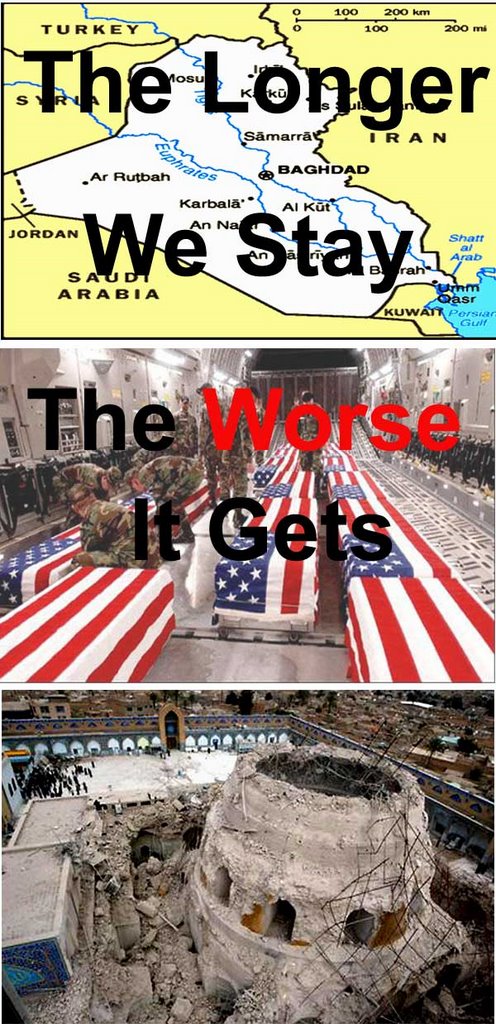
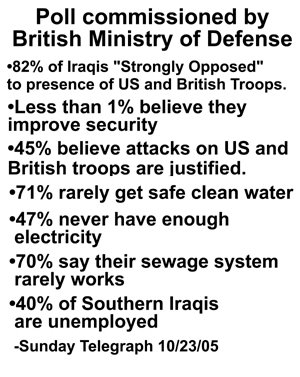
After 3 years of war in Iraq, it is abundantly clear that the occupation is actually making the situation worse. Last fall the British commissioned a poll that showed that 82% of Iraqis want our troops to leave. A recent poll of US soldiers there shows that over 70% think we should leave. Why? because they know that our presence is not helping.
The level of violence continues to increase. There are more attacks and reprisals every day, Amnesty International and others have documented continuing torture in American and Iraq government prisons. Death squads kill with impunity. Ordinary people are scared to go out on the streets due to the general lack of security. Basic services such as clean water and electricity are in very short supply. Promises of reconstruction remain mostly unfulfilled. Most people there blame the Americans.
Extremists are using the anger most people there feel at the mess to increase their own power. Ethnic Cleansing and Civil War are looking more and more likely. Rumsfeld says that the US would stay out of a civil way but it is hard to see how that would be possible.
In short, the first thing we need to do to improve the situation in Iraq is to leave. This will lower the level of tension and cut off support for the insurgency by removing their best recruiting tool, occupying Americans. Only then can the conditions for a settlement between all the parties be created.
February 01, 2006
Tridents at Indian Island
I live in Port Townsend, Washington, near the Indian Island Naval Magazine, the largest munitions depot on the West Coast. Many of the munitions headed for Iraq are loaded here. Not much further away is the Trident Submarine Base in Bangor, WA. Up until now, the Tridents have been exclusively a platform for nuclear missiles. The Navy is now retrofitting some of them to be able to launch cruise missiles, with either conventional high explosives or nuclear warheads. The conventional weapons will be loaded here at Indian Island. After years of refusing to discuss where nuclear weapons are stored, the Navy has said that nuclear weapons will not be loaded at Indian Island. This statement is apparently in response to local protests against the base.
The rest of this article originally appeared as a letter to the Editor in the Jefferson County Leader.
Bringing Trident submarines to Indian Island will not significantly change anything there. It will continue to be the major port used for shipping weapons from the West Coast. It is, however, a disturbing indication of the way our military will be used in the coming years. The Tridents that will be coming here are being refitted to carry cruise missiles, which are capable of carrying either conventional warheads or tactical nuclear weapons. The idea is to allow the submarine to creep up near any coast in the world and launch missiles that could reach their target within minutes. They are also rigged to put ashore commando units, in secret, anywhere they want. Submarines are used for this kind of mission, because, unlike other kinds of forces, they are largely invisible. Covert missions are used to carry out policies without the knowledge or consent of the American people.
The Administration has asserted the right to attack anybody, anytime, anywhere in the name of the "War on Terror". These subs are just the tool they need to do that. Judging by their record so far, most of those missiles will be hitting innocent people who are unlucky enough to be in the wrong place at the wrong time. These attacks will only fuel anti-American feelings.
Even worse, Bush clearly would like to be able use "limited" nuclear weapons in some situations. A nuclear warhead on a cruise missile launched from a Trident without warning only a few minutes from its target would be both devastating and destabilizing. How can we expect other countries to refrain from developing or using nuclear weapons when we keep a huge arsenal of our own and assert our right to bomb anybody we choose?
The rest of this article originally appeared as a letter to the Editor in the Jefferson County Leader.
Bringing Trident submarines to Indian Island will not significantly change anything there. It will continue to be the major port used for shipping weapons from the West Coast. It is, however, a disturbing indication of the way our military will be used in the coming years. The Tridents that will be coming here are being refitted to carry cruise missiles, which are capable of carrying either conventional warheads or tactical nuclear weapons. The idea is to allow the submarine to creep up near any coast in the world and launch missiles that could reach their target within minutes. They are also rigged to put ashore commando units, in secret, anywhere they want. Submarines are used for this kind of mission, because, unlike other kinds of forces, they are largely invisible. Covert missions are used to carry out policies without the knowledge or consent of the American people.
The Administration has asserted the right to attack anybody, anytime, anywhere in the name of the "War on Terror". These subs are just the tool they need to do that. Judging by their record so far, most of those missiles will be hitting innocent people who are unlucky enough to be in the wrong place at the wrong time. These attacks will only fuel anti-American feelings.
Even worse, Bush clearly would like to be able use "limited" nuclear weapons in some situations. A nuclear warhead on a cruise missile launched from a Trident without warning only a few minutes from its target would be both devastating and destabilizing. How can we expect other countries to refrain from developing or using nuclear weapons when we keep a huge arsenal of our own and assert our right to bomb anybody we choose?
July 17, 2005
Root Out the Evil
In Kathleen Parker’s Sunday (7/17/05) column in the Seattle Post-Intelligencer, “Modern Muslims must root out the evil”, Ms. Parker asserts that “moderate Muslims must be unrelenting in eliminating - not just condemning - Islam’s bad actors.” If that is so, then it also follows that Americans must be unrelenting in eliminating our own bad actors. Of course, our bad actors don’t support suicide bombers. They don’t have to because they have airplanes to drop the bombs, but the civilians are just as dead and their friends and families are just as grief-stricken. Whether they were killed by a stray bomb, or by a scared American soldier pulling the trigger a little too quickly at a checkpoint, or indeed by punitive sanctions during the 90s that never hurt Saddam Hussein but denied food, medicine and safe drinking water to the Iraqi population, far more innocent people have been killed by the US government than by terrorists.
You may argue that this is war and different standards apply. If so it is a war that was never declared. Congressional authorization was based on deliberate lies by an Administration that was determined, as the Downing Street Memo tells us, to make the intelligence fit the predetermined policy. The President’s justification for the war has changed with the political climate. Whether he is fighting to eliminate WMDs or to bring democracy to the Middle East or to “fight the terrorists over there so we don’t have to fight them here”, it doesn’t hold water.
If the US is fighting a war, then it follows that its enemies are also fighting a war. Al Quaida issued a declaration of war against the United States several years ago and they refer to their attacks as military operations. I don’t have any special insight into their thoughts but perhaps they see their attacks as similar to, on a much smaller scale, the strategic bombing of English, German and Japanese cities in WWII by all sides. In that case, civilians were seen as participants because of their support for their government’s war effort and the hope was that civilian casualties would undermine that support.
According to this morning’s paper, 1,763 American soldiers have been killed in Iraq. Thousands more have been injured and hundreds of thousands of Iraqis have been killed and injured. The occupation is widely hated and is used as a justification for continued insurgent attacks. The situation continues to deteriorate. Those who hope for a civil war are winning the battle. One can’t help but think that the American occupation is making things worse. Surely there must be an alternative but George Bush’s insistence that he cannot possibly have been wrong in any way stands in the way of finding a way out. Most Americans agree that the war was a mistake. Many have come to the conclusion that the road to peace starts with American withdrawal. That will undercut the appeal of the insurgency and open the door to negotiation among Iraqis. Perhaps peacekeepers can be recruited from other Arab countries as a transitional measure. One thing is certain. It is time to bring our troops home.
Those of us who believe this have an obligation not just to condemn this war but to act to end it. Letters and phone calls to our Senators and Congressional Representatives may prod them to action. Talking to our friends and writing letters to the editor can get more people involved. Join an organization working for peace. Demonstrate.
Go to Washington, DC for the September 24-26 massive mobilization against the war.
Bring the Troops Home.
You may argue that this is war and different standards apply. If so it is a war that was never declared. Congressional authorization was based on deliberate lies by an Administration that was determined, as the Downing Street Memo tells us, to make the intelligence fit the predetermined policy. The President’s justification for the war has changed with the political climate. Whether he is fighting to eliminate WMDs or to bring democracy to the Middle East or to “fight the terrorists over there so we don’t have to fight them here”, it doesn’t hold water.
If the US is fighting a war, then it follows that its enemies are also fighting a war. Al Quaida issued a declaration of war against the United States several years ago and they refer to their attacks as military operations. I don’t have any special insight into their thoughts but perhaps they see their attacks as similar to, on a much smaller scale, the strategic bombing of English, German and Japanese cities in WWII by all sides. In that case, civilians were seen as participants because of their support for their government’s war effort and the hope was that civilian casualties would undermine that support.
According to this morning’s paper, 1,763 American soldiers have been killed in Iraq. Thousands more have been injured and hundreds of thousands of Iraqis have been killed and injured. The occupation is widely hated and is used as a justification for continued insurgent attacks. The situation continues to deteriorate. Those who hope for a civil war are winning the battle. One can’t help but think that the American occupation is making things worse. Surely there must be an alternative but George Bush’s insistence that he cannot possibly have been wrong in any way stands in the way of finding a way out. Most Americans agree that the war was a mistake. Many have come to the conclusion that the road to peace starts with American withdrawal. That will undercut the appeal of the insurgency and open the door to negotiation among Iraqis. Perhaps peacekeepers can be recruited from other Arab countries as a transitional measure. One thing is certain. It is time to bring our troops home.
Those of us who believe this have an obligation not just to condemn this war but to act to end it. Letters and phone calls to our Senators and Congressional Representatives may prod them to action. Talking to our friends and writing letters to the editor can get more people involved. Join an organization working for peace. Demonstrate.
Go to Washington, DC for the September 24-26 massive mobilization against the war.
Bring the Troops Home.
February 11, 2005
Same Day Voter Registration Can Boost Participation
Voter turnout in the United States is among the lowest in the world. When people don't participate in the system, they tend to have less confidence in the political decisions that result.
Restrictive voter registration requirements make it difficult for many to vote. As usual, poor people have a harder time of it. Poor people tend to have less stable living arrangements and may have to move more often. Actually, anybody who moves is going to have a lot going on in their lives. Updating their voter registration may not be their top priority.
There have been efforts to simplify the process. Motor Voter laws that allow you to register to vote when you get a driver's license are one example. Mail in registration is another. Voting by mail works for many people.
Most states cut off voter registration about a month before the election. This is so the election department has time to compile and print up comprehensive lists ready to use on election day. But, this is just when things are getting interesting and new voters are most motivated to get involved. In Washington, mail in registrations have that 30 day cut off but a voter can register in person at their county auditor's office for another two weeks. Curiously, I was told at my local Auditor's office that a completed form from a voter registration drive turned in to the auditor by anyone other than the voter was considered a mail in registration and did not qualify for the extra time even though they had it in hand. I never did understand why it made a difference who handed the form over the counter. Certainly it is confusing and disappointing to a citizen who finally gets motivated to vote, only to be told that they missed the deadline.
Currently six states (Wisconsin, Minnesota, Idaho and 3 others) get around this problem by allowing election day registration. North Dakota abolished voter registration altogether 50 years ago. These states show higher rates of voter participation than the rest of the country. An analysis of voting trends from 1996-2000 showed the greatest increase in turnout in the states that have same day registration. When a 2002 Harris poll asked what would help get them to the polls, non-voters ranked same day registration at the top of the list.
Objectors to same day registration claim that it would promote voter fraud, but this has not been borne out by the experience of those states that use it. Voters are required to sign an affidavit that they are qualified to vote and show proof of identity and residence. This is basically the same as for advance registration. If there are concerns about somebody voting twice, same day registrants can be given a provisional ballot that will be counted after a cross-check of records show that there is no duplication. In fact, a better system for checking on eligibility could actually reduce fraud. Perhaps we could look towards Afghanistan and Iraq and use the finger dipped in indelible ink system to prevent double voting.
Following North Dakota's lead and abolishing voter registration would save the money currently spent on maintaining those records. Since it would also require each voter to show their current residence when they vote, it would automatically eliminate the problem of people neglecting to update their registration.
With voter confidence in the integrity of our electoral processes waning and budget shortfalls challenging us to find more efficient ways to operate our local governments, now is a great time to look into some form of same day voter registration.
Restrictive voter registration requirements make it difficult for many to vote. As usual, poor people have a harder time of it. Poor people tend to have less stable living arrangements and may have to move more often. Actually, anybody who moves is going to have a lot going on in their lives. Updating their voter registration may not be their top priority.
There have been efforts to simplify the process. Motor Voter laws that allow you to register to vote when you get a driver's license are one example. Mail in registration is another. Voting by mail works for many people.
Most states cut off voter registration about a month before the election. This is so the election department has time to compile and print up comprehensive lists ready to use on election day. But, this is just when things are getting interesting and new voters are most motivated to get involved. In Washington, mail in registrations have that 30 day cut off but a voter can register in person at their county auditor's office for another two weeks. Curiously, I was told at my local Auditor's office that a completed form from a voter registration drive turned in to the auditor by anyone other than the voter was considered a mail in registration and did not qualify for the extra time even though they had it in hand. I never did understand why it made a difference who handed the form over the counter. Certainly it is confusing and disappointing to a citizen who finally gets motivated to vote, only to be told that they missed the deadline.
Currently six states (Wisconsin, Minnesota, Idaho and 3 others) get around this problem by allowing election day registration. North Dakota abolished voter registration altogether 50 years ago. These states show higher rates of voter participation than the rest of the country. An analysis of voting trends from 1996-2000 showed the greatest increase in turnout in the states that have same day registration. When a 2002 Harris poll asked what would help get them to the polls, non-voters ranked same day registration at the top of the list.
Objectors to same day registration claim that it would promote voter fraud, but this has not been borne out by the experience of those states that use it. Voters are required to sign an affidavit that they are qualified to vote and show proof of identity and residence. This is basically the same as for advance registration. If there are concerns about somebody voting twice, same day registrants can be given a provisional ballot that will be counted after a cross-check of records show that there is no duplication. In fact, a better system for checking on eligibility could actually reduce fraud. Perhaps we could look towards Afghanistan and Iraq and use the finger dipped in indelible ink system to prevent double voting.
Following North Dakota's lead and abolishing voter registration would save the money currently spent on maintaining those records. Since it would also require each voter to show their current residence when they vote, it would automatically eliminate the problem of people neglecting to update their registration.
With voter confidence in the integrity of our electoral processes waning and budget shortfalls challenging us to find more efficient ways to operate our local governments, now is a great time to look into some form of same day voter registration.
February 04, 2005
Election Reform is Urgent
The irregularities, machine failures, paperless ballots,
disenfranchisement, lack of transparency, and a host of other issues in
the 2000 and 2004 elections underscore an electoral crisis that needs to
be fixed right away. Americans are losing confidence in the integrity of
our electoral system, and with good reason.
The Washington recount taught us some important lessons. First of all,
counties that used black box electronic voting machines had no way to
recount or validate their vote totals. We have to take their results on
faith. At the very least, machines should produce paper ballots for a
manual recount and for routine audits of results. It is extremely
disturbing to see proposed legislation (HB-1025) moving the deadline for
requiring electronic voting machines to produce a paper record of all
votes back from 2006 to 2007. Furthermore, this legislation would permit
the substitution of auditing software for an actual paper ballot. This
approach makes the problem worse, not better. What we need instead are
machines that produce paper ballots and a system to routinely audit the
results by comparing the machine results to the paper ballots in
randomly selected areas. If there is a significant difference, then more
investigation will be required, up to a full manual recount.
These machines are also lacking in security measures. A credit card
transaction on the internet is protected much better than our voting
machines. Voting machines are in many cases connected by modem.
Experienced hackers could obtain access by calling the modem. A small
group of hackers, or a single individual could alter the results in
hundreds of locations by as many votes as they thought they could get
away with. We donít know if this has actually happened but if it did, we
might never find out.
Second, there are counties still using punch cards. Punch cards are
notoriously prone to error. Voters have a hard time verifying that they
actually voted the way they intended. Hand counted paper ballots used to
be used everywhere and provide the greatest confidence in the integrity
of the system. Optical scan ballots are easy to mark and easy to read.
Voters can verify that they didnít make any mistakes before they turn in
their ballot and they can be easily recounted if necessary. Of course,
as with any voting system, there ought to be a routine audit as part of
the certification process to make sure that the count is accurate.
Machines are limited in their ability to interpret votes that any person
would understand instantly. For instance, a voter unfamiliar with
optical scan might circle their choice rather than fill in the little
blip or a punch card machine might leave a hanging or a pregnant chad.
The right to vote should not be denied due to a computerís limitations.
Third, there ought to be a guarantee that absentee ballots and
provisional ballots are actually counted. We saw during the recount that
these ballots are treated very differently in different counties. No
registration or vote should be disqualified without notifying the voter
of the problem and giving them an opportunity to correct the problem.
Provisional ballots were intended to insure that all voters will have a
opportunity to vote and have that vote counted. When a provisional
ballot is needed, it should trigger an investigation of what went wrong,
so that voting and registration procedures can be improved.
We call ourselves the greatest democracy in the world. We owe our
country no less than to make it so.
(Dan Goldstein lives in Port Townsend and is a member of Concerned
Voters of Jefferson County)
(Originally published as an Op-Ed in the Seattle Post Intelligencer)
disenfranchisement, lack of transparency, and a host of other issues in
the 2000 and 2004 elections underscore an electoral crisis that needs to
be fixed right away. Americans are losing confidence in the integrity of
our electoral system, and with good reason.
The Washington recount taught us some important lessons. First of all,
counties that used black box electronic voting machines had no way to
recount or validate their vote totals. We have to take their results on
faith. At the very least, machines should produce paper ballots for a
manual recount and for routine audits of results. It is extremely
disturbing to see proposed legislation (HB-1025) moving the deadline for
requiring electronic voting machines to produce a paper record of all
votes back from 2006 to 2007. Furthermore, this legislation would permit
the substitution of auditing software for an actual paper ballot. This
approach makes the problem worse, not better. What we need instead are
machines that produce paper ballots and a system to routinely audit the
results by comparing the machine results to the paper ballots in
randomly selected areas. If there is a significant difference, then more
investigation will be required, up to a full manual recount.
These machines are also lacking in security measures. A credit card
transaction on the internet is protected much better than our voting
machines. Voting machines are in many cases connected by modem.
Experienced hackers could obtain access by calling the modem. A small
group of hackers, or a single individual could alter the results in
hundreds of locations by as many votes as they thought they could get
away with. We donít know if this has actually happened but if it did, we
might never find out.
Second, there are counties still using punch cards. Punch cards are
notoriously prone to error. Voters have a hard time verifying that they
actually voted the way they intended. Hand counted paper ballots used to
be used everywhere and provide the greatest confidence in the integrity
of the system. Optical scan ballots are easy to mark and easy to read.
Voters can verify that they didnít make any mistakes before they turn in
their ballot and they can be easily recounted if necessary. Of course,
as with any voting system, there ought to be a routine audit as part of
the certification process to make sure that the count is accurate.
Machines are limited in their ability to interpret votes that any person
would understand instantly. For instance, a voter unfamiliar with
optical scan might circle their choice rather than fill in the little
blip or a punch card machine might leave a hanging or a pregnant chad.
The right to vote should not be denied due to a computerís limitations.
Third, there ought to be a guarantee that absentee ballots and
provisional ballots are actually counted. We saw during the recount that
these ballots are treated very differently in different counties. No
registration or vote should be disqualified without notifying the voter
of the problem and giving them an opportunity to correct the problem.
Provisional ballots were intended to insure that all voters will have a
opportunity to vote and have that vote counted. When a provisional
ballot is needed, it should trigger an investigation of what went wrong,
so that voting and registration procedures can be improved.
We call ourselves the greatest democracy in the world. We owe our
country no less than to make it so.
(Dan Goldstein lives in Port Townsend and is a member of Concerned
Voters of Jefferson County)
(Originally published as an Op-Ed in the Seattle Post Intelligencer)
April 15, 2004
Resolution on Iraq
Proposed at the Jefferson County, Washington Democratic Party Convention
Whereas President George W Bush led us into war in Iraq under false pretenses, asserting an imminent danger from Iraq's supposed weapons of mass destruction and links to terrorism, which did not, in fact exist;
Whereas terrorists such as Al Quaeda hope to inflame passions against the United States and are benefiting through increased recruitment and support as a direct result of the destruction and suffering caused by the war, thus increasing the threat of terrorism;
Whereas the occupation is not moving Iraq towards democracy and stability but into a cycle of violence and counter violence in which American troops are opposed by increasing numbers of Iraqis;
Whereas the billions of dollars that are being spent on the war increases the US budget deficit, harms the economy and diverts funds from beneficial purposes;
Therefore be it resolved that we urge the United States government to ask the United Nations to draw up and implement a plan to:
.Withdraw all American troops from Iraq;
.Establish a transitional international peacekeeping force to protect the public until Iraqis can assume that function;
.Hold elections and handle the transition to a democratically elected Iraqi government.
Be it further resolved that the United States should assume a major portion of the cost of the UN Peacekeeping force and the reconstruction of Iraq while leaving the United Nations in control of the transition to Iraqi self government, reconstruction contracts and economic policy during the transitional period.
(This resolution along with all other resolutions proposed was passed along to the State Convention without comment or discussion)
Whereas President George W Bush led us into war in Iraq under false pretenses, asserting an imminent danger from Iraq's supposed weapons of mass destruction and links to terrorism, which did not, in fact exist;
Whereas terrorists such as Al Quaeda hope to inflame passions against the United States and are benefiting through increased recruitment and support as a direct result of the destruction and suffering caused by the war, thus increasing the threat of terrorism;
Whereas the occupation is not moving Iraq towards democracy and stability but into a cycle of violence and counter violence in which American troops are opposed by increasing numbers of Iraqis;
Whereas the billions of dollars that are being spent on the war increases the US budget deficit, harms the economy and diverts funds from beneficial purposes;
Therefore be it resolved that we urge the United States government to ask the United Nations to draw up and implement a plan to:
.Withdraw all American troops from Iraq;
.Establish a transitional international peacekeeping force to protect the public until Iraqis can assume that function;
.Hold elections and handle the transition to a democratically elected Iraqi government.
Be it further resolved that the United States should assume a major portion of the cost of the UN Peacekeeping force and the reconstruction of Iraq while leaving the United Nations in control of the transition to Iraqi self government, reconstruction contracts and economic policy during the transitional period.
(This resolution along with all other resolutions proposed was passed along to the State Convention without comment or discussion)
June 05, 2003
The FCC - A Modest Proposal
The airwaves belong to the people. It is unfortunate, to say the least, that the only way to obtain a license to use those airwaves, in a major market, is to buy a license for millions, sometimes hundreds of millions of dollars. Broadcasting becomes the exclusive prerogative of the rich.
The law provides for broadcast licenses to be issued for a limited period of time. Currently, the term is 8 years, at the end of which time it is always renewed. In theory there is a possibility that in extreme cases of misuse of this public resource, the license could be taken away. Public comments can be taken, a process is followed, but the assumption is that the license will be renewed.
The result is that it is practically impossible for someone new to start a station. All the frequencies are already taken. (Qualification - there are some parts of the country with a few available frequencies, just not where most people live.)* If you had the foresight to grab a license back at the beginning of time, then you are in clover. If not, then you have to buy an existing license. Prices get into the hundreds of millions of dollars, if you can find somebody who is willing to sell. Many licensees are in it primarily to speculate in the price of the license. Any interest to actually run a station is secondary. (I can't substantiate that statement. It goes to the state of mind of a corporation. However, with rising purchase prices for licenses, appreciation of license value represents an opportunity that corporations simply cannot ignore. If speculation in licenses makes them more money than actually running the stations then it is only natural that that will be their major interest.)
So, given this situation, monopolization of the market by a few mega-corporations is practically inevitable. Nobody else can afford to break in. It is profoundly undemocratic and all the worse since it is the public's resource. Congress and the FCC are supposed to protect the public interest but they have been reducing their restrictions and oversight. They are actually protecting the interests of the monopolists.
Now for my proposal. We can change this situation and restore the airwaves to the public, increasing diversity and promoting the free flow of ideas essential to a democracy. All it takes is a small change of emphasis and a huge change of attitude.
What would happen if the license were to actually expire at the end of its term? It would not be automatically renewed, in fact it wouldn't be renewed at all. Somebody else would get a chance to broadcast. Speculation in licenses would end. Since it would expire in a few years, its value would be greatly reduced. In fact, we might want to forbid the sale of a license. If a licensee didn't want it, they could turn it back to the FCC to be reassigned. There are lots of people who would want the chance to broadcast, if only they could get a license. The FCC says as much on their website. In fact, that is what drives the speculation in licenses.
When a license expires it will need to be reassigned. The fairest way to do that would be a lottery. The current FCC assumption that the applicant with the most money is to be favored** has no basis and is profoundly anti-democratic. Many small stations do just fine with quite modest budgets. Actually, with less money tied up in the license, there should be more money available for equipment and programming.
When a broadcaster gives up their license, they would still be eligible to try to get a new one for the same frequency, or a different one, on an equal basis with everybody else. They could sell their equipment to the next licensee, or equipment could be leased for the term of the license.
The public would have to get used to a constantly changing array of broadcast stations. Some might not like losing their favorite station, but certainly many people lose their favorite stations today. Stations are bought or just change their format and programs all the time. You can take it for granted that nothing lasts. At least with new stations coming on the air all the time with a variety of programming choices, we should have a good chance of finding something else to our liking. We will be forced to seek out new sources for news and entertainment, which will help nurture the free and diverse flow of information our democracy needs.
The transition will be difficult. Current owners will not be happy to give up their monopolies. A broadcaster who has huge amounts of money tied up in their license will not like to hear that it has no resale value. Perhaps there could be some ameliorative measures but it is not always in the public interest to protect speculators when their investments go bad. It is, after all, necessary to reform the system precisely because the public interest has been abused.
I have no illusion that this is a perfect system. Perhaps there are negative aspects I haven't thought of, or further refinements that will be needed to prevent abuse. Certainly it can use more study and contributions from many people. I do think that we need to think about how to restore democracy to our public airwaves and not just react to each new outrage as it occurs.
*see the FCC website: http://www.fcc.gov/mb/audio/getstat.html. "Potential applicants for radio and television services should be aware that frequencies for these services are always in heavy demand. For example, the Commission received approximately 30,000 inquiries from persons seeking to start radio broadcast stations last year. Where broadcast frequencies remain available, competing applications are routinely received. Thus, you are cautioned at the outset that the filing of an application does not guarantee that you will receive a broadcast station construction permit. You should also be aware that in many areas of the country, no frequencies may be available on which a new station could commence operating without causing interference to existing stations, which would violate FCC rules. For that reason, we do not recommend that you purchase any equipment before receiving a construction permit from the FCC."
**see the FCC website: http://wireless.fcc.gov/auctions/about/index.html where they assert that the willingness to pay more means that the license will be used more effectively - "The auction approach is intended to award the licenses to those who will use them most effectively." and on http://wireless.fcc.gov/auctions/about/auctiondesigns.html, "This provides information about the value of the licenses to all bidders and increases the likelihood that the licenses will be assigned to the bidders who value them the most."
The law provides for broadcast licenses to be issued for a limited period of time. Currently, the term is 8 years, at the end of which time it is always renewed. In theory there is a possibility that in extreme cases of misuse of this public resource, the license could be taken away. Public comments can be taken, a process is followed, but the assumption is that the license will be renewed.
The result is that it is practically impossible for someone new to start a station. All the frequencies are already taken. (Qualification - there are some parts of the country with a few available frequencies, just not where most people live.)* If you had the foresight to grab a license back at the beginning of time, then you are in clover. If not, then you have to buy an existing license. Prices get into the hundreds of millions of dollars, if you can find somebody who is willing to sell. Many licensees are in it primarily to speculate in the price of the license. Any interest to actually run a station is secondary. (I can't substantiate that statement. It goes to the state of mind of a corporation. However, with rising purchase prices for licenses, appreciation of license value represents an opportunity that corporations simply cannot ignore. If speculation in licenses makes them more money than actually running the stations then it is only natural that that will be their major interest.)
So, given this situation, monopolization of the market by a few mega-corporations is practically inevitable. Nobody else can afford to break in. It is profoundly undemocratic and all the worse since it is the public's resource. Congress and the FCC are supposed to protect the public interest but they have been reducing their restrictions and oversight. They are actually protecting the interests of the monopolists.
Now for my proposal. We can change this situation and restore the airwaves to the public, increasing diversity and promoting the free flow of ideas essential to a democracy. All it takes is a small change of emphasis and a huge change of attitude.
What would happen if the license were to actually expire at the end of its term? It would not be automatically renewed, in fact it wouldn't be renewed at all. Somebody else would get a chance to broadcast. Speculation in licenses would end. Since it would expire in a few years, its value would be greatly reduced. In fact, we might want to forbid the sale of a license. If a licensee didn't want it, they could turn it back to the FCC to be reassigned. There are lots of people who would want the chance to broadcast, if only they could get a license. The FCC says as much on their website. In fact, that is what drives the speculation in licenses.
When a license expires it will need to be reassigned. The fairest way to do that would be a lottery. The current FCC assumption that the applicant with the most money is to be favored** has no basis and is profoundly anti-democratic. Many small stations do just fine with quite modest budgets. Actually, with less money tied up in the license, there should be more money available for equipment and programming.
When a broadcaster gives up their license, they would still be eligible to try to get a new one for the same frequency, or a different one, on an equal basis with everybody else. They could sell their equipment to the next licensee, or equipment could be leased for the term of the license.
The public would have to get used to a constantly changing array of broadcast stations. Some might not like losing their favorite station, but certainly many people lose their favorite stations today. Stations are bought or just change their format and programs all the time. You can take it for granted that nothing lasts. At least with new stations coming on the air all the time with a variety of programming choices, we should have a good chance of finding something else to our liking. We will be forced to seek out new sources for news and entertainment, which will help nurture the free and diverse flow of information our democracy needs.
The transition will be difficult. Current owners will not be happy to give up their monopolies. A broadcaster who has huge amounts of money tied up in their license will not like to hear that it has no resale value. Perhaps there could be some ameliorative measures but it is not always in the public interest to protect speculators when their investments go bad. It is, after all, necessary to reform the system precisely because the public interest has been abused.
I have no illusion that this is a perfect system. Perhaps there are negative aspects I haven't thought of, or further refinements that will be needed to prevent abuse. Certainly it can use more study and contributions from many people. I do think that we need to think about how to restore democracy to our public airwaves and not just react to each new outrage as it occurs.
*see the FCC website: http://www.fcc.gov/mb/audio/getstat.html. "Potential applicants for radio and television services should be aware that frequencies for these services are always in heavy demand. For example, the Commission received approximately 30,000 inquiries from persons seeking to start radio broadcast stations last year. Where broadcast frequencies remain available, competing applications are routinely received. Thus, you are cautioned at the outset that the filing of an application does not guarantee that you will receive a broadcast station construction permit. You should also be aware that in many areas of the country, no frequencies may be available on which a new station could commence operating without causing interference to existing stations, which would violate FCC rules. For that reason, we do not recommend that you purchase any equipment before receiving a construction permit from the FCC."
**see the FCC website: http://wireless.fcc.gov/auctions/about/index.html where they assert that the willingness to pay more means that the license will be used more effectively - "The auction approach is intended to award the licenses to those who will use them most effectively." and on http://wireless.fcc.gov/auctions/about/auctiondesigns.html, "This provides information about the value of the licenses to all bidders and increases the likelihood that the licenses will be assigned to the bidders who value them the most."
December 15, 2002
Dear Al Gore
Dear Al,
I've been thinking about you since I just read a couple of articles by Sarah Vowell about you, about how you were too smart, too nerdy for today's politics and what a shame that is.
I have also listened to sound bites from the last few months, in which you have been critical of the impending war and of Republican economic policies. I have to say that you sounded pretty good. You didn't hedge your bets or worry about offending somebody every time you opened your mouth. What a refreshing change from practically every politician in the country, especially the Democrats. How are the Democrats going to attract support if they don't stand for anything?
Well, I just heard that you decided not to run for President. Probably a smart move. You would have been attacked from all sides and advised to death by well meaning consultants. Your strong direct appealing words wouldn't have lasted long.
You know, I am still furious over the way you blew the 2000 election. Oh, I know that you got more votes and really did win but it shouldn't even have been close. I know you are capable of delivering a strong, passionate message. At the convention and again the day before the election you made speeches that talked about empowering ordinary people and outlining the real differences between Democrats and Republicans. You made me want to support you then. Unfortunately, the rest of the campaign was so lackluster that even when you were right, you failed to engage me or make me want to vote. I would have voted for Nader if my state hadn't been so evenly divided. What almost saved you was fear of what Bush would do. We had no idea, of course, but what we did know was bad enough.
Now we see a President out of control. Republicans are on the attack, with an unabashed policy of enriching the rich with no controls, no thought for the rest of us. Democrats range from cheerleaders for the Republicans to silence. Nobody will say a thing in favor of the majority, the non-millionaires.
And yet, people are acting. Quietly organizing, publicly demonstrating. During the debate in Congress on the resolution authorizing attacking Iraq, representatives received thousands of letters opposed. They were deluged by opposition but most of them wouldn't go against the tide. There is no integrity in the process.
Nowhere is this clearer than in the responses, or lack thereof, to Trent Lott. The Senate Majority Leader, of course, said that he wished that Strom Thurmond's segregationist campaign for President in 1948 had succeeded. He couldn't have been clearer in his support for the policies that Thurmond espoused in that campaign. Thurmond was absolutely opposed to Civil Rights, just as Lott has consistently, in word and deed, opposed Civil Rights legislation. His statement last week showed that he still holds these views. There is no other way to understand it. At first, even the Democratic leadership said nothing, or tried to explain that Lott didn't really mean it. Nobody pressed Lott to explain exactly what he did mean. They only criticized him when it became clear that it would be politically advantageous to do so. And then they said as little as possible. They rushed to accept his apology that managed to not actually apologize for anything. This is the way they do things. They have to be forced to take a stand. Otherwise they just go right along with the corporatism that is rampant today.
I don't know what to do. Do we go Green? Do we try to take back the Democratic Party? Maybe we need a Gene McCarthy to really challenge the leadership and rally the opposition.
I've been thinking about you since I just read a couple of articles by Sarah Vowell about you, about how you were too smart, too nerdy for today's politics and what a shame that is.
I have also listened to sound bites from the last few months, in which you have been critical of the impending war and of Republican economic policies. I have to say that you sounded pretty good. You didn't hedge your bets or worry about offending somebody every time you opened your mouth. What a refreshing change from practically every politician in the country, especially the Democrats. How are the Democrats going to attract support if they don't stand for anything?
Well, I just heard that you decided not to run for President. Probably a smart move. You would have been attacked from all sides and advised to death by well meaning consultants. Your strong direct appealing words wouldn't have lasted long.
You know, I am still furious over the way you blew the 2000 election. Oh, I know that you got more votes and really did win but it shouldn't even have been close. I know you are capable of delivering a strong, passionate message. At the convention and again the day before the election you made speeches that talked about empowering ordinary people and outlining the real differences between Democrats and Republicans. You made me want to support you then. Unfortunately, the rest of the campaign was so lackluster that even when you were right, you failed to engage me or make me want to vote. I would have voted for Nader if my state hadn't been so evenly divided. What almost saved you was fear of what Bush would do. We had no idea, of course, but what we did know was bad enough.
Now we see a President out of control. Republicans are on the attack, with an unabashed policy of enriching the rich with no controls, no thought for the rest of us. Democrats range from cheerleaders for the Republicans to silence. Nobody will say a thing in favor of the majority, the non-millionaires.
And yet, people are acting. Quietly organizing, publicly demonstrating. During the debate in Congress on the resolution authorizing attacking Iraq, representatives received thousands of letters opposed. They were deluged by opposition but most of them wouldn't go against the tide. There is no integrity in the process.
Nowhere is this clearer than in the responses, or lack thereof, to Trent Lott. The Senate Majority Leader, of course, said that he wished that Strom Thurmond's segregationist campaign for President in 1948 had succeeded. He couldn't have been clearer in his support for the policies that Thurmond espoused in that campaign. Thurmond was absolutely opposed to Civil Rights, just as Lott has consistently, in word and deed, opposed Civil Rights legislation. His statement last week showed that he still holds these views. There is no other way to understand it. At first, even the Democratic leadership said nothing, or tried to explain that Lott didn't really mean it. Nobody pressed Lott to explain exactly what he did mean. They only criticized him when it became clear that it would be politically advantageous to do so. And then they said as little as possible. They rushed to accept his apology that managed to not actually apologize for anything. This is the way they do things. They have to be forced to take a stand. Otherwise they just go right along with the corporatism that is rampant today.
I don't know what to do. Do we go Green? Do we try to take back the Democratic Party? Maybe we need a Gene McCarthy to really challenge the leadership and rally the opposition.
November 10, 2002
The Stock Market as a Ponzi Scheme FAQs
The more I think about this, I feel like some paranoid nut spouting conspiracy theories. The problem is that for the life of me I can't find the flaw in my logic. Since the stock market bubble burst, with so many CEOs and other executives coincidentally cashing in their stock just before the crash, I have noted some similarities with the classic Ponzi or pyramid scheme. I have not been alone in this. However, as I consider the matter carefully, I can't see any important difference at all. The inescapable conclusion is that the stock market, as it operates today, is a pyramid scheme that would be shut down in a minute if somebody tried to start it up as a new enterprise. The plan to divert Social Security money into the stock market lends a new urgency to this question.
I found this definition of a pyramid scheme on the SEC Web site.
"In the classic "pyramid" scheme, participants attempt to make money solely by recruiting new participants into the program. The hallmark of these schemes is the promise of sky-high returns in a short period of time for doing nothing other than handing over your money and getting others to do the same.
The fraudsters behind a pyramid scheme may go to great lengths to make the program look like a legitimate multi-level marketing program. But despite their claims to have legitimate products or services to sell, these fraudsters simply use money coming in from new recruits is used to pay off early stage investors. But eventually the pyramid will collapse. At some point the schemes get too big, the promoter cannot raise enough money from new investors to pay earlier investors, and many people lose their money."
Consider then how the stock market operates. Read the above paragraphs substituting "stock Market" for "pyramid scheme". Investors are lured into the market with the prospect of high returns. What you hope for is that lots of other people will want to buy the same thing that you got, thus driving the price up. What you buy is nothing that is of value in and of itself. You can't eat it or fix your house with it or enjoy its beauty. You just hope that new participants are recruited into the scheme so you can sell out at a profit.
Stock Market Ponzi FAQs:
Q: Don't you own a share of the company when you buy stock?
A: In theory, yes. If you are a billionaire you might own enough stock to actually control the company. Your 100 shares gets you no voice in how the company is run. The only actual right you have is the right to sell out to new recruits to the scheme.
Q: What about dividends?
A: Most companies don't pay dividends. They would rather push the stock prices up. People used to own stocks in order to share in the profits via dividends. But the dividends are mostly a small part of the reason to own stocks. We wouldn't care about the Dow if we were in it for the dividends.
Q: Don't stock offerings serve an important purpose in raising capital for companies?
A: The primary purpose of stock offerings is to create a feeding frenzy in the market, drawing in new recruits and driving the stock price up so the insiders can profit. Private channels are much more important ways to raise capital for new ventures. By the time it gets to the stock market, they are just trying to bring in the chumps.
Q: Stock prices go up when companies show a profit and down when they lose money. Doesn't this show that there is something substantial behind stock prices?
A: Hello! Where were you during the tech bubble? From Amazon.com on down, lack of profits did not dampen the rising stock prices. What investors care about is whether other investors will buy a given stock. This depends on "investor confidence". Stocks are bought and sold on a short term basis by the big investors. They will buy a stock when a company does better than expected because they expect others will do the same. This is true even if the news is that the company loses less than expected. Investors will run from a company that makes a profit but a little less than expected in a given quarter to one that loses a little less than expected but still loses.
Q: Who benefits?
A: Many ordinary Americans watched their saving skyrocket during the 90s. Some of them actually got their money out before the crash. The big winners, however, were the insider traders. Ken Lay made millions of dollars by manipulating Enron's stock price and then selling out his shares just before the crash. Although the headlines went to Enron, this pattern was not all that unusual. Many companies used "creative accounting" to lie about their profitability and lure in new investors to push the price up.
Q: They couldn't all be crooks?
A: Maybe not, but consider this. Most CEOs are paid largely in stock options. This means that they can only make obscene incomes if they drive the stock prices up. So, they will do almost anything to drive stock prices up.
Q: What happened to regulation?
A: Good Question.
Q: But seriously ...
A: OK. The SEC requires that companies submit audited financial statements. Auditors are supposed to independently evaluate management figures and give their stamp of approval only if the books really reflect reality. Auditors, such as Arthur Anderson, have found that they are under tremendous pressure from their corporate clients to rubber stamp management's claims. Companies are not eager to pay higher audit fees in order to increase the chance that an audit will come up with unfavorable results. Auditors have been fired for delving too deeply. Meanwhile the SEC is supposed to be overseeing this process and conducting its own investigations but it is underfunded, especially compared to the corporate giants they are supposed to be investigating. Under the current administration the top posts in the SEC are held by people with close ties to the corporate world who seem uninterested in meaningful regulation.
Q: How does all this affect me?
A: Most pension plans are heavily invested in the stock market, so they are vulnerable. Worse yet, companies have largely switched to 401c(3) individual investment plans that encourage us to invest our pension money ourselves. This really puts us at an unfair advantage vis a vis the "big boys". People are watching their pensions evaporating before their eyes.
Q: At least I'll have Social Security?
A: That depends on Congressional action to insure that there are actually sufficient funds available when you retire to pay your benefits. Proposals to convert a portion of Social Security into individual accounts to be invested in the stock market can be seen as another attempt to lure more chumps into the market so that they can be fleeced.
Q: Isn't that a little extreme?
A: I told you I was feeling like a paranoid nut about this. You tell me where I'm wrong.
Q: Sure, the market is down now, but it will go back up again, won't it? After all, stock prices fluctuate but over the long run they always go up.
A: Just remember that the only reason stock prices go up is that there are more buyers than sellers. As long as there are new recruits to the scheme it can keep going but as the SEC says about pyramid schemes in general, "At some point the schemes get too big, the promoter cannot raise enough money from new investors to pay earlier investors, and many people lose their money." There is nothing more substantial than a lot of PR behind it all.
I found this definition of a pyramid scheme on the SEC Web site.
"In the classic "pyramid" scheme, participants attempt to make money solely by recruiting new participants into the program. The hallmark of these schemes is the promise of sky-high returns in a short period of time for doing nothing other than handing over your money and getting others to do the same.
The fraudsters behind a pyramid scheme may go to great lengths to make the program look like a legitimate multi-level marketing program. But despite their claims to have legitimate products or services to sell, these fraudsters simply use money coming in from new recruits is used to pay off early stage investors. But eventually the pyramid will collapse. At some point the schemes get too big, the promoter cannot raise enough money from new investors to pay earlier investors, and many people lose their money."
Consider then how the stock market operates. Read the above paragraphs substituting "stock Market" for "pyramid scheme". Investors are lured into the market with the prospect of high returns. What you hope for is that lots of other people will want to buy the same thing that you got, thus driving the price up. What you buy is nothing that is of value in and of itself. You can't eat it or fix your house with it or enjoy its beauty. You just hope that new participants are recruited into the scheme so you can sell out at a profit.
Stock Market Ponzi FAQs:
Q: Don't you own a share of the company when you buy stock?
A: In theory, yes. If you are a billionaire you might own enough stock to actually control the company. Your 100 shares gets you no voice in how the company is run. The only actual right you have is the right to sell out to new recruits to the scheme.
Q: What about dividends?
A: Most companies don't pay dividends. They would rather push the stock prices up. People used to own stocks in order to share in the profits via dividends. But the dividends are mostly a small part of the reason to own stocks. We wouldn't care about the Dow if we were in it for the dividends.
Q: Don't stock offerings serve an important purpose in raising capital for companies?
A: The primary purpose of stock offerings is to create a feeding frenzy in the market, drawing in new recruits and driving the stock price up so the insiders can profit. Private channels are much more important ways to raise capital for new ventures. By the time it gets to the stock market, they are just trying to bring in the chumps.
Q: Stock prices go up when companies show a profit and down when they lose money. Doesn't this show that there is something substantial behind stock prices?
A: Hello! Where were you during the tech bubble? From Amazon.com on down, lack of profits did not dampen the rising stock prices. What investors care about is whether other investors will buy a given stock. This depends on "investor confidence". Stocks are bought and sold on a short term basis by the big investors. They will buy a stock when a company does better than expected because they expect others will do the same. This is true even if the news is that the company loses less than expected. Investors will run from a company that makes a profit but a little less than expected in a given quarter to one that loses a little less than expected but still loses.
Q: Who benefits?
A: Many ordinary Americans watched their saving skyrocket during the 90s. Some of them actually got their money out before the crash. The big winners, however, were the insider traders. Ken Lay made millions of dollars by manipulating Enron's stock price and then selling out his shares just before the crash. Although the headlines went to Enron, this pattern was not all that unusual. Many companies used "creative accounting" to lie about their profitability and lure in new investors to push the price up.
Q: They couldn't all be crooks?
A: Maybe not, but consider this. Most CEOs are paid largely in stock options. This means that they can only make obscene incomes if they drive the stock prices up. So, they will do almost anything to drive stock prices up.
Q: What happened to regulation?
A: Good Question.
Q: But seriously ...
A: OK. The SEC requires that companies submit audited financial statements. Auditors are supposed to independently evaluate management figures and give their stamp of approval only if the books really reflect reality. Auditors, such as Arthur Anderson, have found that they are under tremendous pressure from their corporate clients to rubber stamp management's claims. Companies are not eager to pay higher audit fees in order to increase the chance that an audit will come up with unfavorable results. Auditors have been fired for delving too deeply. Meanwhile the SEC is supposed to be overseeing this process and conducting its own investigations but it is underfunded, especially compared to the corporate giants they are supposed to be investigating. Under the current administration the top posts in the SEC are held by people with close ties to the corporate world who seem uninterested in meaningful regulation.
Q: How does all this affect me?
A: Most pension plans are heavily invested in the stock market, so they are vulnerable. Worse yet, companies have largely switched to 401c(3) individual investment plans that encourage us to invest our pension money ourselves. This really puts us at an unfair advantage vis a vis the "big boys". People are watching their pensions evaporating before their eyes.
Q: At least I'll have Social Security?
A: That depends on Congressional action to insure that there are actually sufficient funds available when you retire to pay your benefits. Proposals to convert a portion of Social Security into individual accounts to be invested in the stock market can be seen as another attempt to lure more chumps into the market so that they can be fleeced.
Q: Isn't that a little extreme?
A: I told you I was feeling like a paranoid nut about this. You tell me where I'm wrong.
Q: Sure, the market is down now, but it will go back up again, won't it? After all, stock prices fluctuate but over the long run they always go up.
A: Just remember that the only reason stock prices go up is that there are more buyers than sellers. As long as there are new recruits to the scheme it can keep going but as the SEC says about pyramid schemes in general, "At some point the schemes get too big, the promoter cannot raise enough money from new investors to pay earlier investors, and many people lose their money." There is nothing more substantial than a lot of PR behind it all.
November 28, 2000
Blame Florida
It is tempting to blame Bush for suing to stop the votes from being counted, or Gore for endless legal manouvering to somehow make the election come out his way, or little old ladies in Palm Beach who can manage 15 Bingo cards but couldn't figue out the ballot, or Katherine Harris for having too much make-up or the Florida Supreme Court for intervening or the US Supreme Court for intervening... The list goes on.
I blame Florida because nobody there seems to have a clue about how to hold a fair election. This is not a partisan issue because both Democrats and Republicans have built and maintained the system, if you can call it that, that failed to produce a result. We have to accept that whatever happens now, half the country is going to feel cheated. Why? Because Florida can't count votes.
How do you know who won a close election?
1) There have to be voting machines that accurately record the votes cast. Machines are necessary, whether they use gears and levers; punch cards, optical scanners or some other technology, because they are fast and generally accurate. Most ballots will be quickly and accurately read by a good machine. A bad machine, however, will lend itself to outright cheating or confused results. Machines that have been found to produce significantly inaccurate or incomplete results should be replaced. There should be a system to audit the results as part of the certification of the election. The purpose of the audit should be to verify the accuracy of whatever voting system is in use and/or to identify problems so they can be dealt with.
2) There has to be an agreement about what constitutes a vote. Clearly, if the intent of the voter can be reasonably determined, then that intent should prevail even if there are technical problems. An extraneous mark, incorrect ink color or a hanging chad should not disqualify a ballot, even if the machine can't read it. Ballots that are disqualified by the machine should be examined by a human being to determine what the intent of the voter was. This only works if the machine can flag the problem ballots so a person can find them and look at them. If there are a small number of problem ballots, it will be easy to examine each one. If there are a lot of problems, it may be indicative of problems in the machine, so they should be examined carefully and corrective action should be taken.
3) There has to be a procedure in place before the election that provides for a recount under certain well defined circumstances, such as a winning margin of less than 1/2 of 1%. Candidates also have to have the option of requesting a recount.
4) There has to be a well defined procedure for conducting a recount. The same standards should apply for the whole election. This will specifiy what gets counted, who conducts the recount and what counts as a vote. The purpose of the recount is to provide a more accurate result than the original count. Special care should be taken with ballots that have been disputed or rejected by the machines to insure that all qualified voters have their votes counted. Observers from both sides and the news media should be able to verify that everything is done properly and according to the accepted procedures.
So how does Florida stack up?
1) The punch cards used in some Florida counties were woefully inadequate. There is a long history of uncertainties created by chads that are not completely removed. In many cases the attempt to vote is foiled by a bad machine. This is clearly a scandal. Florida has had these problems for years and has not dealt with them. Now it has reared up to cast the Presidential election in doubt.
Additionally, the infamous butterfly ballot has proved to be a huge mistake. Thousands of voters were confused and either voted for the wrong candidate or for two candidates by mistake. Over 4% of the votes cast in Palm Beach County were disqualified for this very reason. Out of 25 people in line at the polls, one person did not have their vote counted. That is outrageious.
2) Every county in Florida has their own standard for whether to count hanging chads or dimples. Palm Beach county counts dimples only if a given ballot has lots of them. Other counties count them regardless. Even within a county, the election boards had to decide as they went along what to count and what not to count. Other states have established a standard and stuck to it. Florida could do neither. As a result the election officers trying to do their job were subject to public pressure, lawsuits and suspicion that they were not acting impartially. It cast the result of the election in doubt.
3) Florida does provide for an automatic recount in very close elections. This part of the process worked well. Nobody disputed that there should be a recount due to the closeness of the election.
4) The recount procedures in Florida were wholly inadequate. The intial recount by machine did nothing more than was done election night. Problem ballots were not examined. The machines read the ballots a little differently but there was no reason to think that the second time was more accurate.
The manual recount was not done statewide, leading to charges that it was an attempt to select areas that would help one candidate.
There was no attempt to isolate the problem ballots and determine the intent of those voters. Instead the manual recount spent incredible amounts of time reviewing ballots that been read accurately by the machines in the first place.
A more productive procedure would have started the recount with a machine recount, folowed by manual examination of ballots rejected by the machines. The same standards should be used statewide. Then any other disputes about any challenged ballots should be examined and resolved according to preset procedures. At the end of this process there would be a pretty clear result with little room for legal challenges.
Of course, Florida isn't the only place with these kinds of problems. We all should examine procedures in our own states and localities to make sure they live up to these standards. This messed up election should be an impetus to clean up our act.‡
I blame Florida because nobody there seems to have a clue about how to hold a fair election. This is not a partisan issue because both Democrats and Republicans have built and maintained the system, if you can call it that, that failed to produce a result. We have to accept that whatever happens now, half the country is going to feel cheated. Why? Because Florida can't count votes.
How do you know who won a close election?
1) There have to be voting machines that accurately record the votes cast. Machines are necessary, whether they use gears and levers; punch cards, optical scanners or some other technology, because they are fast and generally accurate. Most ballots will be quickly and accurately read by a good machine. A bad machine, however, will lend itself to outright cheating or confused results. Machines that have been found to produce significantly inaccurate or incomplete results should be replaced. There should be a system to audit the results as part of the certification of the election. The purpose of the audit should be to verify the accuracy of whatever voting system is in use and/or to identify problems so they can be dealt with.
2) There has to be an agreement about what constitutes a vote. Clearly, if the intent of the voter can be reasonably determined, then that intent should prevail even if there are technical problems. An extraneous mark, incorrect ink color or a hanging chad should not disqualify a ballot, even if the machine can't read it. Ballots that are disqualified by the machine should be examined by a human being to determine what the intent of the voter was. This only works if the machine can flag the problem ballots so a person can find them and look at them. If there are a small number of problem ballots, it will be easy to examine each one. If there are a lot of problems, it may be indicative of problems in the machine, so they should be examined carefully and corrective action should be taken.
3) There has to be a procedure in place before the election that provides for a recount under certain well defined circumstances, such as a winning margin of less than 1/2 of 1%. Candidates also have to have the option of requesting a recount.
4) There has to be a well defined procedure for conducting a recount. The same standards should apply for the whole election. This will specifiy what gets counted, who conducts the recount and what counts as a vote. The purpose of the recount is to provide a more accurate result than the original count. Special care should be taken with ballots that have been disputed or rejected by the machines to insure that all qualified voters have their votes counted. Observers from both sides and the news media should be able to verify that everything is done properly and according to the accepted procedures.
So how does Florida stack up?
1) The punch cards used in some Florida counties were woefully inadequate. There is a long history of uncertainties created by chads that are not completely removed. In many cases the attempt to vote is foiled by a bad machine. This is clearly a scandal. Florida has had these problems for years and has not dealt with them. Now it has reared up to cast the Presidential election in doubt.
Additionally, the infamous butterfly ballot has proved to be a huge mistake. Thousands of voters were confused and either voted for the wrong candidate or for two candidates by mistake. Over 4% of the votes cast in Palm Beach County were disqualified for this very reason. Out of 25 people in line at the polls, one person did not have their vote counted. That is outrageious.
2) Every county in Florida has their own standard for whether to count hanging chads or dimples. Palm Beach county counts dimples only if a given ballot has lots of them. Other counties count them regardless. Even within a county, the election boards had to decide as they went along what to count and what not to count. Other states have established a standard and stuck to it. Florida could do neither. As a result the election officers trying to do their job were subject to public pressure, lawsuits and suspicion that they were not acting impartially. It cast the result of the election in doubt.
3) Florida does provide for an automatic recount in very close elections. This part of the process worked well. Nobody disputed that there should be a recount due to the closeness of the election.
4) The recount procedures in Florida were wholly inadequate. The intial recount by machine did nothing more than was done election night. Problem ballots were not examined. The machines read the ballots a little differently but there was no reason to think that the second time was more accurate.
The manual recount was not done statewide, leading to charges that it was an attempt to select areas that would help one candidate.
There was no attempt to isolate the problem ballots and determine the intent of those voters. Instead the manual recount spent incredible amounts of time reviewing ballots that been read accurately by the machines in the first place.
A more productive procedure would have started the recount with a machine recount, folowed by manual examination of ballots rejected by the machines. The same standards should be used statewide. Then any other disputes about any challenged ballots should be examined and resolved according to preset procedures. At the end of this process there would be a pretty clear result with little room for legal challenges.
Of course, Florida isn't the only place with these kinds of problems. We all should examine procedures in our own states and localities to make sure they live up to these standards. This messed up election should be an impetus to clean up our act.‡
November 10, 2000
Gore Wins
The Presidential Election hinges on the results in Florida. The Florida results depend on three things as of this afternoon (Friday 11/10/00).
1) The results of the recount, which AP reports as giving Bush a 327 vote lead.
2) 2,000-3,000 outstanding absentee ballots, which won't be final until November 17.
3) 19,000 double-punched ballots in Palm Beach County. This represents 4.2% of the total ballots cast in that county for President and more than 58 times the 327 vote lead Bush currently holds. If these 19,000 ballots represent voters who were trying to vote for Gore, then Gore truly won Florida. Any recount has to include consideration of these ballots. They should be studied to see which candidates were voted. Press reports are tha t all or most of these were voted for Gore and Buchanan. I'll wager that this is not due to people who couldn't make up their minds between these two. If these ballots show people voting a straight Democratic ticket then it is pretty safe to say that th ey intended to vote for Gore. That intention should be honored. Even if that applies to only a small number of these ballots, it is more than enough to swing the election to Gore.
Voters have been reporting since Tuesday morning that they were worried th at they had punched their ballot incorrectly in trying to vote for Gore and voted for Buchanan instead. These reports were coming in long before anybody could have guessed how close the election would be. Many people have come forward to report that the y made this mistake. A large number of ballots marked for both of these candidates suggests that people started to punch the wrong hole and then corrected themselves. Unfortunately they ended up with both holes punched. It is very difficult to tell with a punch card ballot whether you voted correctly since the candidates names do not appear on the ballot itself, only on the machine.
The question is, what is to be done?
1) The election can be re-voted in the area affected by the ballot problems. This opens up the campaign again as both sides flood the area with campaign ads and workers to try to influence the outcome. I feel sorry for the people of Palm Beach. It could be a real mess. Besides, would only voters who voted last Tuesday be eligible or could non-voters decide that they want to vote now too? It seems unfair to let them vote again and not the rest of us. Maybe Nader voters would change their minds, knowing the closeness of the election. Maybe Buchanan voters would. No, the election happened we can't redo it.
2) The double-punched ballots can remain disqualified. After all, that is the normal procedure. That seems to be the Bush Campaign's position. Voters should have exercised more care in voting. If they thought they voted wro ng, then they should have requested a new ballot. Indeed, second guessing the intentions of voters is dangerous.
This option will result in Bush's victory. Many Gore Supporters will feel cheated by a deceptive ballot and some will believe that the elec tion was stolen. Bush will serve his term under a cloud. But he will have majorities in both the House and Senate.
3) Some or all of these ballots can be accepted as Gore votes. It seems certain to me that this was the intention of the people who cas t those ballots. Since only a small percentage of these ballots would make Gore President, It is safe to assume that a majority of the voters voted for Gore. Surely the will of the voters should be recognized.
Bush supporters may feel that the election was stolen away by highly suspect tampering with the ballots. Gore will serve out his term under a cloud. He will also face a Republican Congressional majority.
However, this election showed one thing. The country is incredibly evenly split between D emocrats and Republicans. It would be a fair reflection of this situation to have a Democrat as President and a Republican congress. After all, The Democrats won the popular vote for President by a hair and the Republicans won Congress by a hair. The E lectoral College is evenly split.
I believe that the Florida election officers, both campaigns and the American people are acting in good faith to try to find the "right" answer. The punch card ballots are difficult to use under the best of circumstan ces and the ballot could have been laid out differently. This was not an attempt by anybody to affect the outcome of the election. Both parties participated in this situation.
I also believe that the will of the voters can only be recognized with the ac ceptance of the disputed ballots as Gore votes. Gore won more votes, even if there was a technical problem that resulted in an unwanted second punch. 4.2% of the voters in Palm Beach County were disenfranchised by a poorly designed system. This is shock ing! This apparently has been going on for years, although not as badly. Why hasn't anybody noticed this and moved towards a system less prone to failure? I certainly hope that this would be a result of this election, not just in Florida, but throughout the country. If we have learned anything, it is that every vote counts and we have to design a system that accurately records every vote.
1) The results of the recount, which AP reports as giving Bush a 327 vote lead.
2) 2,000-3,000 outstanding absentee ballots, which won't be final until November 17.
3) 19,000 double-punched ballots in Palm Beach County. This represents 4.2% of the total ballots cast in that county for President and more than 58 times the 327 vote lead Bush currently holds. If these 19,000 ballots represent voters who were trying to vote for Gore, then Gore truly won Florida. Any recount has to include consideration of these ballots. They should be studied to see which candidates were voted. Press reports are tha t all or most of these were voted for Gore and Buchanan. I'll wager that this is not due to people who couldn't make up their minds between these two. If these ballots show people voting a straight Democratic ticket then it is pretty safe to say that th ey intended to vote for Gore. That intention should be honored. Even if that applies to only a small number of these ballots, it is more than enough to swing the election to Gore.
Voters have been reporting since Tuesday morning that they were worried th at they had punched their ballot incorrectly in trying to vote for Gore and voted for Buchanan instead. These reports were coming in long before anybody could have guessed how close the election would be. Many people have come forward to report that the y made this mistake. A large number of ballots marked for both of these candidates suggests that people started to punch the wrong hole and then corrected themselves. Unfortunately they ended up with both holes punched. It is very difficult to tell with a punch card ballot whether you voted correctly since the candidates names do not appear on the ballot itself, only on the machine.
The question is, what is to be done?
1) The election can be re-voted in the area affected by the ballot problems. This opens up the campaign again as both sides flood the area with campaign ads and workers to try to influence the outcome. I feel sorry for the people of Palm Beach. It could be a real mess. Besides, would only voters who voted last Tuesday be eligible or could non-voters decide that they want to vote now too? It seems unfair to let them vote again and not the rest of us. Maybe Nader voters would change their minds, knowing the closeness of the election. Maybe Buchanan voters would. No, the election happened we can't redo it.
2) The double-punched ballots can remain disqualified. After all, that is the normal procedure. That seems to be the Bush Campaign's position. Voters should have exercised more care in voting. If they thought they voted wro ng, then they should have requested a new ballot. Indeed, second guessing the intentions of voters is dangerous.
This option will result in Bush's victory. Many Gore Supporters will feel cheated by a deceptive ballot and some will believe that the elec tion was stolen. Bush will serve his term under a cloud. But he will have majorities in both the House and Senate.
3) Some or all of these ballots can be accepted as Gore votes. It seems certain to me that this was the intention of the people who cas t those ballots. Since only a small percentage of these ballots would make Gore President, It is safe to assume that a majority of the voters voted for Gore. Surely the will of the voters should be recognized.
Bush supporters may feel that the election was stolen away by highly suspect tampering with the ballots. Gore will serve out his term under a cloud. He will also face a Republican Congressional majority.
However, this election showed one thing. The country is incredibly evenly split between D emocrats and Republicans. It would be a fair reflection of this situation to have a Democrat as President and a Republican congress. After all, The Democrats won the popular vote for President by a hair and the Republicans won Congress by a hair. The E lectoral College is evenly split.
I believe that the Florida election officers, both campaigns and the American people are acting in good faith to try to find the "right" answer. The punch card ballots are difficult to use under the best of circumstan ces and the ballot could have been laid out differently. This was not an attempt by anybody to affect the outcome of the election. Both parties participated in this situation.
I also believe that the will of the voters can only be recognized with the ac ceptance of the disputed ballots as Gore votes. Gore won more votes, even if there was a technical problem that resulted in an unwanted second punch. 4.2% of the voters in Palm Beach County were disenfranchised by a poorly designed system. This is shock ing! This apparently has been going on for years, although not as badly. Why hasn't anybody noticed this and moved towards a system less prone to failure? I certainly hope that this would be a result of this election, not just in Florida, but throughout the country. If we have learned anything, it is that every vote counts and we have to design a system that accurately records every vote.
Subscribe to:
Posts (Atom)


 Posts
Posts

